Sunday, November 01, 2015

Twice Around the Clock at the Stadium Motordrome - Episode #37

November 1, 2015

By: David L. Morrill
@MototiqueRacing
Sylacauga, Alabama

Motorcycle Illustrated - October 3, 1912

By the fall of 1912, an exciting new sport was sweeping the country. Motordrome racing featured top motorcycle racers from around the country competing on steeply banked circular board tracks, called "Saucer" tracks for their round shape. Motordromes were built in major cities across the country and were typically 1/4 to 1/3 of a mile in length. They could seat crowds of up to ten thousand spectators in bleachers that surrounded the top of the tracks, and electric lighting allowed night racing.  The best motorcycle racers in the country were hired to race on them.

New York City boasted two of the new Motordromes just a short distance from the city. The Vailsburg Park Motordrome was in Newark, New Jersey, and the Stadium Motordrome was located in Brighton Beach, New York. These tracks were popular and drew large crowds to races held several days a week.

Motorcycle Illustrated - September 1912

That changed on September 8, 1921, when popular racers Eddie Hasha, and Johnny Albright, were killed, along with six spectators in a crash at the Vailsburg Park Motordrome in Newark.

New York Times - September 9, 1912

Newark City Father's quickly closed the track and banned motorcycle racing from the city. The Brighton Beach track stayed closed for a week in respect to the deaths of the spectators, and the two riders, who had also regularly competed at the Brighton Beach track.

Stadium Motordrome - Brighton Beach, New York
Library of Congress Collection

When the Stadium Motordrome reopened a week later, it was announced that a "Twice Around the Clock"  24 hour motorcycle race would be held at the track on September 20-21. The purse was a $5500, with the winning team of two riders receiving $2500 and a Gold Championship Cup. This was a princely sum, at a time when major races might pay $500 in gold for a win and was clearly an attempt to draw crowds back to the track, after the tragic crash at Newark.

Brooklyn Daily Eagle - September 1912

A total of five teams, with two riders sharing each, bike would compete in the race: 

Billy Shields & George Lochner - Indian

John Cox & James McNeil - J.A.P.

Arthur Chapple & George Spencer - Indian

  Billy Wray & William Vanderbury - Indian

 H. H. Thomas & Ray Veditz - Indian

 Earle Eckle & Herbert Ayrault were not initially entered in the event but would play a part in the later stages of the race. All the teams rode Indian Motocycles, except the team of John Cox & James McNeil who shared a J.A.P. powered racer.  

Many racers, and fans, thought this was a foolhardy endeavor, as Motordrome races typically lasted no more than an hour or two. These races rarely involved pits stops for refueling, repairs, or rider changes. Many thought the fast, but delicate racing bikes of the time, would only last a few hours. Just how long the racing tires of that day would last on the steep wooden banking was another unknown.

Stadium Motordrome 24 Hour Competitors
Motorcycle Illustrated - October 3, 1912

At 10:10 PM on September 20th, 1912, a starter's pistol was fired and a crowd of ten thousand spectators watched as the five teams of riders took to the track. The team of George Lochner & Billy Shields, riding an Indian, quickly jumped in the lead, with the other teams in hot pursuit. At the end of the first hour Lochner & Shields led, with Chapple & Spencer in second, and Cox & McNeil in third.

Brooklyn Daily Eagle - September 22, 1912

While many thought the machines were the weak link, it was some of the riders, who were not up to the task at hand. At the six-hour point, the team of Thomas & Veditz retired from the race. As the sun rose on the September 21st, many riders were complaining of leg cramps, and kidney pain. The track physician found that John Cox was having heart palpitations, and he was retired from the event.

This is the point where the race scoring started to get complicated. All the teams would spend the next 3 hours in the pits, to rest. During this break in racing, Eckle & Ayrault, were sent out on the track to keep the crowd occupied. At the end of the three-hour break, Eckle was allowed to team with McNeil on the J.A.P. This was the first of several shifts in the makeup riders of the teams.  At the tenth hour Vanderbury retired, so Wray teamed with Veditz.  At the twentieth hour, both Veditz and Spencer retired, leaving Wray to finish the race with Chapple.

When 10:10 PM on September 21st rolled around, Shields & Lochner on an Indian, having completed 21 hours of racing, won the race. They were followed by McNeil & Eckle in second on the J.A.P., with Chapple & Wray in third on an Indian.  Many spectators were not satisfied with the final results, and complained Eckle had been teamed with McNeil, and Eckle did not start the race. The racers were just too exhausted to make a serious issue of the final results. It was however clear to everyone, that the winning team of Shields & Lochner could have easily gone the full 24 hours.

Confusion also arouses over how many miles the top three teams had traveled during their 21 hours of racing. The winning team of Lochner & Shields were credited with having traveled 1374 miles plus two laps, some 4124 laps, around the 1/3-mile track.  It was learned track officials had estimated the number of laps each team would have traveled during the 3-hour safety break, and that number of laps was added to each team's total mileage. The Goodyear Tire Company used those mileage totals in their post-race advertising.

Goodyear Tire Ad
Motorcycle illustrated - October 3, 1912

Despite the questions, race officials finalized the results, the prizes were distributed, and the first, and probably only 21 Hour Motordrome Race slipped into history. The toll this race took on all the riders, was captured in a local newspaper photograph of an exhausted Arthur Chapple taken after the race.

Brooklyn Daily Eagle - September 22, 1912
Sources:

Brooklyn Daily Eagle

Library of Congress Collection

Motorcycle Illustrated

New York Times

Thursday, October 22, 2015

How Racing Teams Worked 100 Years Ago - Episode #36

October 22, 2015
Updated - December 31, 2015

By: David L. Morrill

@MototiqueRacing
Sylacauga, Alabama

Indian Racing Team Fort Erie, Ontario - July 1911
Chris Price @ Archive Moto

This photo was originally shared by Chris Price of Archive Moto. According to Chris, it shows the Indian Racing Team Camp, known as the Wigwam, at the FAM Championship Race held at Fort Erie, Ontario in July 1911.

This enhanced section of the above photo was shared by Marcello Villada. It gives us a rare glimpse into the logistics of professional motorcycle racing in the early teens. It shows Indian Racing Team members, along with the shipping crates for their race bikes.  So how did this work?

Marcello Villada Collection

The various motorcycle companies involved in racing, would prepare their bikes at their race shops. Once the bikes were prepared, they would be loaded into the crates shown in the photo, for shipping.

Maldwyn Jones and his Flying Merkel Racer
 with his shipping crate - 1914
Ralph Goins Collection

The bikes were then shipped by rail, accompanied by mechanics, to the races which were held across the country.


Indian 8 Valve Racer
Barber Vintage Motorsport Museum Collection

In the meantime, the racing team members would receive telegrams instructing them to travel to the races, by rail, and arrive on a specific date. When the bikes arrived at the rail depot of the towns, where the races were held, the were transported to the track by either truck, of by horse drawn livery wagons.

Harley Racers headed to the Dodge City Races
R. I. Jones Collection

When the races were over, the bike were then returned to the factories, and the riders returned to their home cities.

This is a rare glimpse behind the scenes of professional motorcycle racing over 100 years ago!

Sources:

Barber Vintage Motorsports Museum Collection

Classic American Iron

Chris Price @ Archive Moto

Marcello Villada Collection

Ralph Goins Collection

Wednesday, September 16, 2015

Press Release #7

By: David L. Morrill
@ Mototique


A big thank you to the folks at MetroJacksonville.com (Jacksonville Beach, Florida) for including a photo, and a link to Deadly Dave's Blog in their recent story 8 Facts You Didn't Know About Our Beaches.


To read the story on Jacksonville, FL. early motorcycle racers Jonathan Yerkes and Bert Camplejohn click on the link below:

Jonathan Yerkes & Bert Camplejohn - Jacksonville's Early Racing Champions - Episode #14

Sources:

Bicycling World & Motorcycle review

MetroJacksonville.com

Friday, July 10, 2015

100 Years Ago Today - Episode # 35

July 7, 2015
Updated - August 6, 2015

By: David L. Morrill

@MototiqueRacing
Sylacauga, Alabama


Gene Walker at Bob Stubbs Indian Dealership in Birmingham, AL. ca. 1913
Furman Family Collection


100 Years ago today, a young Birmingham, Alabama motorcycle mail clerk, took his first step towards becoming one of the most accomplished professional motorcycle racers of his time.

On July 10, 1915, Gene Walker won the Five Mile National Championship Race at Saratoga, New York. This was Walker's first season as a member of the Indian Motocycle's Factory Racing Team.


Motorcycle Illustrated - July 15, 1915

Pittsburgh, PA. Daily Post - July 11, 1915

During his ten-year racing career, Walker won 19 National Championships, numerous non championship races, and set track records at racetracks across the country.

Atlanta Constitution - September 1919

In April 1920, he set the first officially recognized motorcycle land speed record for Indian at Ormond Beach, Florida.

Indian Motocycles Wigwam News - May 1920

Indian Motocycle Ad - 1920
Walker died of injuries sustained in a practice crash in June 1924 at the age of thirty.

Birmingham, AL. News - June 1924
Indian Motocycle Memorial Ad - June 1924

Gene Walker was inducted into the American Motorcyclist Association's Hall of fame in 1998.


To read more about Gene Walker's career please check out Gene Walker, Birmingham's Lost racing Champion - Episode #2 @


Sources:

Atlanta, GA. Constitution

Birmingham, AL. News

Furman Family Collection

Gene Walker, Birmingham's Lost Racing Champion - Episode 2

Hendee Manufacturing Company - Indian Motocycles

Indian Motocycle Wigwam News

Motorcycle illustrated

Pittsburgh, PA. Daily Post

Thursday, May 14, 2015

Mooresville, North Carolina's Gray Sloop - Episode #34

May 14, 2015
Updated - May 20, 2015

By: David L. Morrill
@MototiqueRacing
Sylacauga, Alabama


Mooresville, North Carolina's Gray Sloop
Specht's Harley-Davidson Birmingham, Alabama
O.V. Hunt Collection - July 1914 (cropped)

Several years ago, I was researching the 1913 & 14 Savannah 300 Road Races for another episode.   I ran across O. C. Stonestreet's article Gray Sloop, Motorcycle Racer.  Gray Sloop of Mooresville, North Carolina was one of two riders killed in racing accidents during the 1914 Savannah 300 Mile Road Race. Mr. Stonestreet incorporated the article as a Chapter in his book They Called Iredell County Home, and it is shared here with his permission. Thank you, Mr. Stonestreet, for sharing your work.

Gray Sloop, Motorcycle Racer

By: O. C. Stonestreet

After referring to itself as "Port City of Lake Norman," for some time now Mooresville, North Carolina, has taken to calling itself "Race City, USA."  Nearly a century ago there was a Mooresville man whose life and achievements might serve to bolster Mooresville's new sobriquet. His name was Gray Sloop.


Gray Sloop was born in Mooresville in August of 1889, the only son of Augustus J. and Dovie Ann Sloop. Gray's father passed away in July of 1904, leaving the 15-year-old as the man of the family.

Parade in Downtown Moooresville, N.C. - 1911
Gray Sloop with Indian Motocycle (far right)
O. C. Stonestreet Collection
It is unclear just when young Sloop began making a name for himself in racing circles, but he was well-established as a motor sportsman by 1913. In late June of that year he left for Elgin, Illinois, just outside of Chicago, to participate in the Elgin Motorcycle Race to be held on the Fourth of July.

This race was described as a 250-mile contest over an eight-mile course and was billed as the first nationally sanctioned motorcycle race and also the first 250-mile motorcycle race in the United States.

At the time of the Elgin race Sloop was riding a Reading- Standard cycle, specially built for him by the company in Reading, Pa. Mooresville's weekly newspaper, The Enterprise, noted, "Mr. Sloop is the only man from the South entering the [Elgin] races, so far, and we predict for him one or more of the capital prizes." First prize in the Elgin Race was $500 in gold and a two-foot-tall trophy, the “V Ray Cup.”

The Statesville Landmark carried more information about the coming race. "The Motorcycle, a magazine published in Springfield, Mass., in its latest issue, speaking of the unusually strong line-up for the national motorcycle race at Elgin, Ill., on July the Fourth, said, after giving a list of the most important entrants, ‘One of the latest entries to be received is from Mooresville, N.C., and is signed “Gray Sloop.” This entry puzzled the contest committee for some time and Chairman Hill was inclined to believe that someone had worked in a yacht by mistake until he looked into the matter. Then he learned that Gray Sloop is a youngster who sprang from nowhere this year and romped off with the motorcycle championship of North Carolina. Sloop will ride a Reading Standard machine in the Elgin race, and he is being talked of as a dark horse who is likely to spring surprises.’"  Sloop didn't win at Elgin, but that didn't stop him.

Motorcycle illustrated - June 1914

The race was won by a Texan, Charles "Fearless" Balke, who, with a blistering average speed of 55 mph over public roads, led an Indian Motorcycles sweep of the first five finishing positions. Out of 45 cyclists who had registered for the Elgin race, 43 began it and just ten completed it.

Sloop was not among those completing the course. According to a Chicago newspaper, Sloop had to make the eighth-mile qualifying run three times before he qualified, this due to brake malfunctions. His troubles continued during the actual race.  “Sloop dropped out of the race,” reported the paper, “in the twentieth lap, after breaking over ten chains on his machine. The chains were the cause of many falls of the different riders, none of whom were injured.”

On June 8, 1914, just short of his 23rd birthday, “Fearless” Balke was killed in an accident at the Hawthorne dirt track near Chicago. Motorcycle racing was a dangerous business.

Chicago Tribune - June 6, 1914

In early July of the next year Gray Sloop did very well in what was billed as the "Southern Championship Race" from Birmingham to Atlanta and back, an endurance race. 

Gray Sloop - July 1914
Chris Price@Georgia Motorcycle History
By this time Sloop was not only riding Harley-Davidson motorcycles, but he was also selling them in Mooresville.

Gray Sloop Harley-Davidson Ad
Mooresville, N.C. Enterprise - 1914

 Reported The Enterprise, "Mr. Gray Sloop returned Tuesday night from Birmingham, Ala., where he participated in the Fourth of July motorcycle races. He won not only first place, but the world's championship, making the total distance of 462 miles from Birmingham to Atlanta and return in 12 hours and 20 minutes. While in route he had twelve changes of tires and changed one wheel. His part of the prize money was considerable."

Entrants in the 1914 Birmingham Ledger Endurance Run
O. V. Hunt - 1914 

Later that same month Sloop and his modified Harley took on Charlotte's Archie Templeton, piloting an Indian motorbike, in a two-contestant, 226-mile race from Charlotte to Columbia, S.C., and back, for a $200 prize 
Templeton completed the second half of the race, about 113 miles, in 2 hours and 56 minutes, whereas Sloop had trouble with his French racing motor just four miles short of the finish line in downtown Charlotte.

It is interesting to note that both Templeton and Sloop were "on their own" when it came to avoiding speeding tickets, other traffic and other "unforeseen difficulties." At the Charlotte finish line, where about a thousand spectators had gathered, Templeton graciously remarked to Sloop, "Hard luck, old man. You raced a good race."  Sloop replied in kind, "Same back at you. A little hard luck on my part, but you deserve full glory for the race."
  
Next, we hear of Sloop as the big winner of the professional 50-mile race held on Labor Day, 1914, on the Isle of Palms, near Charleston, S.C. 

Gray Sloop - Isle of Palms, SC. - September 8, 1914
Chris Price@Georgia Motorcycle History

  "Riding against time on a Harley-Davidson," reported The Enterprise of September 10, 1914, "he rode one mile at the speed of 92 miles an hour. His winning time was 55 minutes and 45 seconds, with 20 hairpin turns, which gives him the championship of North and South Carolina."

Motorcycle Illustrated - September 17, 1914

It is a wonder that Sloop did so well, as about a week prior to the Isle of Palms race, Sloop was in an accident with his motorbike and two-horse surrey wagon in Mooresville. 
"Mr. Sloop," The Enterprise informed its readers, "was knocked senseless to the ground by the impact from the tongue of the surrey. His left arm struck the pole, and the muscles were cut pretty severely. While down, a horse stepped on his hip. "After regaining consciousness, Sloop somehow managed to get back on his cycle, which was relatively undamaged, and get medical help. The young man certainly had grit.

Harley-Davidson Ad featuring Gray Sloop
Bicycling World and Motorcycle Review - September 22, 1914

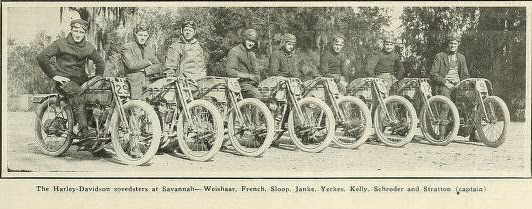
Sloop's last race was run on Thanksgiving Day, 1914. It was the Savannah 300 Road Race in Savannah, Georgia. This was only the second time the race had been held, and Sloop had ridden in the previous year’s race. 

Harley-Davidson Racing Team - 1914 Savannah 300 Mile Road Race
Bicycling World and Motorcycle Review - December 1, 1914

The course wound through the city and consisted of 27 laps of 11 miles. 

1913/14 Savannah 300 Race Course

Holding third place, Sloop had just completed the third lap when he lost control of his Harley, the same machine on which he had won the Isle of Palms Race and ran over a small embankment was hurled through the air. He broke his back, neck, hip and leg and was dead when assistance reached him.

Gray Sloop (right) on the backstretch shortly before his fatal crash
Bicycling World and Motorcycle Review - December 8, 1914

Thus ended the life of the 25-year-old motorcycle racing enthusiast from Iredell County.
Motorcycle Illustrated - November 26, 1914


  The Enterprise quoted a Savannah newspaper:

  "An examination made after the race showed a broken handlebar had been the cause of the accident which cost the life of Sloop. It was found Sloop had fallen on Norwood Avenue and cracked the right side of his handlebar. On Dale Avenue the bar had cracked completely off and Sloop entered the dangerous curve at Waters Road and Estill Avenue with only the left half of the handlebar to his machine. "When he ran into the rough ground, this caused him to lose control. He was thrown from his machine and went into the air. "When descending the back of his neck struck a guy wire with such force as to cause a fracture of the neck. He then dropped between the machine and the tree. During the investigation after the race the piece of broken handlebar which had fallen from Sloop's machine was found on Dale Avenue by members of the Harley-Davidson racing stable."
  
 His death fell like a pall over his hometown. Twenty-five young men of the town met the train carrying his body from Savannah to Charlotte and from the Queen City escorted his remains home to Mooresville. His grave in Willow Valley Cemetery was covered with flowers.

Gray Sloop's Headstone
Willow Valley Cemetery - Mooresville, N.C.

   "For many years he had been the dependence of his widowed mother and his [two] sisters, and the burden of grief falls heavy upon them," reported The Enterprise, which also referred to his handsome appearance, his affable and congenial spirit, and his simple life of purity and nobility.

His racing skills and potential in the new sport were known and admired to such an extent that an article reporting his demise was carried in the New York Times

New York Times - November 27, 1914
Although his name is unknown there today, Gray Sloop was the first to make Mooresville, “Race City, USA.”

Epilogue:

Zeddie Kelly of the Savannah Motorcycle Club, sponsor of the race, lead the first five laps of the race, when he stopped for a spark plug problem.  Kelly quickly reentered the race, but was severely injured on lap nineteen, when his Harley-Davidson left the track, and struck a tree. He died of his injuries the next day and was buried at laurel Grove Cemetery in Savannah.  Kelly's death brought the death toll of the race to two, and the bad publicity in newspapers around the country, led to the cancellation of a proposed 1915 race.

Savannah's Zeddie Kelly shortly before his fatal crash
Bicycling World and Motorcycle Review December 15, 1914

Wilmington, N.C. Morning star - November 28, 1914

About the Author:

O. C. Stonestreet, is an Iredell County, North Carolina native, is a Navy Veteran and a retired public-school history and social studies teacher. He lives in Statesville, N.C., with his wife Judy, and writes a regular column for the Statesville Record & Landmark newspaper. Mr. Stonestreet is also the author of They Called Iredell County Home, which is available through Amazon.com.


References:

      "Will Enter the Big Race" Mooresville Enterprise, June 5, 1913.
      "Will Enter Big Race" Mooresville Enterprise, June 26, 1913.
      "To Be in Motorcycle Race" The Landmark, June 27, 1913.
      "An Election Next Monday" The Landmark, July 1, 1913.
      Day, Donald S., "Balke, on Indian, Wins Elgin Race" The Inter-Ocean Newspaper (Chicago, Ill.), July 5, 1913.
      "Local Briefs" Mooresville Enterprise, July 10, 1913.
      "Won First Prize and World's Championship" The Landmark, July 10, 1914.
      "Gray Sloop Accepts Challenge" Mooresville Enterprise, July 23, 1914.
      "Archie Templeton Won Motorcycle Race from Gray Sloop" Mooresville Enterprise, July 30, 1914.
      "Motorcycle Collided with Surrey" The Landmark, September 1, 1914.
      "Motorcycle and Surrey Collided" Mooresville Enterprise, September 3, 1914.
      "Gray Sloop Wins Races at Charleston" Mooresville Enterprise, September 10, 1914.
      "Killed in Cycle Race" The New York Times, November 27, 1914.
      "Met Death in Savannah" The Landmark, November 27, 1914.
      "Lee Taylor Wins Motorcycle Race" Atlanta Constitution, November 28, 1914.
      "Instantly Killed at Savannah" Mooresville Enterprise, December 3, 1914.
      Stonestreet, O. C., "Gray Sloop: A Man Ahead of His Time" Mooresville Tribune, July 13, 2005.


Attachment Sources:

Bicycling World and Motorcycle Review

Chris Price@Georgia Motorcycle History

Mooresville, N. C. Enterprise

Motorcycle Illustrated

New York Times

O. C. Stonestreet Collection

Wilmington, N.C. Morning Star


Thursday, May 07, 2015

Barber Museum's Vintage Insider News Spring 2015 - Press Release #6

May 7, 2015

By: David L. Morrill

@MototiqueRacing
Sylacauga, Alabama

Vintage Insider News Spring 2015 - Cover

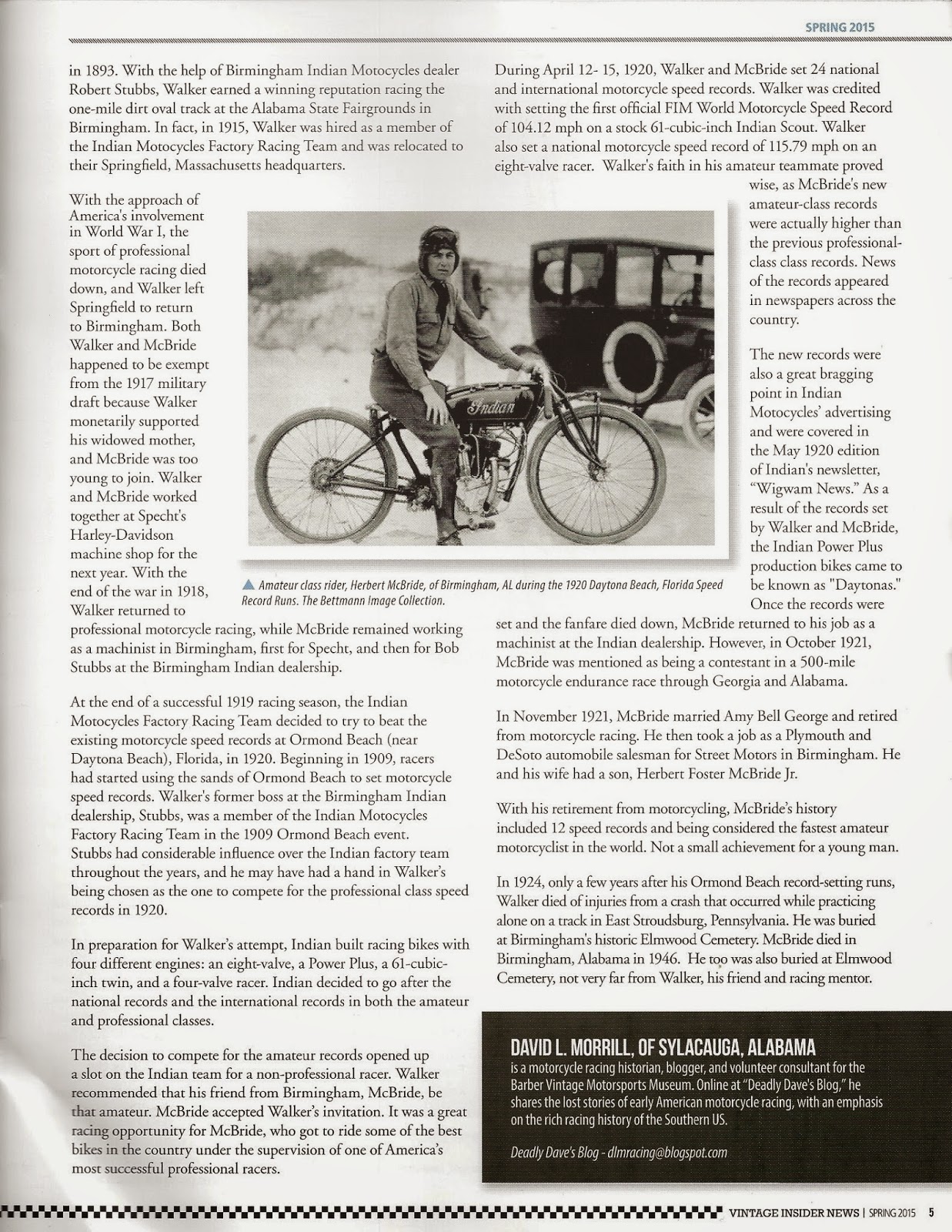
Thanks to the folks at the Barber Vintage Motorsports Museum for including my article, Herbert McBride - Birmingham's Amateur Speed Demon, in the Spring 2015 edition of Vintage Insider News.

Vintage Insider News Spring 2015 Article - Page 1

Vintage Insider News Spring 2015 Article - Page 2

Tuesday, April 14, 2015

A Short History of Harley-Davidson's Early OHV Racers - Episode #33

April 14, 2015
Updated - July 30, 2015

By: David L. Morrill

@MototiqueRacing
Sylacauga, Alabama

Early Harley-Davidson Blanked Off OHV Single Cylinder Racer - ca. 1916
Lonnie Isam Jr. Collection

The idea behind this episode comes from a single photograph shared on Facebook by Lonnie Isam Jr. Lonnie's family has a long history of involvement in antique motorcycle restoration.  The photo shows a rider, whose name escapes me, seated an early Harley-Davidson single cylinder overhead valve (OHV) half mile dirt track racer.

The introduction of Harley-Davidson's all conquering eight valve racers of the teens and twenties, is a bit of a mystery. Little is known about the development of these engines, but I have been able to find a few period articles that may shed a little light on the story. In Episode #30, on the birth of Harley's 11-K racer, I detailed Harley-Davidson's late entry in the professional motorcycle racing game.  When they did, they started with a racing engine loosely based on their 1914 production pocket valve single cam V twin. While this engine was quickly competitive, Harley's chief competitors on the track had been racing exotic overhead valve racing engines for years. Harley's Race Engineer, Bill Ottaway, realized he would quickly reach the limit of the pocket valve racer's development, and so he began developing special four overhead valve cylinders. The exact history of when this development started has been lost to time, but it appears it began sometime in 1915.

1915 Harley Davidson Single Cylinder Pocket Valve Racer
R. I. Jones Collection

While Harley-Davidson had a 1915 single cylinder racer, for reasons unknown, Ottaway chose to use the V twin bottom end, as the test bed for his new engine. This was accomplished, by blanking off one cylinder. By removing one cylinder, piston, rod, and rebalancing the crankshaft he created a blanked of 30.5 ci. single. The 30.5 ci class had been created to slow down the 61ci V twins, which were previously used on the half mile dirt tracks popular in the period.

It is pure speculation, but Ottaway may have chosen to develop the new OHV cylinder, on a single cylinder engine, because the single has a straight intake from the carburetor to the cylinder. The V twin uses the same T shaped intake used on the production engines, with the carburetor sticking out to the right or left of the engine.  That style intake creates more turbulence of the incoming gas/air mixture.

Maldwyn Jones made his reputation on the racing circuit riding Flying Merkle racers but decided to switch to Harley-Davidson for the 1916 racing season.  Bill Ottaway installed one of the new Harley-Davidson blanked off 4 valve race engines into a special lowered Merkle racing frame and fork jones had developed.  Due to his short stature, Jones preferred the Merkle frame's lower seat height, and better fork. Jones would use this bike to win half mile races across the country. Jones also went on to race a Harley-Davidson 8 Valve engine in the same frame and fork combination.

Maldwyn Jones - Harley-Davidson 4 Valve Racer - 1916
R. I. Jones Collection

By April 1916, the OHV single was ready for its first race test. Several bikes were sent to the half mile races held at Roanoke, Virginia on April 30, 1916. The new single cylinder OHV racers were fast right from the start, with team rider Ray Weishaar wining several races.  He even lapped an "OHV ported" Indian in one of the races.

Motorcycle and Bicycle Illustrated - June 1916

Harley-Davidson wasted no time in advertising the new racer's win, with a two-page ad in Motorcycle and Bicycle Illustrated.

Harley-Davidson Ad - Motorcycle and Bicycle Illustrated
July 9, 1916

Now, there was certainly more to Ottaway's plan than just building a single cylinder half mile racer, and there was. He was also, at the same time, developing an eight-overhead valve V twin to challenge Indians eight valve racers.

8 Valve Harley Racer - ca. 1916
Lonnie Isam Jr. Collection

For this venture, he also used the 11-K V twin bottom end. New front and rear OHV cylinders were added, and testing began. By June 1916, the new V twin OHV racer was ready to race, and was shipped to held at Detroit, Michigan on June 11, 1916.

 Motorcycle and Bicycle Illustrated - June 1916

Bill Brier won a heat race on the new eight valve racer, but the new racers suffered teething problems in the longer races, and development continued.

On July 4, 1916, the new 8 valve racer proved its speed by winning the pole for the biggest race of the year, the Dodge City 300. Floyd Clymer, on his first time on board the new 8 valve racer, set the pole time. While Clymer led the race, he eventually slowed with engine problems, Irvin Janke went on to win the race for Harley-Davidson on one of 8 valve racers.
Motorcycle Illustrated - July 6, 1916 

Harley-Davidson Racing Team - 1916 Dodge City 300

The new 8 valve racers showed also their dominance in the 100 Mile Championship Race at Sheepshead Bay, New York. Harley-Davidson took five of the top six spots, proving the new 8 valve racer was more than a match for it's competition.
Harley-Davidson 8 Valve Racer Ad - July 6, 1916
Motorcycle and Bicycle Illustrated 

A new two cam bottom end was developed for both the V twin racer, and the blanked off single. In the hands of Harley's 'Wrecking Crew" Racing Team riders, both of these bikes went on to become a dominant force in racing for years to come.

1923 Harley-Davidson 2 Cam OHV Racing Engine Patent Drawing
WWAG.COM

1928 Harley-Davidson 2 Cam Racing Engine
R. I. Jones Collection

In 1921, Harley-Davidson ceased involvement in professional racing. They did however continue to provide select riders with race bikes thorough their dealer network.  One of the beneficiaries of this program was Gene Walker of Birmingham, Alabama. Walker, an Indian Factory team member, was one of the top riders in the country.

In mid 1921, Walker was suddenly fired by Indian for refusing to ride in the Dodge City 300. Left without a ride, Walker returned to Birmingham, and went to work for his former Birmingham Indian teammate, Gail Joyce, who was now the Birmingham Harley-Davidson dealer. Walker got his hands on a blanked off two cam Harley-Davidson and began racing it. How this came about, has been lost to history, but perhaps Harley-Davidson saw a way to poke their former racing rival Indian. Walker would become a dominant force on half mile dirt tracks around the country.

Gene Walker - Harley-Davidson 2 Cam Single - 1923
Don Emde Collection

After dominating the half mile races on the Harley two cam Harley single in 1923, Harley-Davidson issued an ad touting his dominance.

Harley-Davidson Ad - 1923

The Harley-Davidson ad may have been the final humiliation for Indian, as they quickly rehired Walker. Sadly, he died of injuries sustained in a practice crash on the half mile track at East Stroudsburg, Pennsylvania in June 1924.

After Walker's death, Indian threatened to pull out of racing if the displacement was not reduced to slow the bikes on the half mile dirt tracks. The displacement was reduced to 21ci. -350cc. In 1926, Harley introduced a new single cylinder OHV racer, which came to be known as the Peashooter, for the unique popping sound it made. Most of these bikes went to Europe, Australia, and New Zealand, but a few stayed here for use on half miles, and cinder tracks.

1927 Harley-Davidson Peashooter Racer
Harley-Davidson CAC Cinder Track Racer

When the Great Depression hit, American motorcycle companies were struggling to survive, and racing activities were curtailed. They would return in the 30s with Class C racing, which outlawed specialty racing machines not based on production models. This was not the end of the exotic OHV racers.  The technology was used to build alcohol powered hill climb racers.

1930 Harley-Davidson DAH Hill Climber
R. I. Jones Collection

As the years passed by, few examples of these early OHV racers have survived, and they are among the rarest of Harley-Davidson's early racers.


Sources:

Bicycling World and Motorcycle Review

Don Emde Collection

Lonnie Isam Jr. Collection

Motorcycle Illustrated.

R. I. Jones Collection