Showing posts with label Atlanta Black Streaks. Show all posts

Monday, October 14, 2013

Lakewood Speedway, Atlanta's Early Racetracks - Episode #18

October 14, 2013
Updated - March 12, 2014

By: David L. Morrill
@Deadly Dave's Blog
Sylacauga, Alabama

Lakewood Speedway
Atlanta, GA.

 With the opening of the Lakewood Speedway in 1917, professional motorcycle racing returned to the Atlanta. The one-mile dirt oval was built the fairgrounds in Lakewood, GA. south of downtown Atlanta, and featured a large lake in the center of the track. 

The first motorcycle races were held at Lakewood Speedway on July 4, 1917. A four-race program, including five-, ten-, and fifteen-mile professional races, and a five-mile amateur dash. 


Atlanta Constitution July 4, 1917

Professional motorcycle racing had been curtailed during World War 1 and both Indian and Harley-Davidson had released their factory riders.  The Atlanta race still drew top professional riders from around the South. Gene Walker, and Tex Richards on Harley-Davidsons, would face a strong group of riders including Harry Glen, Ed Wilcox, and Nemo Lancaster. They were all riding Indians for the Atlanta dealer. Walker, a former Indian factory rider, was racing a privately entered Harley-Davidson due to the suspension of the factory racing program by Indian. 

After a long hot day of horse races, the motorcycles took to the track for their races. This brought the crowd to their feet, as the riders ran neck and neck at breakneck speed on the dusty one-mile dirt track. Gene Walker won the five- and ten-mile races, with Nemo Lancaster finishing second and Ed Wilcox finishing third in both races. No results were listed for the fifteen-mile race, which may have been cut from the program due to delays in the earlier horse racing program. The amateur race was won by Atlanta's J. Parmalee. 

The second motorcycle race held at Lakewood Speedway in September 1917 was marred by the death of one of the riders. On the first lap of the race, Atlanta's Ed Wilcox, who was jockeying for position, lost control of his Indian motorcycle, and crashed into the turn one fence. He died of his injuries. The crash was witnessed by his wife, who was a spectator.


Atlanta Constitution
September 4, 1917


Shortly after Lakewood Speedway opened, they revived the annual race for black riders, first held at the Atlanta Motordrome in 1913. A new group of riders, now known as "Atlanta's Black Streaks, competed in annual races until 1924. This was highly unusual in the Jim Crow south, and the coverage of the race in the motorcycling press often reflected the racist attitudes of the time.


Atlanta Black Streak Racers - 1919
By 1919, Atlanta had become the center of Championship Motorcycle Racing in the south, and the Lakewood Speedway races drew some of the fastest riders in the country. In September, top riders from around the country came to Atlanta to compete in the F.A.M. Championship races at Lakewood Speedway.

Atlanta Constitution
May 5, 1919

The entrants included Harley-Davidson riders Albert "Shrimp" Burns, and Ralph Hepburn. Atlanta's Nemo Lancaster, The Southern Champion, and Birmingham, AL.'s Gene Walker were on Indians. Walker was the previous Southern Champion.  Gene Walker and Nemo Lancaster would also compete against each other in a five-mile match race to determine the Southern Racing Champion.

Gene Walker leads Shrimp Burns
Lakewood Speedway - 1919
Furman Family Collection

When the dust settled on the day's races, Walker had broken the track record, and won the one-, five-, and twenty-mile races, along with the five-mile Southern Championship race.


Gene Walker went on to become one of the top racers in the country, winning 19 Championship races, and setting numerous track records, before he was killed in a racing accident in 1924.


Atlanta Constitution - July 2, 1921
In the early 20s, the popularity of motorcycle racing began to drop off in Atlanta. This may have been due to the fact that more folks were now using automobiles, rather than motorcycles, for transportation. Lakewood Speedway shifted the focus of it's racing program, to automobiles. Several of Atlanta's motorcycle racing stars, like Harry Glenn, and Tex Richards, began to compete in the auto races at Lakewood.  This was the end of the first great period of motorcycle racing in Atlanta. The track continued to hold occasional championship motorcycle races, but there is little documentation available on this period of Atlanta motorcycle racing history.

On September 2, 1929, Olin "Easy" Pickens was killed on the first lap of a motorcycle race at Lakewood. Witnesses stated he was thrown from his bike, after he blew his rear tire, and struck the outside fence. The turn one section of the Lakewood Speedway was very tricky, and the dust kicked up limiting riders' vision was always a problem. This is the same spot where Ed Wilcox was killed in the 1917 race.

Olin Edgar "Easy" Pickens (on bike)
Daryl Pickens Collection

Waco, TX. News-Tribune - September 3, 1929
After World War II, Lakewood Speedway began to hold NASCAR stock car races. This continued until 1960, when the Atlanta Motor Speedway opened 20 miles south of Atlanta in 1960. 

On August 8, 1948, Lakewood was the scene of one of the American Motorcyclist Associations most memorable events. Riders Billy Huber and Bobby Hill finished the 10 Mile National Race in a dead heat. This is the only time in AMA history of a dead heat finish in a National Race.

#71 Bobby Hill - Indian,  #7 Billy Huber- H-D   Lakewood Speedway - August 8, 1948
Chris Price @ Archive Moto

# 7 Billy Huber H-D, #13 Ted Edwards H-D, #71 Bobby Hill - Indian
American Motorcyclist Association Hall of Fame

American Motorcyclist Association's Hall of Fame - Billy Huber

The event is described in the AMA's Hall of Fame page for Billy Huber:

"One of Huber's most notable races occurred on Aug. 8, 1948, at the 10-Mile National at the Lakewood Park mile in Atlanta. Coming into the final lap of the race, Indian's Bobby Hill held a 30-yard lead over second-place Huber. Huber cut the lead in half during the first turn, holding his position on the back straight. Hitting the final turn wide open, Huber drove out of the corner on the inside and pulled up behind Hill. Capitalizing on the draft, Huber swung out with the finish line only 150 yards away and pulled neck mad neck with Hill. Both riders crossed the finish line simultaneously in a photo finish, setting a Lakewood Park record of 7:46.47. President Benton of the Lakewood Park Speedway declared both riders winners, and both received first-prize money."


Pottstown, PA. Mercury - August 9, 1948


Lakewood Speedway - 1948
Chris Price @ Archive Moto


In 1966, the Lakewood Speedway claimed another rider. On May 15, 1966, Orlando, FL. flat track racer Dexter Campbell was competing in the AMA Dirt track Championship Race at Lakewood. Campbell led the pack into the first turn on his KR-750 Harley-Davidson, but lost control of his bike, and was thrown into a guardrail on the outside of the track.  He bounced back onto the track and was struck by other riders. Campbell died of his injuries.


Dexter Campbell
Robbie Knight Collection
Campbell's death was eerily similar to the death Ed Wilcox, the Atlanta rider killed in the same spot of the first lap of the Championship race 48 years earlier. 

Lakewood continued to host A.M.A. National dirt track races through the early 70s. Three-time A.M.A. Grand National Champion Bart Markel made his final appearance in Grand National competition at the 1972 Atlanta National, finishing 12th.


Bart Markel
Imc. Narod. Ru Collection

On March 16, 1973, motorcycle stuntman Evel Knievel came to the Lakewood Exhibit Hall for three motorcycle jumps. Knievel made three successful jumps on his Harley-Davidson XR-750. The jumps took place on Friday, March 16 thru Sunday March18, 1973. 


Evel Knievel - Harley- Davidson XR-750
The Daily Grid - blog. calendars.com
Lakewood Speedway continued to host In September 1973, Lakewood Speedway hosted the American Motorcyclist Association's Atlanta Mile National Gold Cup Races. Top riders from around the country competed in this two-day event.


DadsVintageAds.com

As the focus of racing in Atlanta, shifted to the Atlanta Motor Speedway, the crowds at Lakewood races dwindled, and the track was closed in 1979.  Professional motorcycle racing would not return to the Atlanta area, until Road Atlanta opened in Braselton, GA. in the early 1970s.

With the passage of time, Atlanta’s role in early American motorcycle racing history has faded from memory, but during the teens and early twenties, the city played an important role in early racing history.

Sources:

American Motorcyclist Association's Hall of Fame

Atlanta Constitution

DadsVintageAds.com

Dana Haley

Daryl Perkins Collection

Deny Haven

Furman Family Collection

Imc. Narod. Ru Collection

Jesse O'Brien

Lucille Campbell Gatewood

Mike Bell

Motorcycling and Bicycling

Newspapers.com

Professional Flat Track Memorial

Robbie Knight Collection

Terry Griffith

The Daily Grid - blogcalenders.com

Thursday, June 13, 2013

Henry Hammond Springs of Augusta, GA. - Episode #15

June 13, 2013
Updated - June 12, 2015

By: David L. Morrill
@Deadly Dave's Blog
Sylacauga, Alabama


Atlanta's Henry Hammond Springs -1921
Don Emde Collection

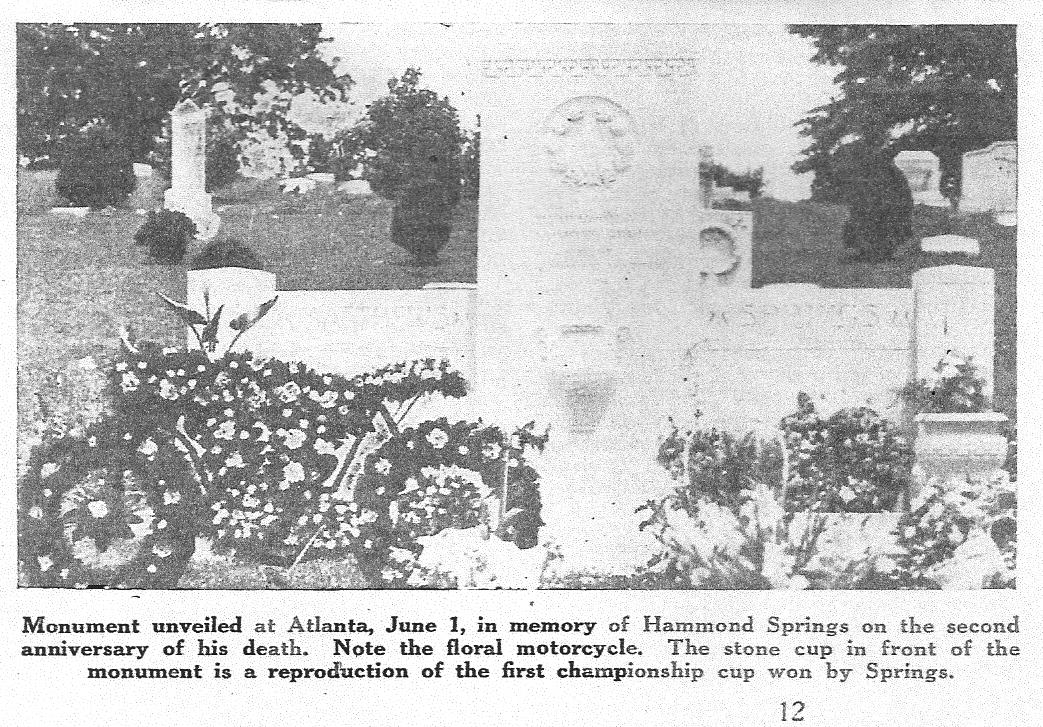
The idea for this article came to me, while I was researching the death of early Birmingham, Alabama racer Gene Walker. The June 1924 issue of Motorcycling & Bicycling had an article on Walker's death, but also included a photograph of the dedication of a memorial to Atlanta racer Hammond Springs on the second anniversary of his death.

As I looked around for information on Springs' racing career, I found there was little information available. Springs rose from a local Atlanta racer to ride an Indian factory prepared racer in the most prestigious national race of that time. At the time, he was the youngest professional racer in the country. While much of Hammond Springs' story has been lost to time, it is time to share what remains.

Henry Hammond Springs was born in Augusta, Georgia in 1902. Tragedy came early to the Springs family. On December 26,1909, Hammond's father, Augusta Fire Fighter Edward Springs, was killed responding to a fire. Edward Springs was driving a steamer fire truck to the scene of a fire, when he was pulled from the driver's seat, and run over by the wheels. Several years later Hammond's widowed mother Mary remarried, and the family moved to Atlanta.

Growing up in Atlanta, which was the southern capital of motorcycle racing, Hammond Springs was drawn to motorcycle racing. Racing a Harley-Davidson, Springs began honing his racing skills at Atlanta's Lakewood Speedway. The one-mile oval dirt track, which was located south of downtown Atlanta, held its first motorcycle race in front of a crowd of twenty-three thousand spectators on July 4, 1917. 

Lakewood Speedway
Atlanta, GA.


Professional motorcycle racing had been curtailed throughout the country during America's involvement in World War 1.  Some local racing continued during this period, which allowed amateur racers like Hammond Springs, to compete with more experienced professional racers. Springs first mention in the press was as an entry for the Lakewood Races held on July 4, 1918.

Atlanta Constitution - July 4, 1918

He is not mentioned in the results. There were no motorcycle races held at Lakewood Speedway on Labor Day. The event sponsors dropped motorcycle racing in favor of Automobile races. It was probably due to the death of Atlanta rider Ed Wilcox on the first lap of the 1917 Labor Day race at Lakewood.

When professional racing returned to Atlanta in 1919, seventeen-year-old Hammond Springs had already made a name for himself at Lakewood racing his eight valve Harley-Davidson.

Atlanta Constitution - May 29, 1919

In June 1919, Springs had his first serious brush with the danger involved in racing. While chasing Nemo Lancaster at Lakewood, Springs struck the rear tire of Lancaster's machine. Both riders were violently thrown from their machines, with Springs landing on his head. The spectators, who saw the crash, feared both riders had been killed. Both Springs and Lancaster required medical attention, but later returned to the track, to watch the final races. They were a bit banged up, but not seriously injured.

Atlanta Constitution - June 1919
Furman Family Collection

The caption for this photo collage from the Atlanta Constitution states:

"At the top is a scene from the northwest turn at Lakewood snapped a few minutes before the accident occurred. At the left below is Eugene Walker who regained his title as Southern Dirt Track Champion. At the right below are the two principles in the accident. Nemo Lancaster has his right foot bandaged, and Hammond Springs has a cracked dome as a result of the smash-up. Neither was seriously injured as both were back on the track to witness the ten-mile championship."


On July 4, 1919, Springs finished third in the one-mile trial, less than a second behind Indian riders Nemo Lancaster and Tex Richards. Rain plagued the later races, and Springs was unable to keep up his earlier pace on the wet track.


In August 1919, Hammond Springs was involved in one of the more unusual stories of early Atlanta motorcycle racing. Each year, small group of black racers competed in an outlaw race at Lakewood Speedway billed as the Grand Colored Motorcycle Championship Race. The event drew large crowds from Atlanta's black community.

While the Atlanta Indian and Harley-Davidson dealers were not directly involved in the race, several of the racers worked for them, and they often provided back door support. This may not have been purely philanthropic on the dealer's part, as large side bets were often placed between them on the race outcome.

Hammond Springs had recently switched to riding for the Atlanta Indian dealer Harry Glenn, and his mechanic was black racer Hal "Demon" Wade. After Wade complained to Springs that his tired 1912 Indian racer was not up to the challenge, Springs took matters into his own hands. Without permission, Springs and Wade snuck in the Indian shop on the night before the race and removed the new big valve racing engine from Springs' racer. Then they installed it in Wade's 1912 racer.

Atlanta's Hal "Demon" Wade - 1919

The competitive engine allowed Wade to easily win the final race. The story came out in an article in Motorcycling & Bicycling, and in Jim Crow Atlanta, it could have certainly put an end Springs' racing career. Springs' sponsor won a tidy side bet on the race outcome with the local Harley-Davidson dealer, and all was forgiven.

With Hammond Springs success in the July 4th Atlanta races, Harry Glenn was anxious for his young rider to begin professional competition. Glenn convinced Springs' Mom to allow the 17-year-old to enter the Labor Day races at Lakewood.


The Labor Day motorcycle races returned to Lakewood Speedway in 1919. They drew large crowds and a big purse, which attracted the best riders in the South. Hammond Springs race ended with a blown engine on the first lap of the race. Rumors at the time had Hammond springs going to the Harley-Davidson team for the 1920 season.

Motorcycle Illustrated - September 18, 1919.
On July 5, 1920, Hammond Springs won the 10-Mile Race at Lakewood defeating both Tex Richards and Harry Glenn.

Atlanta Constitution 
July 6, 1920

Motorcycle and Bicycle Illustrated - July 8, 1920

By 1921, Springs was making a name for himself racing in national championship races around the country as a member of the Indian Factory racing team.

Motorcycle and Bicycle Illustrated - September 1, 1921
Indian dispatched a large team of riders, including Hammond Springs, to compete in premier race of the year, the Dodge City 300. Indian's Shrimp Burns turned the fastest lap in the time trials with Hammond Springs, and Johnny Seymour tying with the 5th fastest lap.

Atlanta Constitution - June 12, 1921


Harley-Davidson dispatched a large team of riders, with Ralph Hepburn and Otto Walker setting the second and third fastest laps. As the race started, pole sitter Shrimp Burns, pulled out with mechanical problems. The heat, and the length of the race took a toll on several of the other Indian riders, who slowed with mechanical problems. The race was won Harley-Davidson's Otto Walker. The only bright spot for Indian, was Johnny Seymour's second place finish. The remaining top finishers were all Harley-Davidson mounted.

After the Dodge City race, Hammond Springs traveled to the Indian factory in Springfield, Massachusetts. During that visit, he was photographed on his Dodge City racer on the factories roof.

On August 15, 1921, Hammond Springs won the 10 Mile Professional Race on the one-mile dirt track at Pottstown, Pennsylvania. Springs edged out Harley-Davidson's star rider, Jim Davis, by just two feet at the finish. Davis had won the 5 Mile Professional Race, and set a new track record earlier that day, with Springs finishing fourth.

On May 17, 1922, an article appeared in the Atlanta Constitution on local riders Nemo Lancaster and Hammond Springs entering the upcoming race at the Lakewood Speedway. In describing Springs, the article stated:


Atlanta Constitution
May 17, 1922


On May 20, 1922, Springs won the 10 Mile National Race at the Lakewood Speedway. This was Springs first win in a National Championship race, and it came in front of his hometown crowd. He also defeated local Champion, Nemo Lancaster, and his Indian teammate Gene Walker. This was the highlight of Springs career.


Motorcycle and Bicycle Illustrated - May 25, 1922

Atlanta Constitution
May 21, 1922

But, as fate often has it in the racing game, Springs' greatest triumph was followed only nine days later by tragedy.

On May 30, 1922, Hammond Springs traveled to the half mile dirt track at Springbrook Park in South Bend, Indiana. Springs was leading the last race of the day, with Dayton, Ohio rider Eddie Brinch close behind. They collided throwing both riders from their machines. Brinch sustained a broken collarbone, but Hammond Springs died of his injuries that evening in a South Bend Hospital.

This article from Wichita Daily Eagle contains the last known photograph of Hammond Springs racing. At the time the article was written, it was boot known he had died from injuries.

Wichita, KA. Daily Eagle - May 30, 1922

The death of the daring young Atlanta rider was reported in newspapers across the country.


Atlanta Constitution - May 1922
Wichita, KA. Beacon - May 31, 1922

The coroner's inquest found the death was a racing accident and cleared both riders of responsibility for the fatal accident. Springs was nineteen, when he died. Hammond Springs was returned to Atlanta and buried at West View Cemetery.


On the day of his funeral, Springs received a motorcycle escort to the cemetery from both the Atlanta Police Department and the Atlanta Motorcycle Club. Atlanta motorcycling notables Harry Glenn, Hal Gilbert, Nemo Lancaster, Tex Richards, and Charlie Hages were pallbearers at his funeral. Atlanta's motorcycle shops were closed the day of his funeral, as an act of respect for Springs family.


Hammond Spring's Funeral Notice
Atlanta Constitution 
June 3, 1922

Springs was a hometown hero in Atlanta, and on the second anniversary of his death, an elaborate memorial was dedicated at his grave site. It features a stone reproduction of the loving cup trophy, Springs received for his first race win at the Atlanta's Lakewood Speedway.

Motorcycle and Bicycle Illustrated
June 1924


Henry Hammond Springs Memorial
West View Cemetery Atlanta, GA.

Bertha Avery Hood Collection - 2011

In the December 1922 Motorcycle and Bicycle Illustrated reported that Hammond's brother, Clarence Springs, had taken over long time Atlanta Harley-Davidson dealer, Gus Castle's, Atlanta business interests.

Motorcycle and Bicycle Illustrated - December 28, 1922


Author's Note:

Special thanks to Don Emde and Mike Bell for their contributions to this story.


Sources:

Atlanta Constitution

Bertha Avery Hood Collection

Don Emde Collection

Find A Grave.com

Furman Family Collection

Mike Bell Collection

Motorcycle and Bicycle Illustrated

Stephen Wright - American Racers 1900-1940

Wichita, KA. Beacon

Wichita, KA. Daily Eagle

Wikipedia.org