Showing posts with label Joe Wolters. Show all posts

Tuesday, January 06, 2015

Birth of a Racer, Harley-Davidson's 11K Stripped Stock Racer - Episode #30

January 6, 2015
Updated - January 17, 2016

By: David L. Morrill
@MototiqueRacing
Sylacauga, Alabama

The story of Harley-Davidson's entry in racing in 1914, is one of the great success stories of early American Motorcycle Racing. Harley-Davidson was late in entering Championship Racing. They faced stiff competition from Indian, Excelsior, and others, who all had long histories of competition at the championship level. Harley's weapon of choice would come to be known as the 11K Stripped Stock Racer. Although it started out as little more than a production bike stripped for racing, with hard work, and perseverance, it evolved into a race winner in less than a year.

1914 Harley-Davidson 11K Stripped Stock Racer

The story of Harley-Davidson's first true racer goes back to 1910. In their 1910 Model 6 production line they listed a single Model 6E. It was described as a "Factory Stock Racer, 30ci F head single." According to Techs Harley Davidson Vin Information Guide 1910-1919 there was a single Model 6E racer produced in 1910.

Early Teens Harley-Davidson Racer
Doug Olson Collection
While Harley-Davidson steadfastly avoided entering the deadly serious business of early board, and dirt track, Championship racing, they did compete in endurance run events. Around this time, road race events became popular. These events were generally run over courses made up of public roadways, and therefore did not require the specialized racing machines used in track racing.

This form of racing appealed to the Harley-Davidson management, as it highlighted both the speed, and reliability of their production motorcycles. When their customers had success, it found its way into their Harley-Davidson's advertising.

Bicycling World and Motorcycle Review - September 1912

Harley-Davidson Ad
The Call-Leader (Elwood, Indiana) 

October 2, 1912
William "Bill" Ottaway
Pioneers of American Motorcycle Racing
The first serious step towards developing a true racer came in 1913, when William Harley hired engineer William "Bill" Ottaway away from rival Thor Motorcycles and had developed their highly successful Factory racers. Ottaway became Harley's assistant in the newly formed Harley-Davidson Racing Department and was given the monumental task of developing a competitive racer from the 1914 Model 10 production bike. Through 1913, Ottaway slowly adapted the 61ci Pocket Valve IOE (intake over exhaust) production V twin engine for racing.

Daniel Statnekov, author of Pioneers of American Motorcycle Racing, believes that the basis for the race engine was a production motor built with looser tolerances for use by police departments. This motor came to be referred to as an "A" motor. That certainly makes sense, as these early engines had cast iron top ends, and total loss oiling systems. Racing drastically increased the heat, and stress engines components were subjected to.

By July of 1914, the new racers were ready for their first test in a major race. The new racers were shipped off to Dodge City, Kansas for the biggest race of the year, the 300 Mile Coyote Classic held on July 4th.

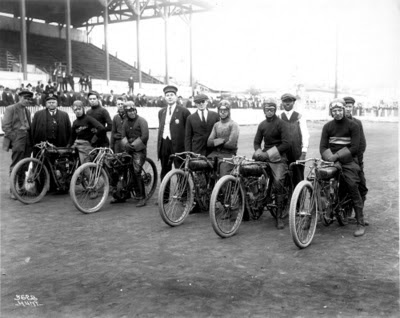
Harley Davidson Racing Team - 1914 Dodge City 300
The bikes in the Team photo above, show the production roots of the Harley-Davidson Team's new racers. They feature frames, that are similar to the 1914 Harley production V Twin frame, and spring front fork. They retain the floorboards of the production bikes. The engines appear to have new gear case covers, with oil pumps cast into them.

The blistering July heat in Dodge City, was a test of both man, and machine. The new racers showed competitive speed but lacked the reliability for such a long event. Only two of the six team's bikes, where running at the end of the race.

Despite the setback at Dodge City, continued develop the racing engines. By the end of the initial development, the race motors would feature larger intake ports, manifold, carburetor, along with stiffer valve springs, a special cam shaft, and steel flywheels, and the oil pump, which was cast into the gear case cover mentioned earlier. This motor would come to be referred to as "Fast" motor.

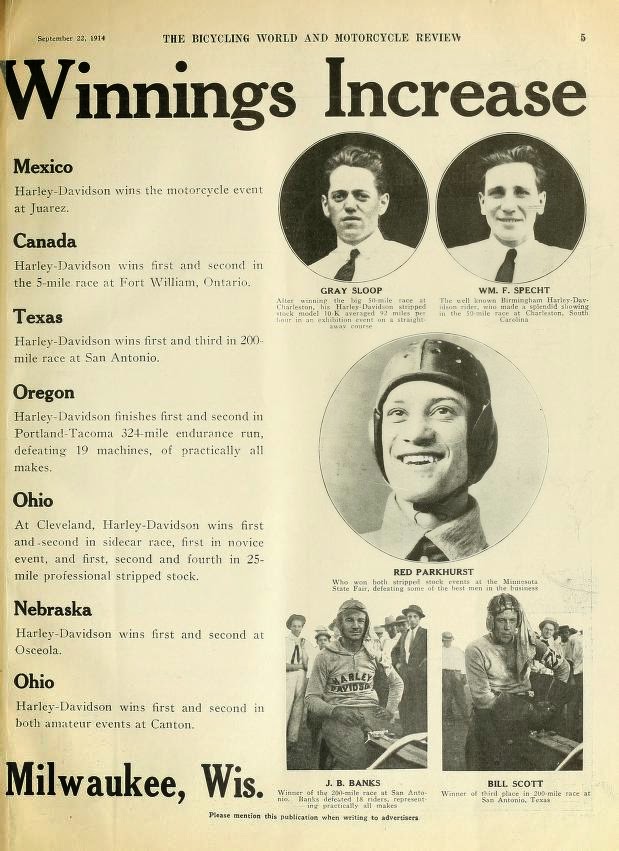
Track testing continued, and in September, a two-page ad touting the 11K's recent racetrack victories appeared in the September 22, 1914, edition of Bicycling World and Motorcycle Review.


A few days later, Leslie "Red" Parkhurst won the 10 Mile Stripped Stock race at Wisconsin, and his teammate Roy Artley finished second.
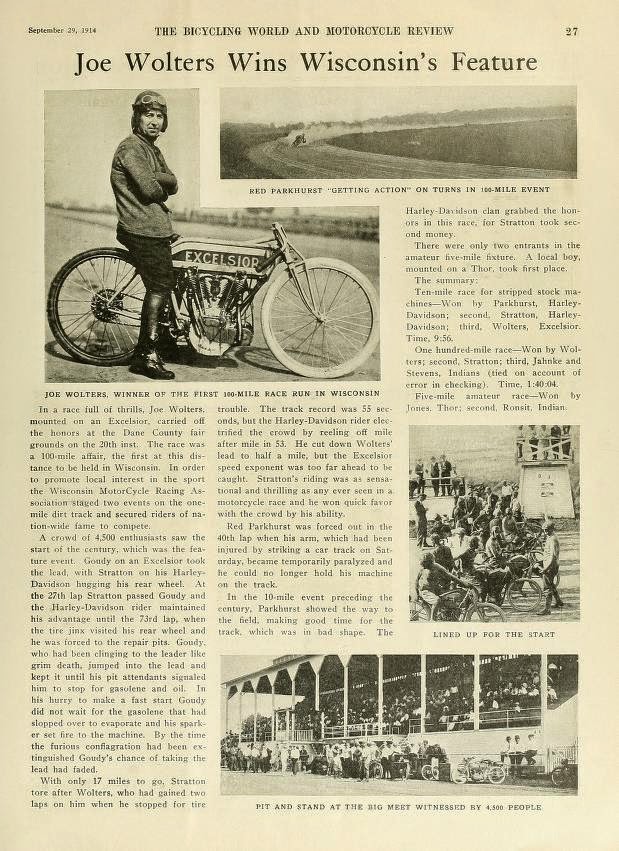

While the Wisconsin race was a only regional race, Parkhurst, and Artley, did beat Excelsior team rider Joe Wolters.  Parkhurst and Stratton had the similar results at Brainerd, Michigan State Fair's 3 Mile, and 10 Mile Stripped Stock Races.

The Brainerd Daily Dispatch (Brainerd, Michigan) - September 14, 1914

Atlanta Constitution - November 15, 1914
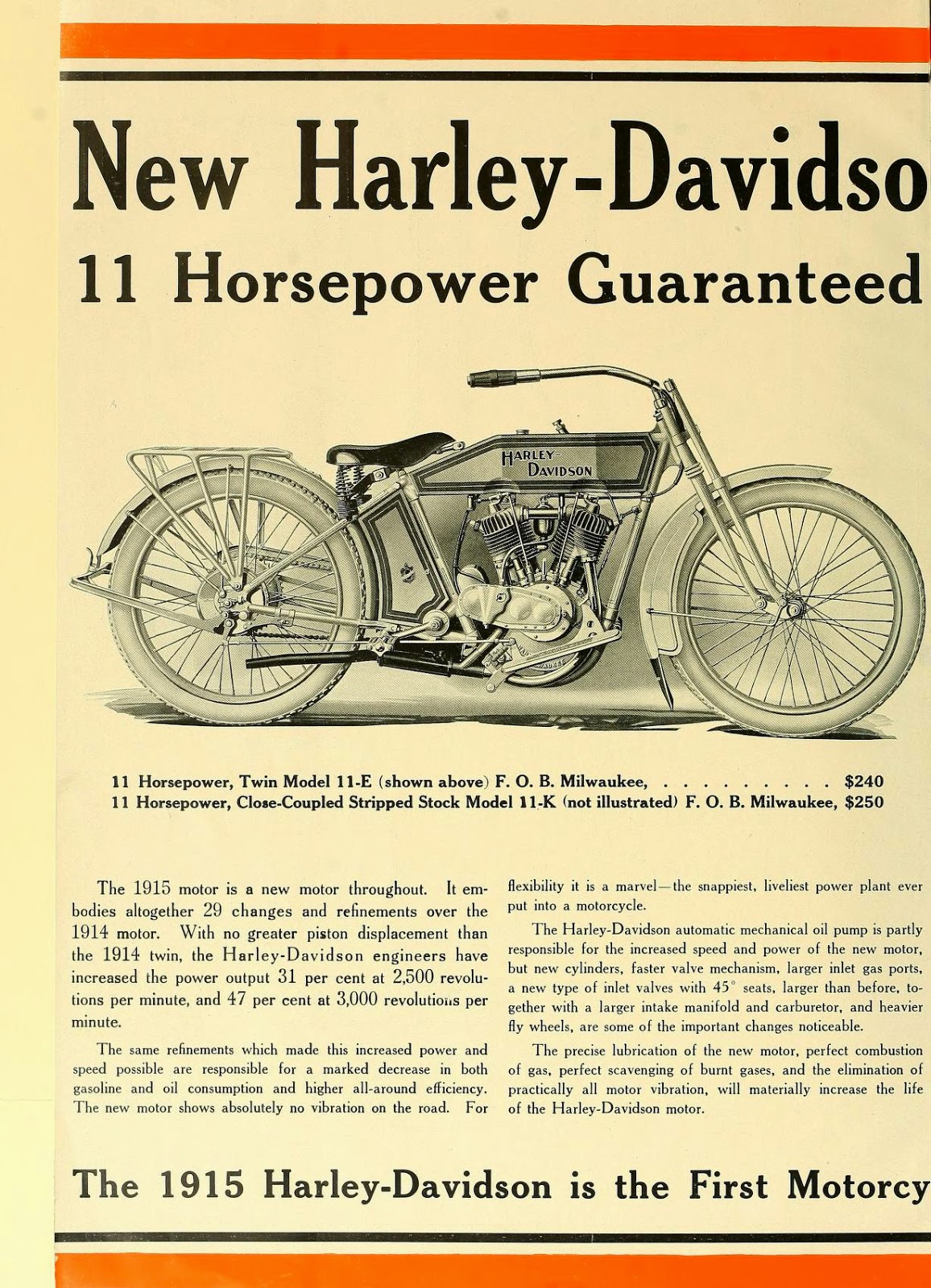
In the October 6, 1914, edition of Bicycling World and Motorcycle Review, the first ad appears mentioning a 1915 Close Coupled Stripped Stock Model 11K for sale for $250.00. The ad claims the bike has 11 horsepower, the same as the 1915 V twin Production bikes. There is little doubt at this stage in development, Bill Ottaway was getting much more horsepower, from his 11K racing engines.


The 11K racers were ready for another track test in Championship event by early October. "Red" Parkhurst traveled to Birmingham, Alabama for the One Hour FAM Championship Race. He was joined in Birmingham by Atlanta racer Johnny Aiken, and New Orleans racer Arthur Mitchell, who were provided racers through the new Birmingham Harley-Davidson dealer William F. Specht Jr.

The bikes run on the one-mile dirt oval in Birmingham were track bikes, featuring a short-coupled racing frame, and the new girder style rigid front fork pictured below.

Arthur Mitchell at Specht's Harley-Davidson Birmingham, Alabama
O.V. Hunt - 1914
Despite stiff competition from Indian riders Gene Walker and Gail Joyce, along with Excelsior rider Joe Wolters, Parkhurst won the One Hour FAM Championship Race, along with several preliminary non championship races held at Birmingham. Parkhurst win in the Championship Race survived two post-race protests, and Harley wasted little time in touting their first "Championship" win. Parkhurst's win showed the 11K racer could compete on equal footing with serious competition. This was a big step forward for the Harley-Davidson racing program.

Bicycling World and Motorcycle Review - October 1914
In early November, Parkhurst won the 5, 10-, and 25-Mile Races at the San Angelo Track in Phoenix, Arizona. Teammate Roy Artley, finished second in the 10-, and 25-Mile races. As a result of the positive press Harley-Davidson got from their wins in both Birmingham, and Phoenix, Harley-Davidson decided to send a full team of riders to the Savannah 300 Mile Road Race on November 25, 1914.


1914 Savannah 300 Harley-Davidson Team Riders 
Bicycling World and Motorcycle Review - December 1914
At the end of the grueling event run over 11 miles of public roads, Harley-Davidson rider Irving Janke finished third. The bikes used by the team riders appear to be the same style production framed racers used in the earlier Dodge City 300. Sadly, Harley-Davidson rider Gray Sloop of Mooresville, NC., and Zeddie Kelly of Savannah, were killed in separates accidents during the event. Sloop and Kelly are in this team photo above.

Harley-Davidson made a major change to the 1915 production V twin engine, casting a new wider crankcase, with webbed reinforcement, a wider/heavier crankshaft. Several race motors based on the new 1915 motors were built, but testing proved them to be slower, than the narrow case race motors. The narrow 1914 style case continued be used throughout the life of the pocket valve race motors. It was updated several times, with new castings to adapt to changes in cylinders, etc.

Having proved the 11K racer could be competitive, in the country's most demanding races, the bike was put into production for 1915. The new racers were provided to both factory riders, and through their dealer network to select racers. There were some eight versions of the new racer listed as "Specialty Models" for sale in 1915.

1915 Harley-Davidson 11KT

These two photos, show the two major versions of the new 11K racer. Factory rider "Red" Parkhurst is pictured with the 11TK Track Racer, and Joe Wolters with the 11KR Roadster Racer model.

Red Parkhurst - 11KT (left) Joe Wolters - 11KR (right)
Harley-Davidson Archives
Joe Wolters, who had provided stiff competition to Parkhurst at Birmingham, and denied a win in the Savannah 300, due to a last lap blown tire, had switched from Excelsior, to the Harley-Davidson Team for the1915 racing season.

Joe Wolters - 11KR (left)  Joe Wolters - 11KT (right)
Harley-Davidson Archives

According to Tech's Harley-Davidson VIV Information Guide 1910-1920 the eight variants of the 11K Racer. Production numbers are provided, when listed in the guide:

Specialty Models

Model 11K4 - Track Racer, F head single with magneto 
Model 11K5 - Roadster Racer, F head single with magneto
Model 11K12 - "Fast Motor", F head V twin with magneto
Model 11K12H - "Fast Motor", F head V twin with electrical system
Model 11KT - Track Racer, F head V twin with magneto
Model 11KR - Roadster Racer, F head V twin with magneto 
Model 11KRH - Roadster Racer, F head V twin with electrical system
Model 11KTH - Track Racer, F head V twin with electric

The new racer quickly proved to be a winner, in the hands of team rider Otto Walker. In April, Walker won the Venice, California 300 Mile Road Race.

Daniel Statnekov@Pioneers of American Motorcycle Racing

Walker followed that up in July, with a win at the Dodge City 300. These were two of the biggest races in the country, and Otto Walker and the new racer became a force to reckon with. In just one year of competition, the new racers had proven they could win major Championship races against the best riders in the country.

1915 Harley-Davidson Ad
Motorcycle Illustrated
After the 1915 season, Harley Davidson made two major changes to their new racer. The first was a new Keystone frame, which removed the frame loop under the engine, and sandwiched the engine between two mounting plates on the sides of the engine. The second was the introduction of a new overhead valve cylinder, with four valves per cylinder.

Bill Ottaway, took a "Fast" Motor" bottom end, removed the front cylinder, piston, and rod. With a rebalanced crankshaft, he created a "blanked off" four valve 30.5ci. single. Maldwyn Jones, who had recently come to Harley-Davidson from Merkle, won several races using the new engine.  Eight valve racing V twin racing engines were also built, which used the "Fast" motor single cam bottom end. The "Fast" motor bottom end was eventually replaced by a special two cam racing bottom end.


Maldwyn Jones  Harley-Davidson Blanked Off
Single Cylinder 2 Cam 4 Valve Racer
While development continued on the pocket valve engines, they were usually relegated to backup status to the eight valve racers. In the longer races, the eight-valve racer, were used as rabbits, to make the competition run harder to keep up.

The production numbers for some of the 11K racers produced between 1915 and 1918 are listed on Tech's Harley-Davidson VIV Information Guide 1910-1920 as follows:

1915 
11KT (Twin - Track) - 37 
11KR (Twin - Road race) -121 

1916
16S (Single - Track) - 12
16T (Twin - Track) - 23
16R (Twin - Road Race) - 82

1917

17S (Single - Track) - 5
17T (Twin - Track) - 1
17R(Twin - Road Race) - 12

1918
18R (Twin - Road Race)
  
Beginning in 1917, various limited production specialty racing models based on special "Fast" motors were produced, along with the 4 and 8 overhead valve racers introduced in 1916. There are no production numbers for these specialty models.

The eight-valve engines were faster than the pocket valve motors but did not always have the reliability to finish long races. Several of the tried-and-true pocket valve racers, were often entered as insure a win.

Harley-Davidson Single cam 8 Valve racing Engine
http://www.antiquemotorcycle.org


In 1921, the factory built several " blanked off" racing engines, using the latest pocket valve cylinders. These single cylinder racers were known as SCAs (single cylinder alcohol), as they they ran on alcohol. 

Harley-Davidson Keystone Frame SCA Racer
Wheels Through Time Museum Collection

Harley-Davidson SCA "Blanked Off" Pocket Valve Racing Engine
The pocket valve racing engine, which debuted with the 11K racer, stayed in production through the 1920s, with various updates of the engine cases, cylinders, etc. While it would come to be overshadowed by the eight-valve racing engine, it was Harley-Davidson's first Nationally competitive racing engine, and was directly tied to the development of the eight-valve replacement.


Sources:

antiquemotorcycle.org

Atlanta Constitution

Bicycling World and Motorcycle Review - 1914

Birmingham, Alabama Public Library Archives

Brian Slark & Kelly Stewart@Barber Vintage Motorsports Museum

Chris Price@Georgia Motorcycle History

Daniel Statnekov@Pioneers of American Motorcycle Racing

Doug Olson Collection

Harley-Davidson Archives

Matt Walksler@Wheels Through Time Museum

Tech's Harley-Davidson VIN Information 1910-1920

The Call Leader - Elwood, Indiana - 1912


Saturday, February 01, 2014

Joe Wolters Cheats the Angel of Death - Episode #22

February 1, 2014

By: David L. Morrill
@MototiqueRacing
Sylacauga, Alabama

Joe Wolters
Daniel Statnekov Collection - statnekov.com


I ran across this story while doing research one day. The December 11, 1911, edition of the San Francisco Chronicle newspaper featured this headline:


Needless to say, that one caught my attention, and I set out find out what I could about one of the strangest events in early racing history.

By 1911, Joe Wolters, and his Excelsior Motorcycles teammate Jake De Rosier, were dominating board track races around the country. In December of 1911, Wolters found himself in San Francisco, California competing in a series of races at the newly opened half mile Oakland Motordrome in Elmhurst, CA. The Oakland Motordrome featured a steep 40-degree circular wooden racing surface. These early steeply banked circular tracks were known as "Saucer Tracks", as they looked like large saucers. The motorcycles of the day would hit close to 80 miles per hour on the saucer board tracks.


Oakland Motordrome
San Francisco Chronicle - December 1911


The events held at the Oakland Motordrome on December 10, 1911, featured several motorcycle races, along with a flying exhibition. Among the flyers featured in the aviation exhibitions was Didier Masson, and his Curtiss Flyer Biplane.


Didier Masson & his Curtiss Flyer Biplane
earlyaviators.com
Masson was a famous French Aviator, who had been on a barnstorming tour of the United States since 1910. A photograph of Masson's Curtiss Flyer Biplane in flight was featured in the advertising for the day's events.

Oakland Motordrome Ad
San Francisco Chronicle - December 9, 1911

Joe Wolters had just finished winning the afternoon's Ten Mile Professional Race at the Motordrome in commanding fashion, and was still traveling at a blistering pace, when Masson attempted to land his Biplane on the track's infield. The events, which followed were described in the newspaper article below:

San Francisco Chronicle - December 11, 1911
The fact that Wolters escaped the crash with only minor injuries, and Masson was uninjured, is truly amazing.  Wolters bike had torn through the wing of the biplane and struck the revolving propeller snapping it off. He was truly one lucky fellow that day!

Joe Wolters went on to win many more races, and set numerous track records, during his long career. In 1963, at age 81, Wolters recounted the events of that day, along with his long racing career, in an article that appeared in the Tucson, AZ. Daily Citizen newspaper.

Tucson, AZ. Daily Citizen - August 16, 1963

In the article Joe Wolters stated, he woke up in the hospital two hours after the crash with a skull fracture but was released after just six hours. These early racers were a tough breed. Wolters retired from motorcycle racing in 1921, after a long and successful career.

Dedier Masson repaired his Curtiss Flyer and continued his barnstorming tour. Later, Masson served as a mercenary pilot in the Mexican Civil War and went on to serve in the French Air Corp's Escadrille 18 during World War 1. He once again escaped death, when the engine for his Newport 17 fighter cut out during a dogfight with a German opponent. Masson was able still able to shoot down the German plane, before crash-landing his Newport.  Crawling from his wrecked plane, Masson then narrowly escaped a German artillery barrage. Truly a very lucky man! For more information on Masson's career please visit:


Despite their many accomplishments, the scrappy Chicago motorcycle racer, and the French flyer, would always be remembered for their strange death-defying meeting at the Oakland Motordrome on December 11, 1911.

Joe Wolters also played an important part in another of my stories. The link is below:

Friday, October 26, 2012

Controversial 1914 Birmingham, AL. F.A.M. Race - Episode #7

October 26, 2012
Updated - March 3, 2015

By: David L. Morrill

@ Deadly Dave's Blog
Sylacauga, Alabama


American Iron Magazine - 2013

A special thank you to Buzz Kanter, and the staff of American Iron Magazine, for including this article in their American Glory Special Edition celebrating Harley-Davidson's 110th anniversary.

This story started with a trip to my local Harley-Davidson dealer a few months back. Harley is now selling early racing photographs from their achieves, and the local dealer had several framed board track photos for sale. I picked up a photo of Otto Walker taken after his win at Venice, California in April 1915.

Harley-Davidson Motor Company Archive

The small plaque on the photo claimed this was Harley-Davidson's first Championship win. That was a little surprising, as I had heard of at least one earlier Championship Race win.  I figured it was time to share a small and almost forgotten piece of Harley-Davidson's history.


1914 Harley-Davidson 11-K Racer (left)
Stripped Stock Model (right)


1914 was a pivotal year for Harley-Davidson. Although long opposed to Championship racing, the factory changed course.  They hired engineer William "Bill" Ottaway to develop their production v twin engine for racing. The result was the Harley- Davidson 11-K racer.

Harley-Davidson 11-K Racer
Leslie "Red" Parkhurst was the first rider hired by the Harley Davidson factory in 1914 to ride the new racer. By July, the racer was ready for its first big test, the Dodge City 300-Mile Road Race in Dodge City, Kansas. Parkhurst was one of six team members sent by the factory to compete in the Dodge City 300 that year. The new racers were fast, but only two of six were running at the end of the race.

Leslie "Red " Parkhurst

Daniel Statnekov Collection
On October 5, 1914, Red Parkhurst lined up for the Federation of American Motorcyclists (FAM) One Hour Championship Race held at the Alabama State Fairgrounds Raceway in Birmingham, Alabama.  Parkhurst was riding one of Bill Ottaway's factory prepared 11-K racers. Parkhurst was assisted in his pit by the new Birmingham Harley-Davidson dealer William F. Specht Jr., along with Johnny Aiken.

1914 Harley- Davidsons - Specht's Harley- Davidson Birmingahm, AL.
O. V. Hunt Collection

Specht, who was also a racer, had relocated to Birmingham from Atlantic City, New Jersey. In early 1914, he opened a Harley-Davidson dealership in Cliff Howell's bicycle shop in downtown Birmingham. The arrival of the first wagon load of 1914 Harley-Davidsons in Birmingham was documented by local photographer and motorcycle enthusiast O.V. Hunt.


In the Birmingham race, Parkhurst's chief competition was Excelsior factory rider Joe Wolters. The Birmingham Indian dealer Bob Stubbs sponsored two local racers, Gail Joyce and Gene Walker. Joyce was the more experienced of the two, having won several Southern Series races outside Birmingham. Walker had made a name for himself in the amateur ranks at the Birmingham track, but this would be his first professional race.

Alabama State Fairgrounds Raceway
O.V. Hunt 1914 - Birmingham Public Library Archives

As the race started, Gene Walker jumped into the lead setting a new track record. Parkhurst was running second, followed by Wolters.  On the third lap, Parkhurst passed Walker for the lead. Walker was later passed by Wolters. Parkhurst built a considerable lead over Walker, Wolters, and Gail.  On lap 33, a fuel problem forced Parkhurst to into the pits.

Red Parkhurst
Daniel Statnekov Collection

In the Harley-Davidson pit, Specht and Aiken refueled Pankhurst's axillary fuel tank. Parkhurst attempted to clean his oil and dirt covered goggles with a handkerchief he kept tied to his handlebars. The handkerchief was also covered with oil and dirt, so Parkhurst asked a spectator for a clean handkerchief. The spectator enthusiastically provided a handkerchief, and assisted Parkhurst with cleaning his goggles. Parkhurst rejoined the race, and when the flag was thrown to end the race, he was leading Joe Wolters by half a lap. Indian rider Gene Walker took the lead at the beginning of the race, setting a new track record, and finished 3rd. Shortly after the race, Walker's Indian teammate, Gail Joyce, filled an official protest, claiming the spectator in the pits had improperly aided Parkhurst.

The results of the race were not settled until the following week at the Chicago Motorcycle Show. On Tuesday of the show, Joe Wolters approached FAM Chairman John L. Donovan claiming he was due another lap at Birmingham. He claimed he had finished a half a lap ahead of Parkhurst.

The October 27, 1914, issue of Bicycling World and Motorcycle Review quoted Chairman Donovan's finding on the two Birmingham race protests. In disallowing Joyce's protest, Chairman Donovan stated:

"Safety requires that competitors in races shall be permitted to see what they are doing. It certainly would be ridiculous to disqualify Parkhurst because he permitted someone to assist him in wiping the oil and dirt off his goggles. Parkhurst clearly is entitled to the victory."

Concerning Joe Wolters' late protest, Chairman Donovan stated:

"Of course, the rules require that protests shall be made within a half-hour after the close of the race. The rules would not permit official consideration of additional points not included in the original protest. But courtesy required that I should wire for information, and I did so. It is perfectly clear that Parkhurst won the F. A. M. hour championship fairly and squarely."

With the protests settled, Parkhurst was awarded the trophy and his winnings on the second day of the Chicago show.  Shortly after the decision was announced, a large sign proclaiming Parkhurst's victory on a "stripped stock Harley-Davidson against ported and eight valve machines," appeared behind the 11-K Harley-Davidson on display at the show. Parkhurst's win went on be the center piece of Harley-Davidson's advertising for the upcoming 1915 model.

Was the 1914 Birmingham Championship Race win the first for a Harley-Davidson factory rider on a factory prepared bike? I'll leave that one to the experts. The one/two finish of factory riders Otto Walker and Red Parkhurst in the 1915 Venice race was a more prestigious win against stiffer competition. But Parkhurst's Birmingham win may have paid a much more import role in Harley-Davidson history and opened the door for the Venice win months later.

Harley Davidson founders William Harley and William Davidson attended the July 1914 Dodge City 300 Road Race.  They made it clear in post-race comments; their intention was to provide factory prepared machines to select dealer supported riders. It appears; they had no intention of a full factory supported racing team. The publicity surrounding Parkhurst's Birmingham win may have changed their minds. In November 1914 they sent a factory supported race team to compete in the Savannah 300 Road Race in Savannah, Georgia.

This was the beginning of the famed Harley-Davidson Racing Team, which came to be known as "The Wrecking Crew." Parkhurst's 1914 Birmingham win may have opened the door for creation of a fully factory supported racing team. The Harley-Davidson Factory Racing Team continues to compete today and is one of the longest running and most successful racing teams in the country.


Leslie "Red" Parkhurst continued to ride for Harley-Davidson through 1921 His most prestigious win came at the 1919 Marion, Indiana 200-Mile Road Race. Parkhurst retried from professional racing in 1921 but continued to race occasional events through 1924.

Reading, PA. Times - November 6, 1919

There was another participant, who benefited greatly from his finish in the 1914 Birmingham race. Gene Walker, the young local rider who finished fifth that day, was hired by the Indian factory in Springfield, Massachusetts. Walker went on to become one of the greatest riders of his time. In 1920, Motorcycling and Bicycling Magazine proclaimed Gene Walker "Champion of Champions."


Don Emde Collection

Motorcycle racing historian and 1972 Daytona 200 winner Don Emde provided this Gene Walker race poster from his collection. For more information on Gene Walker's career, please check out my article:

Gene Walker, Birmingham's Lost Racing Champion: 

http://dlmracing.blogspot.com/2012/07/gene-walker-birminghams-lost-racing.html


Sources:

Birmingham, Alabama Public Library Archives

Chris Price@Georgia Motorcycle History

Don Emde Collection

Motorcycling and Bicycling

Daniel Statnekov Collection - Pioneers of American Motorcycle Racing: 
http://www.statnekov.com/motorcycles/index.html

Johnny Whitsett Collection

Reading, PA. Times

Parkhurst Family Webpage:

http://www.parkhurstfamily.org