May 14, 2015
Updated - May 20, 2015
By: David L. Morrill
@MototiqueRacing
Sylacauga, Alabama
Several years ago, I was researching the 1913 & 14 Savannah 300 Road Races for another episode. I ran across O. C. Stonestreet's article Gray Sloop, Motorcycle Racer. Gray Sloop of Mooresville, North Carolina was one of two riders killed in racing accidents during the 1914 Savannah 300 Mile Road Race. Mr. Stonestreet incorporated the article as a Chapter in his book They Called Iredell County Home, and it is shared here with his permission. Thank you, Mr. Stonestreet, for sharing your work.
 |
| Mooresville, North Carolina's Gray Sloop Specht's Harley-Davidson Birmingham, Alabama O.V. Hunt Collection - July 1914 (cropped) |
Several years ago, I was researching the 1913 & 14 Savannah 300 Road Races for another episode. I ran across O. C. Stonestreet's article Gray Sloop, Motorcycle Racer. Gray Sloop of Mooresville, North Carolina was one of two riders killed in racing accidents during the 1914 Savannah 300 Mile Road Race. Mr. Stonestreet incorporated the article as a Chapter in his book They Called Iredell County Home, and it is shared here with his permission. Thank you, Mr. Stonestreet, for sharing your work.
Gray Sloop, Motorcycle Racer
By: O. C. Stonestreet
After referring to itself as "Port City of Lake Norman," for some time now Mooresville, North Carolina, has taken to calling itself "Race City, USA." Nearly a century ago there was a Mooresville man whose life and achievements might serve to bolster Mooresville's new sobriquet. His name was Gray Sloop.
Gray Sloop was born in Mooresville in August of 1889, the only son of Augustus J. and Dovie Ann Sloop. Gray's father passed away in July of 1904, leaving the 15-year-old as the man of the family.
 | |
|
This race was described as a 250-mile contest over an eight-mile course and was billed as the first nationally sanctioned motorcycle race and also the first 250-mile motorcycle race in the United States.
At the time of the Elgin race Sloop was riding a Reading- Standard cycle, specially built for him by the company in Reading, Pa. Mooresville's weekly newspaper, The Enterprise, noted, "Mr. Sloop is the only man from the South entering the [Elgin] races, so far, and we predict for him one or more of the capital prizes." First prize in the Elgin Race was $500 in gold and a two-foot-tall trophy, the “V Ray Cup.”
The Statesville Landmark carried more information about the coming race. "The Motorcycle, a magazine published in Springfield, Mass., in its latest issue, speaking of the unusually strong line-up for the national motorcycle race at Elgin, Ill., on July the Fourth, said, after giving a list of the most important entrants, ‘One of the latest entries to be received is from Mooresville, N.C., and is signed “Gray Sloop.” This entry puzzled the contest committee for some time and Chairman Hill was inclined to believe that someone had worked in a yacht by mistake until he looked into the matter. Then he learned that Gray Sloop is a youngster who sprang from nowhere this year and romped off with the motorcycle championship of North Carolina. Sloop will ride a Reading Standard machine in the Elgin race, and he is being talked of as a dark horse who is likely to spring surprises.’" Sloop didn't win at Elgin, but that didn't stop him.
 |
| Motorcycle illustrated - June 1914 |
The race was won by a Texan, Charles "Fearless" Balke, who, with a blistering average speed of 55 mph over public roads, led an Indian Motorcycles sweep of the first five finishing positions. Out of 45 cyclists who had registered for the Elgin race, 43 began it and just ten completed it.
Sloop was not among those completing the course. According to a Chicago newspaper, Sloop had to make the eighth-mile qualifying run three times before he qualified, this due to brake malfunctions. His troubles continued during the actual race. “Sloop dropped out of the race,” reported the paper, “in the twentieth lap, after breaking over ten chains on his machine. The chains were the cause of many falls of the different riders, none of whom were injured.”
On June 8, 1914, just short of his 23rd birthday, “Fearless” Balke was killed in an accident at the Hawthorne dirt track near Chicago. Motorcycle racing was a dangerous business.
 |
| Chicago Tribune - June 6, 1914 |
In early July of the next year Gray Sloop did very well in what was billed as the "Southern Championship Race" from Birmingham to Atlanta and back, an endurance race.
 |
| Gray Sloop - July 1914 Chris Price@Georgia Motorcycle History |
By this time Sloop was not only riding Harley-Davidson motorcycles, but he was also selling them in Mooresville.
 |
| Gray Sloop Harley-Davidson Ad Mooresville, N.C. Enterprise - 1914 |
Reported The Enterprise, "Mr. Gray Sloop returned Tuesday night from Birmingham, Ala., where he participated in the Fourth of July motorcycle races. He won not only first place, but the world's championship, making the total distance of 462 miles from Birmingham to Atlanta and return in 12 hours and 20 minutes. While in route he had twelve changes of tires and changed one wheel. His part of the prize money was considerable."
 |
| Entrants in the 1914 Birmingham Ledger Endurance Run O. V. Hunt - 1914 |
Later that same month Sloop and his modified Harley took on Charlotte's Archie Templeton, piloting an Indian motorbike, in a two-contestant, 226-mile race from Charlotte to Columbia, S.C., and back, for a $200 prize
Templeton completed the second half of the race, about 113 miles, in 2 hours and 56 minutes, whereas Sloop had trouble with his French racing motor just four miles short of the finish line in downtown Charlotte.
It is interesting to note that both Templeton and Sloop were "on their own" when it came to avoiding speeding tickets, other traffic and other "unforeseen difficulties." At the Charlotte finish line, where about a thousand spectators had gathered, Templeton graciously remarked to Sloop, "Hard luck, old man. You raced a good race." Sloop replied in kind, "Same back at you. A little hard luck on my part, but you deserve full glory for the race."
 |
| Gray Sloop - Isle of Palms, SC. - September 8, 1914 Chris Price@Georgia Motorcycle History |
"Riding against time on a Harley-Davidson," reported The Enterprise of September 10, 1914, "he rode one mile at the speed of 92 miles an hour. His winning time was 55 minutes and 45 seconds, with 20 hairpin turns, which gives him the championship of North and South Carolina."
 |
| Motorcycle Illustrated - September 17, 1914 |
It is a wonder that Sloop did so well, as about a week prior to the Isle of Palms race, Sloop was in an accident with his motorbike and two-horse surrey wagon in Mooresville.
"Mr. Sloop," The Enterprise informed its readers, "was knocked senseless to the ground by the impact from the tongue of the surrey. His left arm struck the pole, and the muscles were cut pretty severely. While down, a horse stepped on his hip. "After regaining consciousness, Sloop somehow managed to get back on his cycle, which was relatively undamaged, and get medical help. The young man certainly had grit.
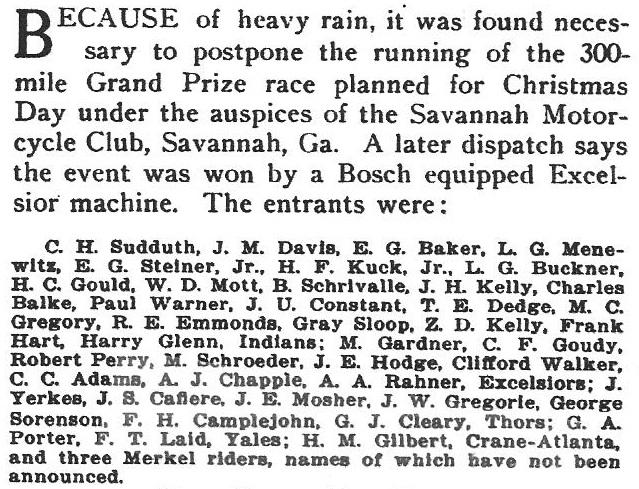
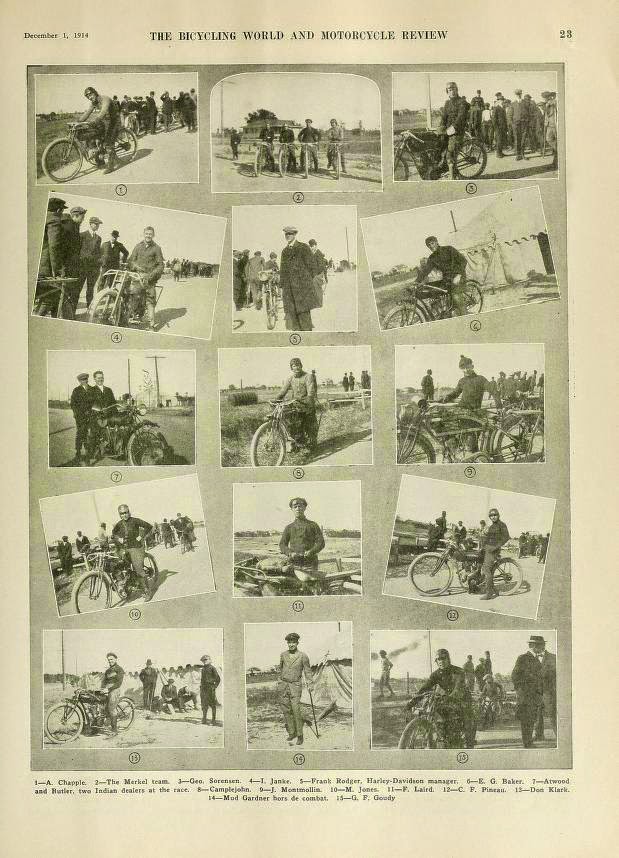
Sloop's last race was run on Thanksgiving Day, 1914. It was the Savannah 300 Road Race in Savannah, Georgia. This was only the second time the race had been held, and Sloop had ridden in the previous year’s race.
 |
| Harley-Davidson Ad featuring Gray Sloop Bicycling World and Motorcycle Review - September 22, 1914 |
Sloop's last race was run on Thanksgiving Day, 1914. It was the Savannah 300 Road Race in Savannah, Georgia. This was only the second time the race had been held, and Sloop had ridden in the previous year’s race.
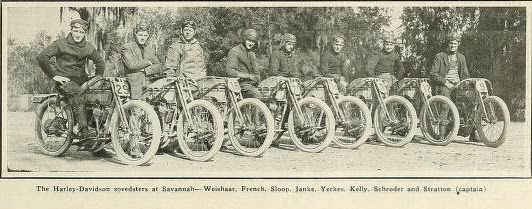
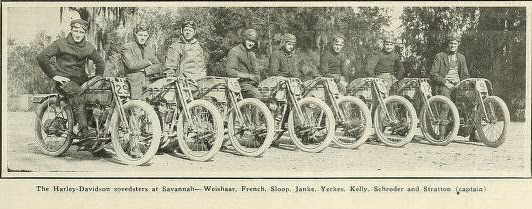 |
| Harley-Davidson Racing Team - 1914 Savannah 300 Mile Road Race Bicycling World and Motorcycle Review - December 1, 1914 |
The course wound through the city and consisted of 27 laps of 11 miles.
 |
| 1913/14 Savannah 300 Race Course |
Holding third place, Sloop had just completed the third lap when he lost control of his Harley, the same machine on which he had won the Isle of Palms Race and ran over a small embankment was hurled through the air. He broke his back, neck, hip and leg and was dead when assistance reached him.
 | |
| Gray Sloop (right) on the backstretch shortly before his fatal crash Bicycling World and Motorcycle Review - December 8, 1914
|
 |
| Motorcycle Illustrated - November 26, 1914 |
The Enterprise quoted a Savannah newspaper:
"An examination made after the race showed a broken handlebar had been the cause of the accident which cost the life of Sloop. It was found Sloop had fallen on Norwood Avenue and cracked the right side of his handlebar. On Dale Avenue the bar had cracked completely off and Sloop entered the dangerous curve at Waters Road and Estill Avenue with only the left half of the handlebar to his machine. "When he ran into the rough ground, this caused him to lose control. He was thrown from his machine and went into the air. "When descending the back of his neck struck a guy wire with such force as to cause a fracture of the neck. He then dropped between the machine and the tree. During the investigation after the race the piece of broken handlebar which had fallen from Sloop's machine was found on Dale Avenue by members of the Harley-Davidson racing stable."
His death fell like a pall over his hometown. Twenty-five young men of the town met the train carrying his body from Savannah to Charlotte and from the Queen City escorted his remains home to Mooresville. His grave in Willow Valley Cemetery was covered with flowers.
"For many years he had been the dependence of his widowed mother and his [two] sisters, and the burden of grief falls heavy upon them," reported The Enterprise, which also referred to his handsome appearance, his affable and congenial spirit, and his simple life of purity and nobility.
 |
| Gray Sloop's Headstone Willow Valley Cemetery - Mooresville, N.C. |
"For many years he had been the dependence of his widowed mother and his [two] sisters, and the burden of grief falls heavy upon them," reported The Enterprise, which also referred to his handsome appearance, his affable and congenial spirit, and his simple life of purity and nobility.
His racing skills and potential in the new sport were known and admired to such an extent that an article reporting his demise was carried in the New York Times.
 |
| New York Times - November 27, 1914 |
Although his name is unknown there today, Gray Sloop was the first to make Mooresville, “Race City, USA.”
Epilogue:
Zeddie Kelly of the Savannah Motorcycle Club, sponsor of the race, lead the first five laps of the race, when he stopped for a spark plug problem. Kelly quickly reentered the race, but was severely injured on lap nineteen, when his Harley-Davidson left the track, and struck a tree. He died of his injuries the next day and was buried at laurel Grove Cemetery in Savannah. Kelly's death brought the death toll of the race to two, and the bad publicity in newspapers around the country, led to the cancellation of a proposed 1915 race.
Epilogue:
Zeddie Kelly of the Savannah Motorcycle Club, sponsor of the race, lead the first five laps of the race, when he stopped for a spark plug problem. Kelly quickly reentered the race, but was severely injured on lap nineteen, when his Harley-Davidson left the track, and struck a tree. He died of his injuries the next day and was buried at laurel Grove Cemetery in Savannah. Kelly's death brought the death toll of the race to two, and the bad publicity in newspapers around the country, led to the cancellation of a proposed 1915 race.
 |
| Savannah's Zeddie Kelly shortly before his fatal crash Bicycling World and Motorcycle Review December 15, 1914 |
 |
| Wilmington, N.C. Morning star - November 28, 1914 |
About the Author:
O. C. Stonestreet, is an Iredell County, North Carolina native, is a Navy Veteran and a retired public-school history and social studies teacher. He lives in Statesville, N.C., with his wife Judy, and writes a regular column for the Statesville Record & Landmark newspaper. Mr. Stonestreet is also the author of They Called Iredell County Home, which is available through Amazon.com.

References:
"Will Enter the Big Race" Mooresville Enterprise, June 5, 1913.
"Will Enter Big Race" Mooresville Enterprise, June 26, 1913.
"To Be in Motorcycle Race" The Landmark, June 27, 1913.
"An Election Next Monday" The Landmark, July 1, 1913.
Day, Donald S., "Balke, on Indian, Wins Elgin Race" The Inter-Ocean Newspaper (Chicago, Ill.), July 5, 1913.
"Local Briefs" Mooresville Enterprise, July 10, 1913.
"Won First Prize and World's Championship" The Landmark, July 10, 1914.
"Gray Sloop Accepts Challenge" Mooresville Enterprise, July 23, 1914.
"Archie Templeton Won Motorcycle Race from Gray Sloop" Mooresville Enterprise, July 30, 1914.
"Motorcycle Collided with Surrey" The Landmark, September 1, 1914.
"Motorcycle and Surrey Collided" Mooresville Enterprise, September 3, 1914.
"Gray Sloop Wins Races at Charleston" Mooresville Enterprise, September 10, 1914.
"Killed in Cycle Race" The New York Times, November 27, 1914.
"Met Death in Savannah" The Landmark, November 27, 1914.
"Lee Taylor Wins Motorcycle Race" Atlanta Constitution, November 28, 1914.
"Instantly Killed at Savannah" Mooresville Enterprise, December 3, 1914.
Stonestreet, O. C., "Gray Sloop: A Man Ahead of His Time" Mooresville Tribune, July 13, 2005.
Attachment Sources:
Bicycling World and Motorcycle Review
Bicycling World and Motorcycle Review
Chris Price@Georgia Motorcycle History
Mooresville, N. C. Enterprise
Mooresville, N. C. Enterprise
Motorcycle Illustrated
New York Times
O. C. Stonestreet Collection
Wilmington, N.C. Morning Star
Wilmington, N.C. Morning Star