Showing posts with label Hammond Springs. Show all posts

Thursday, June 13, 2013

Henry Hammond Springs of Augusta, GA. - Episode #15

June 13, 2013
Updated - June 12, 2015

By: David L. Morrill
@Deadly Dave's Blog
Sylacauga, Alabama


Atlanta's Henry Hammond Springs -1921
Don Emde Collection

The idea for this article came to me, while I was researching the death of early Birmingham, Alabama racer Gene Walker. The June 1924 issue of Motorcycling & Bicycling had an article on Walker's death, but also included a photograph of the dedication of a memorial to Atlanta racer Hammond Springs on the second anniversary of his death.

As I looked around for information on Springs' racing career, I found there was little information available. Springs rose from a local Atlanta racer to ride an Indian factory prepared racer in the most prestigious national race of that time. At the time, he was the youngest professional racer in the country. While much of Hammond Springs' story has been lost to time, it is time to share what remains.

Henry Hammond Springs was born in Augusta, Georgia in 1902. Tragedy came early to the Springs family. On December 26,1909, Hammond's father, Augusta Fire Fighter Edward Springs, was killed responding to a fire. Edward Springs was driving a steamer fire truck to the scene of a fire, when he was pulled from the driver's seat, and run over by the wheels. Several years later Hammond's widowed mother Mary remarried, and the family moved to Atlanta.

Growing up in Atlanta, which was the southern capital of motorcycle racing, Hammond Springs was drawn to motorcycle racing. Racing a Harley-Davidson, Springs began honing his racing skills at Atlanta's Lakewood Speedway. The one-mile oval dirt track, which was located south of downtown Atlanta, held its first motorcycle race in front of a crowd of twenty-three thousand spectators on July 4, 1917. 

Lakewood Speedway
Atlanta, GA.


Professional motorcycle racing had been curtailed throughout the country during America's involvement in World War 1.  Some local racing continued during this period, which allowed amateur racers like Hammond Springs, to compete with more experienced professional racers. Springs first mention in the press was as an entry for the Lakewood Races held on July 4, 1918.

Atlanta Constitution - July 4, 1918

He is not mentioned in the results. There were no motorcycle races held at Lakewood Speedway on Labor Day. The event sponsors dropped motorcycle racing in favor of Automobile races. It was probably due to the death of Atlanta rider Ed Wilcox on the first lap of the 1917 Labor Day race at Lakewood.

When professional racing returned to Atlanta in 1919, seventeen-year-old Hammond Springs had already made a name for himself at Lakewood racing his eight valve Harley-Davidson.

Atlanta Constitution - May 29, 1919

In June 1919, Springs had his first serious brush with the danger involved in racing. While chasing Nemo Lancaster at Lakewood, Springs struck the rear tire of Lancaster's machine. Both riders were violently thrown from their machines, with Springs landing on his head. The spectators, who saw the crash, feared both riders had been killed. Both Springs and Lancaster required medical attention, but later returned to the track, to watch the final races. They were a bit banged up, but not seriously injured.

Atlanta Constitution - June 1919
Furman Family Collection

The caption for this photo collage from the Atlanta Constitution states:

"At the top is a scene from the northwest turn at Lakewood snapped a few minutes before the accident occurred. At the left below is Eugene Walker who regained his title as Southern Dirt Track Champion. At the right below are the two principles in the accident. Nemo Lancaster has his right foot bandaged, and Hammond Springs has a cracked dome as a result of the smash-up. Neither was seriously injured as both were back on the track to witness the ten-mile championship."


On July 4, 1919, Springs finished third in the one-mile trial, less than a second behind Indian riders Nemo Lancaster and Tex Richards. Rain plagued the later races, and Springs was unable to keep up his earlier pace on the wet track.


In August 1919, Hammond Springs was involved in one of the more unusual stories of early Atlanta motorcycle racing. Each year, small group of black racers competed in an outlaw race at Lakewood Speedway billed as the Grand Colored Motorcycle Championship Race. The event drew large crowds from Atlanta's black community.

While the Atlanta Indian and Harley-Davidson dealers were not directly involved in the race, several of the racers worked for them, and they often provided back door support. This may not have been purely philanthropic on the dealer's part, as large side bets were often placed between them on the race outcome.

Hammond Springs had recently switched to riding for the Atlanta Indian dealer Harry Glenn, and his mechanic was black racer Hal "Demon" Wade. After Wade complained to Springs that his tired 1912 Indian racer was not up to the challenge, Springs took matters into his own hands. Without permission, Springs and Wade snuck in the Indian shop on the night before the race and removed the new big valve racing engine from Springs' racer. Then they installed it in Wade's 1912 racer.

Atlanta's Hal "Demon" Wade - 1919

The competitive engine allowed Wade to easily win the final race. The story came out in an article in Motorcycling & Bicycling, and in Jim Crow Atlanta, it could have certainly put an end Springs' racing career. Springs' sponsor won a tidy side bet on the race outcome with the local Harley-Davidson dealer, and all was forgiven.

With Hammond Springs success in the July 4th Atlanta races, Harry Glenn was anxious for his young rider to begin professional competition. Glenn convinced Springs' Mom to allow the 17-year-old to enter the Labor Day races at Lakewood.


The Labor Day motorcycle races returned to Lakewood Speedway in 1919. They drew large crowds and a big purse, which attracted the best riders in the South. Hammond Springs race ended with a blown engine on the first lap of the race. Rumors at the time had Hammond springs going to the Harley-Davidson team for the 1920 season.

Motorcycle Illustrated - September 18, 1919.
On July 5, 1920, Hammond Springs won the 10-Mile Race at Lakewood defeating both Tex Richards and Harry Glenn.

Atlanta Constitution 
July 6, 1920

Motorcycle and Bicycle Illustrated - July 8, 1920

By 1921, Springs was making a name for himself racing in national championship races around the country as a member of the Indian Factory racing team.

Motorcycle and Bicycle Illustrated - September 1, 1921
Indian dispatched a large team of riders, including Hammond Springs, to compete in premier race of the year, the Dodge City 300. Indian's Shrimp Burns turned the fastest lap in the time trials with Hammond Springs, and Johnny Seymour tying with the 5th fastest lap.

Atlanta Constitution - June 12, 1921


Harley-Davidson dispatched a large team of riders, with Ralph Hepburn and Otto Walker setting the second and third fastest laps. As the race started, pole sitter Shrimp Burns, pulled out with mechanical problems. The heat, and the length of the race took a toll on several of the other Indian riders, who slowed with mechanical problems. The race was won Harley-Davidson's Otto Walker. The only bright spot for Indian, was Johnny Seymour's second place finish. The remaining top finishers were all Harley-Davidson mounted.

After the Dodge City race, Hammond Springs traveled to the Indian factory in Springfield, Massachusetts. During that visit, he was photographed on his Dodge City racer on the factories roof.

On August 15, 1921, Hammond Springs won the 10 Mile Professional Race on the one-mile dirt track at Pottstown, Pennsylvania. Springs edged out Harley-Davidson's star rider, Jim Davis, by just two feet at the finish. Davis had won the 5 Mile Professional Race, and set a new track record earlier that day, with Springs finishing fourth.

On May 17, 1922, an article appeared in the Atlanta Constitution on local riders Nemo Lancaster and Hammond Springs entering the upcoming race at the Lakewood Speedway. In describing Springs, the article stated:


Atlanta Constitution
May 17, 1922


On May 20, 1922, Springs won the 10 Mile National Race at the Lakewood Speedway. This was Springs first win in a National Championship race, and it came in front of his hometown crowd. He also defeated local Champion, Nemo Lancaster, and his Indian teammate Gene Walker. This was the highlight of Springs career.


Motorcycle and Bicycle Illustrated - May 25, 1922

Atlanta Constitution
May 21, 1922

But, as fate often has it in the racing game, Springs' greatest triumph was followed only nine days later by tragedy.

On May 30, 1922, Hammond Springs traveled to the half mile dirt track at Springbrook Park in South Bend, Indiana. Springs was leading the last race of the day, with Dayton, Ohio rider Eddie Brinch close behind. They collided throwing both riders from their machines. Brinch sustained a broken collarbone, but Hammond Springs died of his injuries that evening in a South Bend Hospital.

This article from Wichita Daily Eagle contains the last known photograph of Hammond Springs racing. At the time the article was written, it was boot known he had died from injuries.

Wichita, KA. Daily Eagle - May 30, 1922

The death of the daring young Atlanta rider was reported in newspapers across the country.


Atlanta Constitution - May 1922
Wichita, KA. Beacon - May 31, 1922

The coroner's inquest found the death was a racing accident and cleared both riders of responsibility for the fatal accident. Springs was nineteen, when he died. Hammond Springs was returned to Atlanta and buried at West View Cemetery.


On the day of his funeral, Springs received a motorcycle escort to the cemetery from both the Atlanta Police Department and the Atlanta Motorcycle Club. Atlanta motorcycling notables Harry Glenn, Hal Gilbert, Nemo Lancaster, Tex Richards, and Charlie Hages were pallbearers at his funeral. Atlanta's motorcycle shops were closed the day of his funeral, as an act of respect for Springs family.


Hammond Spring's Funeral Notice
Atlanta Constitution 
June 3, 1922
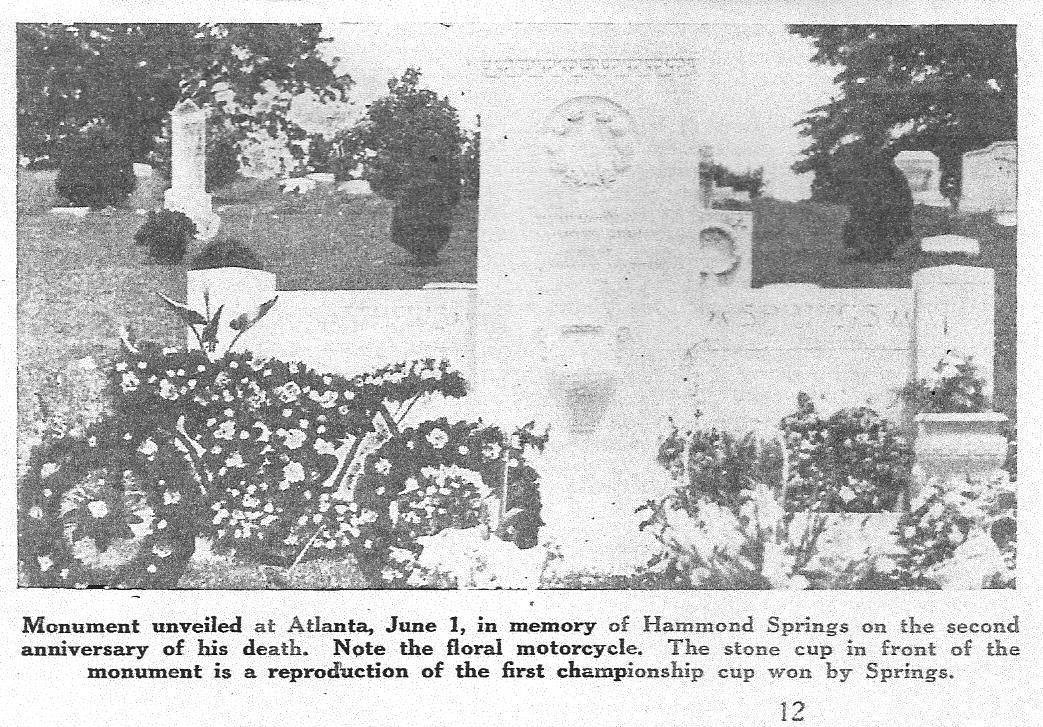
Springs was a hometown hero in Atlanta, and on the second anniversary of his death, an elaborate memorial was dedicated at his grave site. It features a stone reproduction of the loving cup trophy, Springs received for his first race win at the Atlanta's Lakewood Speedway.

Motorcycle and Bicycle Illustrated
June 1924


Henry Hammond Springs Memorial
West View Cemetery Atlanta, GA.

Bertha Avery Hood Collection - 2011

In the December 1922 Motorcycle and Bicycle Illustrated reported that Hammond's brother, Clarence Springs, had taken over long time Atlanta Harley-Davidson dealer, Gus Castle's, Atlanta business interests.

Motorcycle and Bicycle Illustrated - December 28, 1922


Author's Note:

Special thanks to Don Emde and Mike Bell for their contributions to this story.


Sources:

Atlanta Constitution

Bertha Avery Hood Collection

Don Emde Collection

Find A Grave.com

Furman Family Collection

Mike Bell Collection

Motorcycle and Bicycle Illustrated

Stephen Wright - American Racers 1900-1940

Wichita, KA. Beacon

Wichita, KA. Daily Eagle

Wikipedia.org


Wednesday, July 04, 2012

Atlanta's Black Streak Racers - Episode #1

September 5, 2024
Updated - October 16, 2014

By: David L. Morrill
@ Mototique Blog
Ocala, Florida

Atlanta's Black Streak Racers
                            
The Other Harley-Davidson vs Indian War

"Bones the Outlaw" (left), Horace "Midnight" Blanton (right) 
with their Indian Racers - Atlanta 1924

A while back I heard a rumor there was a group of black board track motorcycle racers from Atlanta, GA. I checked around and found one photo from 1919, but no other information. I began contacting my board track racing sources, but no one had heard about them. One day I received package from Stephen Wright of Morro Bay, CA. with a few period articles from his collection. With those articles, I was able to put together the article below about this little-known piece of early motorcycle racing history. This article would not have been possible with Stephen Wright's assistance.


Beginning in the mid-teens, factory racing teams from both Indian and Harley-Davidson fought a hard battle for dominance on the board and dirt tracks around the country. Great riders like, Gene Walker, Shrimp Burns, Otto Walker, and many others made their names riding for either the Indian Wigwam or the Harley Wrecking Crew. The bikes they rode were little more than bicycles, with powerful V twin engines, and no brakes. Motorcycle racing was a major spectator sport and drew tens of thousands of spectators across the country.  
Hall "Demon Wade" Ware - 1918 Champion
Beginning In 1913, another group of motorcycle racers sought fame and fortune on the racetracks around Atlanta, Georgia. These black riders had colorful nicknames like, "Hard Luck" Bill Jones, Hall “Demon Wade” Ware, Horace “Midnight” Blanton, and “Bones the Outlaw,” and raced each other first at the Atlanta Speedway, and later at the Motordrome board track, as well as the Lakewood Speedway. They did not have the latest factory racing bikes, and their racers were often cobbled together with obsolete parts from the scrap piles of the local motorcycle dealers. They were known as Atlanta’s ‘Black Streaks’ and while their races were covered by the national motorcycle press, the articles reflected the racial prejudice of the day, with a 1919 Motorcycling and Bicycling article titled “When Dinge Met Dinge in Georgia”; the text was even worse.

In 1909, Coca Cola founder Asa Candler opened the Atlanta Speedway in an area, which is now the site of Hartsfield-Jackson Atlanta International Airport. The two-mile oval track featured an asphalt and gravel racing surface, which was modeled after the recently opened Indianapolis Speedway. Motorcycle races for white riders were held there beginning in November 1909.  

The first mention of a motorcycle race for black riders, comes in an Atlanta Constitution article on events held at the Speedway on Labor Day 1913 by the " Atlanta Colored Labor Day Association."


Atlanta Constitution _ August 31, 1913

The race featured a black automobile racer, "Hard Luck" Bill Jones, who had recently switched to racing motorcycles. The only race results appeared in a later Constitution article on Jones. John Sims on an Indian was the winner.


Atlanta Constitution - September 2, 1913

In May 1913, Jack Prince came to Atlanta to build a board track for motorcycle racing. The 1/4-mile circular track, named the Atlanta Motordrome, was built on the site of the old Fairgrounds at Jackson Street NE and Old Wheat Street close to Atlanta's Ebenezer Baptist Church.
Jack Prince
Jack Prince built several of these early circular tracks, which featured a nearly vertical racing surface of rough sawn lumber. They were often referred to as "Saucer Tracks."


Atlanta Motordrome Ad - 1913

From the tracks opening, the Motordrome races featured the top white riders in Atlanta. Stars like Harry Glenn, Nemo Lancaster, Tex Richards, and more fought hard for wins, on the 56-degree banned 1/4-mile circular board track, in front of large crowds of enthusiastic fans.

Atlanta's Harry Glenn - Atlanta Motordrome 1913
Chris Price@Archive Moto

That changed in August 1913, when word got out that the Motordrome was planning a race for black riders. On September 5, 1913, the planned race was the subject of a full page highly critical article under the headline was "Dealers Condemn Atlanta's Colored Races" in Motorcycling magazine.

Motorcycling - September 5, 1913
Scott Bashaw Collection

The article quoted local Atlanta Harley-Davidson dealer Gus Castle, and Thor /Jefferson dealer Johnny Aiken. Both dealers' statements reflected the attitude of most whites in Jim Crow Atlanta. Gus Castle stated:
"I think the negro racing game is a substantial benefit, as it drives the last nail in the coffin of motorcycle track racing in Atlanta, and that's a blessing of no small importance."
 Aiken's stated:
"Except that it will popularize motorcycling among Negros and in that way cheapen the sport in the eyes of white men."
The article went on to state that there were about forty black motorcyclists in Atlanta, and that the white dealers refused to sell them new motorcycles.
After reading the article in Motorcycling, Federation of American Motorcyclists (F.A.M.) Chairman John L. Donovan wired the track operators stating the Atlanta Motordrome would be "outlawed" and their race sanctions withdrawn "as the F.A.M. does not allow colored men as members."
Despite the threats from Donovan, on October 19, 1913, an article appeared in the Atlanta Constitution newspaper announcing a race featuring black riders would be taking place at the Motordrome.
Atlanta Constitution October 19, 1913

The article states "The men who ride are all experienced and have ridden motorcycles on board tracks before." That statement seems to confirm that black riders' rode on Motordrome style board tracks in other cities. Sadly, that history has been lost.
Atlanta Constitution October 21, 1913

Atlanta Constitution October 23, 1913
The race was postponed twice due to rain. Weather was a constant problem at the Atlanta Motordrome. The riders could not safely race on the steep wooden banking, when it was wet, and races were often postponed several times.

Atlanta Constitution October 26, 1913

Atlanta Constitution October 28, 1913

A pre-race article on racer "Hard Luck" Bill Jones appeared in the Atlanta Constitution the day before the race.


Atlanta Constitution October 27, 1913

The race featuring black riders took place at the Motordrome on afternoon of October 28, 1913. The race featured black riders Bill Jones, and Lloyd Brown of Atlanta, along with the Wilson brothers from New Orleans, and Ben Griggs and Willie McCabe of Chattanooga. The Atlanta Constitution did not cover the race, and the results are unknown.
Less than a month after the race, an article appeared in Motorcycling World and Bicycling Review that stated the owners of the Motordrome, had filed for bankruptcy. It further stated:

 “This Motordrome earned an unsavory reputation by pulling off a race with negro riders, in defiance of F.A.M. regulations, thereby becoming outlawed as long as the present management exists.” 

The Motordrome reopened the following year under new management. There is no record of any further races featuring black riders at the track. With the opening of the Lakewood Speedway, motorcycle racing shifted away from the Motordrome. 


Atlanta's Lakewood Speedway
"The Indy of the South"
The one-mile dirt oval Lakewood Speedway opened south of the city in 1917 and began running motorcycle races. The track owners revived the races for black riders, which they billed as the Grand Colored Motorcycle Championship Race. " A black South Carolina racer named Tom Reese, who called himself the Champion of South Carolina, arrived in Atlanta for the June race." Reese’s manager began to brag that Reese could beat any Atlanta rider and he was prepared to place a large cash wager to back up his claim.

The event drew large crowds from Atlanta’s black community, and wagers were placed on the favorite riders. While the Harley-Davidson and Indian factories had no involvement in these races, the local white Harley-Davidson and Indian dealers gave limited assistance to their chosen racers. They also often placed large wagers between themselves on the outcome of the race.

On May 31, 1919, Bones the Outlaw appeared in a pre-race article for the 1919 Southern Dirt Track Championship, which featured top white riders from around the south, including Birmingham's Gene Walker, and Atlanta's Nemo Lancaster. Bones was standing with his employer Harry Glenn.

Atlanta Constitution - May 31, 1919


 At the local Indian dealer, Hall “Demon Wade” Ware saw an opportunity. Already an accomplished local racer, Ware worked for the dealer as a mechanic. He convinced his boss, Nemo Lancaster, to lend him a competitive bike to race against Reese. While Lancaster recognized Ware’s talent, the rumor was he had a very large side bet with Reese’s manager. At the start of the race, Reese on a Harley-Davidson jumped out to an early lead. Reese’s manager was already looking forward to winning the wager. Ware, on the loaned Indian, soon caught the Carolina Champion, and passed him winning the race.  Ware claimed the $150 first prize, and Lancaster collected on large side bet with Reese’s manager.  
The race in August 1919, was another hard-fought battle between Demon Wade, and Bones the Outlaw. Midnight Blanton won several of the preliminary races and had a shot at winning the championship race. The night before the race, Atlanta board track racer Hammond Springs (who was white) helped Wade install Springs new Indian racing engine into Wade’s older Indian frame. The competitive engine allowed Wade the edge he needed to leave Blanton in his dust. On the final lap, he and Bones the Outlaw, crossed the line in a tie. This required a rematch, which Wade won hands down, claiming the 1919 championship.
The race held on June 5, 1922, proved to be a bit of a disappointment. Once again, several racers from around the south arrived, prepared to race. When Hal Wade's bike was unloaded, the motor was covered. This gave rise to rumors; Wade had another special racing engine. Wade was close to his former employer, Harry Glenn, who was now and Indian factory representative. 


Harry Glenn business card autographed by Hall Ware Wade
Scott Bashaw Collection

When race time rolled around, only Horace Blanton came to the starting line, to face Wade.

Hal "Demon" Wade - Gary Phelps Collection
@motorcycletimeless

Wade won two five-mile races, defending the Southern Champion title he had held since 1915. The remainder of the day's races were canceled due to the lack of competition.


Motorcycle & Bicycle Illustrated - June 15, 1922


Horace "Midnight" Blanton
1924 Champion
By the 1924 race, Bones the Outlaw switched to racing automobiles, and Demon Wade had sold his machine and moved north. For the 1924 races, Bones the Outlaw made a demonstration run in his racing car, blasting around the dirt oval and putting on quite a show, narrowly avoiding crashing several times. In the motorcycle race, Horace Blanton had no real competition, his two chief rivals having moved on, and he easily claimed the championship over a field of less experienced riders.


The 1924 race appears to have been the final race for the black racers, and the story of the Atlanta Black Streak racers eventually faded into history. Still, for seven years a group of black motorcycle created a unique story in the Jim Crow south and had their moment in the limelight.

Author's Note:
This 1919 Motorcycling and Bicycling Magazine article about Atlanta's Black Streak Racers uses language that reflects the racist attitudes of the time. It is included for historical context, and to show the prejudice these young men endured during their racing careers.

Motorcycling and Bicycling - August 27, 1919

This early teen photo of an African American racer #17 lined up with white racers was recently shared on Facebook. There was no information on the location and is most certainly not related to the Atlanta racers. It may very well predate the Labor Day 1913 race for black riders held at the Atlanta Speedway.

Early Harley-Davidson Mounted Racers ca. 1912
Armando Cecili Collection


Epilogue: October 16, 2014

I was deeply saddened to learn of the passing of Stephen Wright. For those who did not know of Steve, he was one of the absolute experts on early American motorcycling. He wrote several books on early motorcycling, and helped many writers, like me, to share those stories.


Stephen Wright

Stephen's book, American Racer 1900-1939 is the definitive study on early American motorcycle racing. He provided much of the research, this story is based on, and I will forever be indebted to him. Steve will be deeply missed, and this story is dedicated to his memory.


Sources:

Armando Cecili Collection

Atlanta Constitution

Chris Price@Archive Moto

Gary Phelps Collection@motorcycletimeless

Georgia Motorcycle History - by Chris Price

Motorcycle Racers - Ebony Magazine Volume # 10 - 1955

Harley-Davidson.com

Mike Bell Collection

Motorcycling and Bicycling

Randy "Detroit" Hayward@detroit_antique_motorcycles

Scott Bashaw Collection

Stephen Wright

The Vintagent - http://thevintagent.blogspot.com/

Wikipedia.org