Showing posts with label Birmingham Alabama. Show all posts

Sunday, July 06, 2014

O.V. Hunt - Birmingham's Photographer - Episode #25

July 6, 2014
Updated - May 28, 2017

By: David L. Morrill
@MototiqueRacing
Sylacauga, Alabama


O. V. Hunt (rear) and Robert Stubbs (front) - Birmingham, AL. ca. 1913
Birmingham, Alabama Public Library Archives - O.V. Hunt Collection


If you've ever picked up a book on the history of Birmingham Alabama, you have very likely seen an O.V. Hunt. photograph. Beginning in the early teens, Mr. Hunt photographed Birmingham's rapidly rising skyline, and recorded the events of daily life in the Magic City. Mr. Hunt was also a motorcycle enthusiast and recorded many significant motorcycle events held in Birmingham in the teens and twenties.

My own involvement with Mr. Hunt's photographs began, when Johnny Whitsett sent me a DVD containing scans of several of Hunt's Birmingham motorcycle event photographs, he received from one of Mr. Hunt's relatives. Over the next several years, I attempted to identify, both the events depicted, and the subjects in those photographs.

                                                                                                                                                       
Oscar Virgil Hunt was born in Bowden, Georgia in 1881. By 1900, Hunt's family had relocated to Birmingham, Alabama, and the eighteen-year-old Hunt was working as a day laborer. In the next few years, his passion for photography, developed into a career, and he opened a photography studio on 4th Avenue North in Birmingham.  He also worked as a photographer for the Birmingham Ledger Newspaper.


O.V. Hunt Photographic Studio - Birmingham, AL.
Birmingham, Alabama Public Library Archives - O.V. Hunt Collection

Mr. Hunt developed a reputation of taking great risks to get his photographs. In 1912, climbed on to an early Biplane in the infield of the Alabama State Fairgrounds racetrack, and he took to the air above Birmingham to take aerial photos of the city. Mr. Hunt, who had mastered self-promotion, often appears in photographs taken by his firm.

Eugene "Wild Bill" Heth (left) O.V. Hunt (right)
Alabama State Fairgrounds ca. 1912
Birmingham, Alabama Public Library Archives

O.V. Hunt Collection
In July 1913, Hunt, and his camera, were suspended from a steel beam suspended from the top of the Tutwiler Hotel, which was under construction in downtown Birmingham.

Birmingham, Alabama Public Library Archives
O.V. Hunt Collection - 1913
The Alabama State Fairgrounds in Birmingham had a one-mile dirt oval racetrack, which held its first motorcycle race in 1906. Mr. Hunt was a friend of Robert Stubbs, the Birmingham dealer for the Hendee Manufacturing Company, which produced Indian Motorcycles. Stubbs, was a motorcycle racing enthusiast, having been a member of the Indian Factory racing Team.

Amateur Motorcycle Race Alabama State Fairgrounds - ca. 1912
Birmingham, Alabama Public Library Archives - O.V. Hunt Collection

Stubbs had retired from track racing, but sponsored local riders Gail Joyce, Richard Gayle, and Eugene Walker. Joyce and Gayle were experienced riders having competed in races around the state for several years. Gene Walker worked for the Post Office delivering mail on his motorcycle, and was making a name for himself competing in races at the Fairgrounds racetrack. Stubbs riders were photographed by Mr. Hunt in front Stubbs Dealership in 1913.

Richard Gayle (left), Gail Joyce (center), Gene Walker (right)
Furman Family Collection - O.V. Hunt ca. 1913

In early 1914, Hunt was hired by the new Birmingham Harley-Davidson Motorcycle dealer, William F. Specht Jr. to record the opening of his dealership at 1714 3rd Avenue North. Mr. Hunt captured the first load of ten Harley-Davidson motorcycles arriving by horse drawn wagon at Specht's dealership.

William F. Specht Jr. (far right) Specht Harley-Davidson - Birmingham, AL.
Johnny Whitsett Collection - O.V. Hunt - 1914


Hunt took a photograph of Harley-Davidson Racing Team members Johnny Aiken (Atlanta), Bill Specht Jr. (Birmingham), and Gray Sloop (Mooresville, NC.) in front of Specht's dealership. Sadly, Gray Sloop was killed, along with Savannah, GA. rider Zeddie Kelly, while competing in the 1914 Savannah 300 Mile Road Race.

Johnny Aiken (right), Bill Specht Jr. (center), Gray Sloop (right)
Johnny Whitsett Collection - O.V. Hunt - 1914


Interior of Specht Harley-Davidson in Birmingham, AL.
Birmingham, Alabama Public Library Archives 

O.V. Hunt Collection 1914

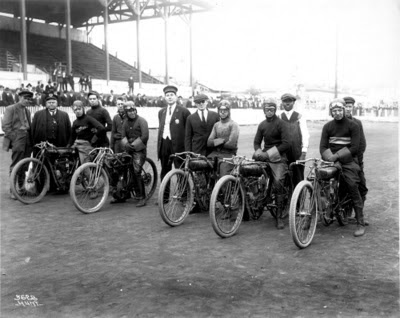
Mr. Hunt was the official photographer for the July 14, 1914, Birmingham Ledger Motorcycle Endurance Run. This grueling event took place over several days on the public roads between Birmingham and Atlanta, Georgia.  This a pre-race photograph of some of the thirty-one of race competitors in from of the Birmingham Ledger Offices in downtown Birmingham.

1914 Birmingham Ledger Endurance Run Competitors
Johnny Whitsett Collection - O.V. Hunt - 1914
The race, which was run over the next two days on the public roadways between Birmingham, and Atlanta, Georgia began at 3:00 am on the morning of July 4th. The start/finish line was in front of the Birmingham Ledger office at 1st Avenue North and 21st Street.

Start/Finish Line - Birmingham, AL. - July 1914
Birmingham, Alabama Public Library Archives - O.V. Hunt Collection

There was great controversy with the results of the1914 race, and a protest was filed by the Harley-Davidson Team. When the referee ruled against them, the Harley-Davidson team withdrew from the race leading to an Indian sweep for Robert Stubbs' Birmingham Indian race team. Team rider Gail Joyce was declared the winner.

Gail Joyce - Birmingham, AL.  - July 1914
Johnny Whitsett Collection - O.V. Hunt

1914 Indian Motorcycle Promotional Poster
Scott Bashaw Collection

In October 1914, a race took place at the Alabama State Fairgrounds track that became an important part of Harley-Davidson's early racing history, and O.V. Hunt was there. Two of the photographs Hunt took that day have survived, and they are the only photographs of the event known to exist. The one-hour Federation of American Motorcyclists race became the Harley- Davidson Racing Teams First National Championship race win. It also launched the professional racing career of a young man from Birmingham, who became one of the greats of early American motorcycle racing.

Alabama State Fairgrounds F.A.M. One Hour Championship Race
Johnny Whitsett Collection - O.V. Hunt 1914
This starting line photograph of the Alabama State Fairgrounds racetrack shows the riders preparing to take to the track. The young man with the focused look seated on his Indian racer on the right of the photo is John Eugene Walker. This was the Birmingham natives first professional motorcycle race.

As a side not, you can see this photograph also captures the iconic Vulcan statue, buy Giuseppe Moretti, to the right of the grandstand. The Vulcan statute remained at the Fairgrounds until the 1930's, when it was moved to its current location on the top of Red Mountain and became the symbol for the City of Birmingham.


Alabama State Fairgrounds F.A.M. One Hour Championship Race
Birmingham, Alabama Public Library Archives - O.V. Hunt 1914
 

At the end of the one-hour race, Harley-Davidson's Red Parkhurst was declared the winner, with Joe Wolters finishing second, Gail Joyce finishing third, and Gene Walker fifth.  Two protests were filed, but the race results were upheld. The race went down as the newly formed Harley-Davidson Racing Team's first Championship Race win and became a key part of their advertising campaign for their 1915 model.


1915 Harley-Davidson Ad

It was also a big day for Gene Walker.  Walker briefly lead the race and set a new track lap record. This attracted the attention of the Indian Racing Team, and Walker joined their team for the 1915 racing season. Walker went on to become one of the great riders of the late teens, and early twenties.

In early 1915, Mr. Hunt's firm took a publicity photo for Robert Stubbs' Indian dealership. The photograph touted the release of the 1915 Indian motorcycle and appears to have been staged as a satire of Specht's Harley-Davidson 1914 horse drawn wagon photo.

Robert Stubbs Indian Publicity Photo - Birmingham, AL.
Johnny Whitsett Collection - O.V. Hunt 1915
In this photo, Stubbs pulls a wagon full of dapper young men on a new 1915 Indian motorcycle. The message is clearly, that while Harley-Davidsons arrive in a horse drawn wagon, the new Indian can pull the wagon. O.V Hunt stands behind Robert Stubbs, who is seated on the motorcycle.

In April 1915, the second annual Birmingham Ledger Endurance Run was staged, and once again the Mr. Hunt photographed the contestants for the Birmingham Ledger.

Birmingham Ledger - April 3, 1915
O.V.  Hunt

The 1915 event also had it's share of controversy. At the end of the second days run from Atlanta to Birmingham, Harley-Davidson rider Willard DeGroat, and Indian rider Robert Horton were tied for the top horns. A third day run was scheduled as a tie breaker but was rained out. Horton failed to show for the agreed-on tie breaker, and DeGroat was award the overall win. 

Willard DeGroat - Birmingham, AL.
Jessica DeGroat Hayes Collection - O.V. Hunt 1915

During this period, Mr. Hunt also took several photographs of sidecar equipped motorcycles. These bikes were used by local businesses to deliver goods and provide roadside assistance to stranded motorists. The riders of the bikes were often African American.

Birmingham, Alabama Public Library Archives - O.V. Hunt Collection ca. 1916

With the approach of America's involvement in World War 1, motorcycle shops across the country faced hard times. The Military purchased most of the production of new motorcycles, spare parts, and tires. These were going overseas, and motorcycle dealers across the country really felt the pinch. Many dealers found it difficult to keep their doors open. In 1917, many of the young men, who had been customers of the shops were drafted.  This was the final blow, and countless shops closed their doors.

While the Birmingham Harley-Davidson and Indian dealers remained in business through the war, big changes to the motorcycle business in Birmingham came in 1919. Robert Stubbs closed his Indian dealership and took a job managing a motorcycle shop in Montgomery, Alabama. William F. Specht Jr. returned to Atlantic City.

Gail Joyce opened the Gail Joyce Motor Company at 1709 3rd Avenue North. Although the records are sketchy, the Joyce Motor Company appears to have handled both Indian, and or Harley-Davidson sales in Birmingham during this period. Mr. Hunt continued photographing Joyce's dealership, and several motorcycle events for Joyce. After the war, motorcycles began the shift from basic transportation to recreational use. The novelty of motorcycle events faded in Birmingham.


Gail Joyce Motor Company (center) - Birmingham, AL. ca. 1931
Birmingham, Alabama Public Library Archives - O.V. Hunt Collection

On June 24, 1924, the Birmingham News reported the death of Gene Walker form injuries received while practicing for a race in East Stroudsburg, PA. During his career, Walker won 19 Championship motorcycle races, and set track records across the country. During the winters, he returned to Birmingham, where he worked as a Motorcycle Police Officer for the city. 1920, Walker set the first official motorcycle land speed record at Ormond Beach Florida.

Under the headline "Motorcycle Riding Has Lost Its Greatest Star in Death of Walker" Birmingham News sports reporter Zipp Newman detailed Walker's career, and the circumstances of his death. The article was accompanied by a photograph of Walker taken by O.V. Hunt in 1913.

Birmingham News - June 24, 1924
Birmingham, Alabama Public Library Archives - O.V. Hunt ca. 1913 

The Birmingham Police Department Motorcycle Unit, and a large contingency of local motorcyclists, escorted Walker's funeral procession to Birmingham's Elmwood Cemetery. It was a fitting remembrance of the young man, who put Birmingham, Alabama on the map for sports fans across the country.


Indian Motorcycle Company's Memorial Ad - 1924

In 1934, Gail Joyce died in Birmingham. His family continued to operate the Gail Joyce Motor Company and were still the Birmingham Harley-Davidson dealer in the 1950s.

Oscar V. Hunt continued to photograph Birmingham's event's big, and small, for several more decades, retiring in 1953.  He passed away at age eighty-one in Birmingham, Alabama in 1962. His legacy to the Magic City is his photographs.

Birmingham The Magic City Sign - Birmingham, Al.
Birmingham, Alabama Public Library Archives - O.V. Hunt Collection ca. 1926
Through the time machine of his lens, O.V. Hunt instantly transports us back to the streets of Birmingham one hundred years ago, and we view can the early days of Birmingham motorcycle sport. What better legacy, could he have left us?

Sources:

Birmingham Ledger

Birmingham News

Birmingham, Alabama Public Library Archives - O.V. Hunt Collection

Clay Nordan - A Minor Mystery Solved

Chris Price - www.Georgia Motorcycle History.com

Hunt Family Collection

Jessica DeGroat Hayes Collection

Johnny Whitsett Collection

Kelly Stewart - Barber Vintage Motorsports Museum

Scott Bashaw Collection


Friday, January 03, 2014

Gene Walker's Four Valve Racer - Episode #21

January 3, 2014
Updated - July 8, 2014

By: David L. Morrill
@ Deadly Dave's Blog
Sylacauga, Alabama


Gene Walker - 1923

They say a pictures worth a thousand words, and this old photo certainly is worth a few. To start with, Daytona 200 winner Don Emde sent me this photo as part of some research I was doing a few years back. It was taken in 1923, and the rider is Gene Walker of Birmingham, Alabama.

Now some folks will tell you, Gene Walker rode Indian Motorcycles, and that is mostly true. From the time the Birmingham Indian dealer, Bob Stubbs, first put young Walker on and eight valve Indian racer at the Alabama State Fairgrounds, through many of his race wins, and numerous track records, Gene Walker raced Indians.

So, how did one of the most famous Indian riders of his time, come to be photographed on a Harley-Davidson racer?

And even more interesting, how did he become part of Harley-Davidson's 1923 advertising?

The story starts with America's entry into World War I. Professional racing was curtailed, and Indian factory rider, Gene Walker, returned to Birmingham. As his widowed mother's sole support, Walker was exempted from the draft. He found work as a motorcycle machinist at the Harley-Davidson shop run by Bill Specht. During the winter, Walker supplemented his income working as a Birmingham Motorcycle Police Officer. Walker also kept his hand in racing, winning a few non-championship races, at Atlanta's Lakewood Speedway on a privately entered Harley-Davidson.

With his return to the Indian Racing Team in 1919, Gene Walker again won races, set track records, and even set the first officially recognized motorcycle land speed record for Indian.

So, how did he come to fall into disfavor with the management at Indian?

In July 1921, Walker agreed to compete in the biggest race of the year, the 300 Mile Coyote Classic in Dodge City, Kansas. A few days before the race, Walker notified his bosses he would not compete at Dodge City. Walker contended that the Dodge City track was dusty, and dangerous, but he may have had another reason.

Just two weeks later, Walker entered a race in South Bend, Indiana. His bosses at Indian, accused him of "cherry picking" races for easy wins, and purses. The dispute played out in the motorcycle press for the next month. Walker continued to win races on Indians, and it appeared the dispute was settled, until Walker was unexpectedly released by Indian at the end of the 1921 reaching season. The reason given by Indian's Management, was his failure to meet his contractual obligations by not competing at Dodge City.

Walker returned to Birmingham, and he appears to have gone back to work at the Harley-Davidson shop. He also resumed his duties as a motorcycle police officer. That story was picked up by newspapers across the country.

Santa Cruz, CA. News - December 1923
Walker returned to racing on the privately entered Harley-Davidson 30.5ci four valve racer shown in the photograph. Harley had shut down their factory racing effort at the end of the 1921 racing season.  They were however, offering bikes to select qualified riders. Walker's former Birmingham Indian teammate, Gail Joyce, was now the Birmingham Harley-Davidson dealer at the Gail Joyce Motor Company at 1709 3rd Avenue North.

Gail Joyce Motor Company (center) - Birmingham, AL ca. 1931
Birmingham, Alabama Public Library Archives - O.V. Hunt Collection

Harley-Davidson may have also seen it as an opportunity to thumb their nose at their racing rival Indian.  However, it came about, Walker began to dominate the short track races around the country, and Harley-Davison took full advantage of the publicity his wins brought them.

Harley-Davidson Ad - 1923

By the end of the 1923 season, Indian rehired Walker. He quickly rewarded them with a win on the board track at Los Angeles, and later wins at the Ascot Speedway. Sadly, Gene Walker died of injuries he sustained in a crash at the half mile dirt track at East Stroudsburg, Pennsylvania in June 1924.

So, what became of the factory for valve Harley-Davidson racer in the photo?

 I wish I knew. None of the Harley-Davidson blanked off four valve racers seem to have survived. Like their big brothers, the twin cam eight valve racers, they were very rare. I can only hope it's hiding undiscovered in some dark corner of a Birmingham warehouse. If it does turn up, I sure hope I get the first call. It will certainly take very deep pockets to own it!

Sources:

Birmingham, Alabama Public Library Archives - O.V. Hunt Collection
Santa Cruz, CA. News

Thursday, December 06, 2012

Building a 1921 Harley-Davidson Race Engine - Episode #8


December 6, 2012
Updated - February 13, 2014

By: David L. Morrill
@ Deadly Dave's Blog
Sylacauga, Alabama

This project started in 2010, when I visited the Wheels Through Time Museum in Maggie Valley, NC. The Motorcycle Cannonball Run cross country race, for pre-1916 bikes, stopped there. The visit allowed me to check out both the W.T.T. collection and the Cannonball entrants. The collection at Wheels Through Time is one of the finest collections of early motorcycles and memorabilia in the country.  It's a must visit for any motorcycle enthusiast:


While examining their collection, I came across a very rare early racer. The bike in question is a 1921 Harley Davidson SCA (Single Cylinder Alcohol) serial #1 racer. Looking at this old racer, in as raced condition, most would ignore it in favor of the bright and shiny restored bikes. These rusty relics are often worth way more than the bright and shiny restored bikes. As they say, it's only original once!

1921 Harley Davidson SCA Factory Racer #1
Wheels Through Time Collection

In the early 1920's, the engine displacement for short tracks was reduced from 61ci (1000cc) to 30.5ci (500cc), in the interest of safety. As a result of the displacement change, the folks at the Harley-Davidson factory race shop looked around for a way to build a competitive 30.5ci single cylinder race motor. They realized they could remove one cylinder, piston, and rod from their existing 61ci V twin pocket valve race motor and get the 30.5 ci. single cylinder engine they needed.

1922 Harley-Davidson SCA Racer
Glenn Bator Collection

The pocket valve engines are also referred to as I.O.E. (intake over exhaust) engines having an overhead intake valve and a flat head style exhaust valve below it. This design allowed the intake valve to be quickly changed if a problem arose, which often happened with a one-piece cast-iron cylinder and head.

1921 SCA #1 Blanked Off Twin Racing Engine
Wheels Through Time Collection

As I examined the motor on the SCA racer, I realized it was not all that dissimilar to the 1921 Harley-Davidson Model J engine that was on my workbench at home. I decided it would be cool to try and build a replica racer that folks could see, hear, and touch. Building an exact copy was not in the cards. Harley-Davidson factory racing engines in this period used special early narrow engine cases bearing racing serial numbers. If you could find a set of cases, or any of the ultra-rare internal bits that made them so fast, the cost would be too high for my budget. Fortunately, the basic engine layout is very similar to the Model J production motor.

My 1921 Harley Model J V Twin Engine
Before Conversion to a Banked Off Single

When you do a project like this, there is a steep learning curve. First off, the oldest Harley motor I had worked on previously was from the mid 1950s. The engines from the early 1920s, are a very different animal. When I got back to my shop, I tore into my 1921 V twin motor and found the internals were in pretty good shape, considering its 90 years old. The one thing that was missing, were the piston rings. This engine was on display in a museum for many years, and the rings were probably removed to keep the cast iron cylinder and piston from rusting together. These early cast iron rings are rare and hard to find. I managed to pick up a junk 1918 Model J motor that just happened to have a good usable piston and rings that would work in my cylinder. Problem solved, or so I thought.

Turned out the piston used a later larger diameter wrist pin, which would require a shift to a later model drilled rod. These rods are slightly longer than the early rods, but that didn't present a problem. It does raise the compression slightly, by pushing the piston father up the bore, but the engine stroke remains the same. I had a set of these rods stashed away. The crankshaft would have to be disassembled, rebuilt for a single, and then rebalanced.

Crankshaft Modified for a Single

I contacted my friend Jim Haubert, who worked for the Harley-Davidson factory, and asked him to modify my crankshaft. We decided to use the rear forked connecting rod, and the race from the front rod, to contain the center roller bearings in the big end. When Jim got the replacement rod, he realized the pressed in big end bearing races needed to be replaced. He didn't have a fixture to safely replace the bearing races.


Front Cylinder Mockup
The rod was shipped to Steve McPhillips at Moroney's Harley-Davidson in New York. Steve builds XR-750 race engines for many of the top dirt track racers, so it took a while for him to get to my rod. While the crankshaft parts were touring the country, I started mocking up the empty engine cases in my frame. These blanked off motors were built using either a front or rear cylinder, depending on the rider's preference. I mocked it up both ways, but since the rear cylinder had a nice wrist pin gouge in the bore, I settled on the front cylinder set up.
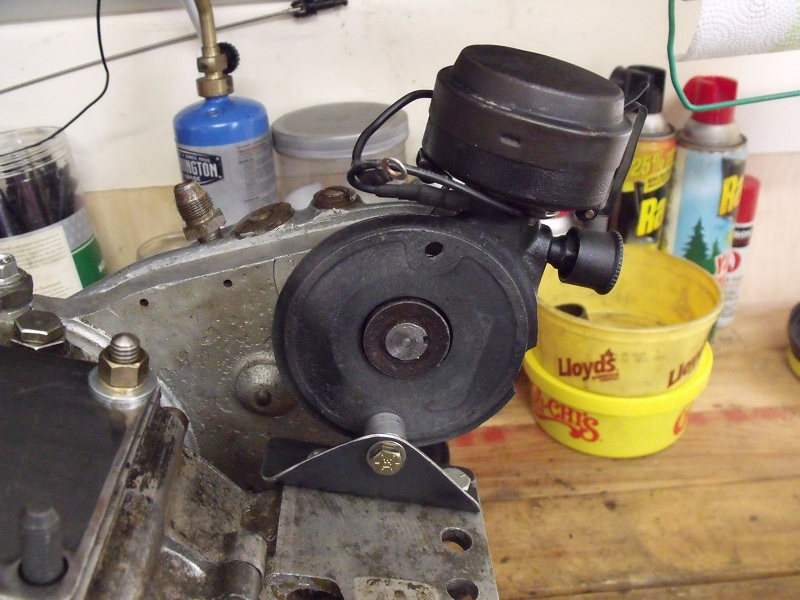
When the crankshaft returned from Jim's shop, final assembly was pretty easy. I modified a set of rockers to just work on the front cylinder cam lobes and made a plate to cover the missing cylinder. George Hood sent me a prototype rocker tower, with a longer rocker. This setup lets the engine breathe a little better. The generator was modified, eliminating the armature. The timer points cam was modified to fire only on the front cylinder. The ignition is now powered by small 12-volt battery firing through a modern coil.
Modified Generator/Timer Case

Within a few weeks, I the engine installed in a street frame, and fired it up for the first time:

YouTube video of the initial start up:


The next problem was the carburetor. I originally used a modified V twin intake, which had the carburetor come out on the right side of the engine. The original Model J twin cylinder engine used a one-inch bore Schebler carburetor. After the initial runs, I realized it needed to be changed to a smaller 3/4" bore Schebler. I found a guy, who had one, and we worked a trade.


Modified Intake & Ignition

The motor ran better with the smaller carburetor, but still had some problems running properly at full throttle. It was then I realized I had an intake air leak, where the carburetor intake attaches to the cylinder head. This is a common problem, and it took a little effort to fix. I turned a straight aluminum intake, and rubber mounted it to the cylinder. This is not period correct, but it allowed the motor to run better at all throttle setting.

I recently switched to a Linkert M741-1 carburetor from and Indian Jr. Scout. The Linkert features separate high and low speed adjustable needles, where the Schebler had only a single needle to adjust the fuel mixture at all throttle settings. This was a great improvement, that allows the engine to run well at both high, and low speed throttle setting.

Linkert 741-1 Carburetor with modified Rubber Mounted Intake

Stay tuned for Part 2
Assembling a Keystone Racing Chassis

Friday, October 26, 2012

Controversial 1914 Birmingham, AL. F.A.M. Race - Episode #7

October 26, 2012
Updated - March 3, 2015

By: David L. Morrill

@ Deadly Dave's Blog
Sylacauga, Alabama


American Iron Magazine - 2013

A special thank you to Buzz Kanter, and the staff of American Iron Magazine, for including this article in their American Glory Special Edition celebrating Harley-Davidson's 110th anniversary.

This story started with a trip to my local Harley-Davidson dealer a few months back. Harley is now selling early racing photographs from their achieves, and the local dealer had several framed board track photos for sale. I picked up a photo of Otto Walker taken after his win at Venice, California in April 1915.

Harley-Davidson Motor Company Archive

The small plaque on the photo claimed this was Harley-Davidson's first Championship win. That was a little surprising, as I had heard of at least one earlier Championship Race win.  I figured it was time to share a small and almost forgotten piece of Harley-Davidson's history.


1914 Harley-Davidson 11-K Racer (left)
Stripped Stock Model (right)


1914 was a pivotal year for Harley-Davidson. Although long opposed to Championship racing, the factory changed course.  They hired engineer William "Bill" Ottaway to develop their production v twin engine for racing. The result was the Harley- Davidson 11-K racer.

Harley-Davidson 11-K Racer
Leslie "Red" Parkhurst was the first rider hired by the Harley Davidson factory in 1914 to ride the new racer. By July, the racer was ready for its first big test, the Dodge City 300-Mile Road Race in Dodge City, Kansas. Parkhurst was one of six team members sent by the factory to compete in the Dodge City 300 that year. The new racers were fast, but only two of six were running at the end of the race.

Leslie "Red " Parkhurst

Daniel Statnekov Collection
On October 5, 1914, Red Parkhurst lined up for the Federation of American Motorcyclists (FAM) One Hour Championship Race held at the Alabama State Fairgrounds Raceway in Birmingham, Alabama.  Parkhurst was riding one of Bill Ottaway's factory prepared 11-K racers. Parkhurst was assisted in his pit by the new Birmingham Harley-Davidson dealer William F. Specht Jr., along with Johnny Aiken.

1914 Harley- Davidsons - Specht's Harley- Davidson Birmingahm, AL.
O. V. Hunt Collection

Specht, who was also a racer, had relocated to Birmingham from Atlantic City, New Jersey. In early 1914, he opened a Harley-Davidson dealership in Cliff Howell's bicycle shop in downtown Birmingham. The arrival of the first wagon load of 1914 Harley-Davidsons in Birmingham was documented by local photographer and motorcycle enthusiast O.V. Hunt.


In the Birmingham race, Parkhurst's chief competition was Excelsior factory rider Joe Wolters. The Birmingham Indian dealer Bob Stubbs sponsored two local racers, Gail Joyce and Gene Walker. Joyce was the more experienced of the two, having won several Southern Series races outside Birmingham. Walker had made a name for himself in the amateur ranks at the Birmingham track, but this would be his first professional race.

Alabama State Fairgrounds Raceway
O.V. Hunt 1914 - Birmingham Public Library Archives

As the race started, Gene Walker jumped into the lead setting a new track record. Parkhurst was running second, followed by Wolters.  On the third lap, Parkhurst passed Walker for the lead. Walker was later passed by Wolters. Parkhurst built a considerable lead over Walker, Wolters, and Gail.  On lap 33, a fuel problem forced Parkhurst to into the pits.

Red Parkhurst
Daniel Statnekov Collection

In the Harley-Davidson pit, Specht and Aiken refueled Pankhurst's axillary fuel tank. Parkhurst attempted to clean his oil and dirt covered goggles with a handkerchief he kept tied to his handlebars. The handkerchief was also covered with oil and dirt, so Parkhurst asked a spectator for a clean handkerchief. The spectator enthusiastically provided a handkerchief, and assisted Parkhurst with cleaning his goggles. Parkhurst rejoined the race, and when the flag was thrown to end the race, he was leading Joe Wolters by half a lap. Indian rider Gene Walker took the lead at the beginning of the race, setting a new track record, and finished 3rd. Shortly after the race, Walker's Indian teammate, Gail Joyce, filled an official protest, claiming the spectator in the pits had improperly aided Parkhurst.

The results of the race were not settled until the following week at the Chicago Motorcycle Show. On Tuesday of the show, Joe Wolters approached FAM Chairman John L. Donovan claiming he was due another lap at Birmingham. He claimed he had finished a half a lap ahead of Parkhurst.

The October 27, 1914, issue of Bicycling World and Motorcycle Review quoted Chairman Donovan's finding on the two Birmingham race protests. In disallowing Joyce's protest, Chairman Donovan stated:

"Safety requires that competitors in races shall be permitted to see what they are doing. It certainly would be ridiculous to disqualify Parkhurst because he permitted someone to assist him in wiping the oil and dirt off his goggles. Parkhurst clearly is entitled to the victory."

Concerning Joe Wolters' late protest, Chairman Donovan stated:

"Of course, the rules require that protests shall be made within a half-hour after the close of the race. The rules would not permit official consideration of additional points not included in the original protest. But courtesy required that I should wire for information, and I did so. It is perfectly clear that Parkhurst won the F. A. M. hour championship fairly and squarely."

With the protests settled, Parkhurst was awarded the trophy and his winnings on the second day of the Chicago show.  Shortly after the decision was announced, a large sign proclaiming Parkhurst's victory on a "stripped stock Harley-Davidson against ported and eight valve machines," appeared behind the 11-K Harley-Davidson on display at the show. Parkhurst's win went on be the center piece of Harley-Davidson's advertising for the upcoming 1915 model.

Was the 1914 Birmingham Championship Race win the first for a Harley-Davidson factory rider on a factory prepared bike? I'll leave that one to the experts. The one/two finish of factory riders Otto Walker and Red Parkhurst in the 1915 Venice race was a more prestigious win against stiffer competition. But Parkhurst's Birmingham win may have paid a much more import role in Harley-Davidson history and opened the door for the Venice win months later.

Harley Davidson founders William Harley and William Davidson attended the July 1914 Dodge City 300 Road Race.  They made it clear in post-race comments; their intention was to provide factory prepared machines to select dealer supported riders. It appears; they had no intention of a full factory supported racing team. The publicity surrounding Parkhurst's Birmingham win may have changed their minds. In November 1914 they sent a factory supported race team to compete in the Savannah 300 Road Race in Savannah, Georgia.

This was the beginning of the famed Harley-Davidson Racing Team, which came to be known as "The Wrecking Crew." Parkhurst's 1914 Birmingham win may have opened the door for creation of a fully factory supported racing team. The Harley-Davidson Factory Racing Team continues to compete today and is one of the longest running and most successful racing teams in the country.


Leslie "Red" Parkhurst continued to ride for Harley-Davidson through 1921 His most prestigious win came at the 1919 Marion, Indiana 200-Mile Road Race. Parkhurst retried from professional racing in 1921 but continued to race occasional events through 1924.

Reading, PA. Times - November 6, 1919

There was another participant, who benefited greatly from his finish in the 1914 Birmingham race. Gene Walker, the young local rider who finished fifth that day, was hired by the Indian factory in Springfield, Massachusetts. Walker went on to become one of the greatest riders of his time. In 1920, Motorcycling and Bicycling Magazine proclaimed Gene Walker "Champion of Champions."


Don Emde Collection

Motorcycle racing historian and 1972 Daytona 200 winner Don Emde provided this Gene Walker race poster from his collection. For more information on Gene Walker's career, please check out my article:

Gene Walker, Birmingham's Lost Racing Champion: 

http://dlmracing.blogspot.com/2012/07/gene-walker-birminghams-lost-racing.html


Sources:

Birmingham, Alabama Public Library Archives

Chris Price@Georgia Motorcycle History

Don Emde Collection

Motorcycling and Bicycling

Daniel Statnekov Collection - Pioneers of American Motorcycle Racing: 
http://www.statnekov.com/motorcycles/index.html

Johnny Whitsett Collection

Reading, PA. Times

Parkhurst Family Webpage:

http://www.parkhurstfamily.org