Showing posts with label Cliff Howell. Show all posts

Monday, May 06, 2013

1914 & 1915 Birmingham Ledger Endurance Races - Episode #12

May 6, 2013
Updated - November 11, 2015

By: David L. Morrill
@ Deadly Dave's Blog
Sylacauga, Alabama


1914 Indian Poster
Scott Bashaw Collection

Several years ago, my friend Johnny Whitsett sent me some early motorcycling photographs taken in Birmingham, Alabama by Oscar V. Hunt. As a professional photographer, Mr. Hunt documented many sporting events in the early years of Birmingham.  He was also a motorcycle enthusiast, and close friend of the Birmingham Indian Motorcycle dealer, Bob Stubbs. Among that group of photos, were several that featured Harley-Davidson and Indian riders that were taken in downtown Birmingham in 1914. They document some type of endurance motorcycle race, but the information about the race had been lost over the last 100 years.

The Birmingham Ledger newspaper sponsored several early motorcycle events in Birmingham, but I had never seen any information on this event. Recently early motorcycle collector Scott Bashaw shared an Indian Motorcycle Company promotional poster that touts Indian's domination of a Birmingham Ledger Speed and Endurance Run. I figured this might just be the race where these photos were taken and set out to see what I could find.


Scott's poster does not list the year, but one of O.V. Hunt's photos taken in 1914 shows a group of riders in front of the Birmingham Ledger Office at 2027 1st Avenue North.


1914 Birmingham Ledger Southern Championship Endurance Race

Motorcycle endurance runs, which were held on public roadways, were popular throughout the South beginning in the early days of motorcycling. They were often runs made between cities, to establish, or break record run times. In 1910, Birmingham Indian Motorcycle dealer Bob Stubbs set a record riding from Birmingham to Atlanta, Georgia in 7 hours and 5 minutes.


1914 Race Contestants at the Birmingham Ledger Office
O.V. Hunt 1914 - Johnny Whitsett Collection

In June 1914, The Federation of American Motorcyclists announced the three-day Southern Championship Endurance Road Race to be held on July 4th, 5th, and 6th. starting in in Birmingham, Alabama. The race was sponsored by the Birmingham Ledger Newspaper, and took place on public roadways between Birmingham, Alabama and Atlanta, Georgia.

Birmingham's Bob Stubbs would lead the Indian team out of his dealership located at 1805 4th Avenue North in Birmingham. Stubbs was joined by his team riders Gail Joyce, and Gene Walker, and John McHale. All three were from Birmingham. Joyce and Walker were making names for themselves riding Indian racers provided by Stubbs on the one-mile dirt oval at the Alabama State Fairgrounds in Birmingham. They were joined by Atlanta Indian rider Ed Wilcox, who had competed in the grueling 5-hour 1913 Savannah 300 Grand Prize Road Race.

The Harley-Davidson Team included Mooresville, NC. rider Gray Sloop, who had also competed in the 1913 Savannah 300 Road Race. He was joined by Atlanta riders Johnny Aiken, and R.B. Parrish. Aikens had been seriously injured during practice for the 1913 Savannah 300, when he crashed into a tree. Aikens had recovered from his injuries and was fit to ride. They were considered three of the best endurance riders in the country.

Atlanta's Johnny Aiken
O.V. Hunt 1914 - Johnny Whitsett Collection
Birmingham's William F. Specht Jr. rounded out the factory team. Specht, an accomplished racer and Harley-Davidson dealer from New Jersey, had recently moved to Birmingham. He opened his Birmingham dealership in Cliff Howells bicycle shop on 3rd Avenue North.

In mid-June 1914, William Specht and Joe Esdale did a test run of the racecourse for the July 4th race. Both riders arrived in Atlanta on time, and without incident. The next morning, they left Atlanta for the return trip to Birmingham.

They were accompanied by Atlanta Harley-Davidson dealer Johnny Aiken. The return runs of Esdale, and Aiken, were slowed by flat tires. Specht arrived back in Birmingham at 4:00pm. repeating the previous day's perfect run. Esdale and Aiken, were delayed slightly by their tire problems, but arrived back in Birmingham without further incident.


Specht Harley-Davidson Dealership Birmingham, Al.
Johnny Aiken - William F. Specht, Jr. - Gray Sloop
O.V. Hunt 1914 - Johnny Whitsett Collection
                                                                                                                                                                                                                                                                                                                                                                                                                                                                               
A total of 31 riders paid the $5.00 entry fee, and drew a number, to determine their start time. There was a $500.00 cash prize for the winning rider. There were also two "splendid" cups, one for the individual winner, and one for the winning team. 

The riders lined up at the Start/Finish line in front of the Birmingham Ledger Office at 4:00 AM on July 4th for the start of the race. The riders were sent out individually at two-minute intervals. The 211-mile course would have control points at Gadsden, Al. and Rome, GA. 

Birmingham, AL. Starting Line
O. V. Hunt 1914 - Birmingham, AL. Public Library Archives 

The only serious incident happened just outside Gadsden, Alabama, when William Specht collided with Gadsden rider Will Alford. Initial reports stated Specht had been disemboweled and probably will die. This was reported in the Birmingham News, a competitor with the Birmingham Ledger, and proved to be a gross exaggeration Specht's injury.

Birmingham News - July 7, 1914

It was left to a Harley-Davidson spokesman to squash the rumor of Specht's impending death. In reality, Specht was not badly hurt, but both bikes were destroyed. Specht, and Alford were unable rejoin the race.

There was a one-hour lunch break at the Rome, Ga. control point.  As the rider's left Rome, headed to Atlanta, they had no idea of the challenges they met. There were three mountains to cross on the way into Atlanta. If that wasn't enough of a challenge, torrential rains began falling as the approached the Altoona pass, with it's three hairpin turns. A total of 21 riders, wet and tired riders, crossed the Atlanta start/finish line in front of Atlanta's Piedmont Hotel. Eighteen riders arrived on time, with three others 10 to 20 minutes late.

At the end of the first leg, eight Harley-Davidson riders had perfect scores. These included Gray Sloop, Johnny Aiken, and Red Parrish. Gray Sloop made the run in 6 hours, breaking the 1910 record set by Bob Stubbs' on his Indian, by over an hour.

Atlanta Constitution - July 5, 1914

They were followed by Indian riders Bob Stubbs, Gene Walker, and Gayle Joyce, who also had perfect scores. Their Indian teammate Brown had been forced out near Carterville by mechanical problems.

On July 5th, the race contestants reversed course returning to Birmingham from Atlanta.


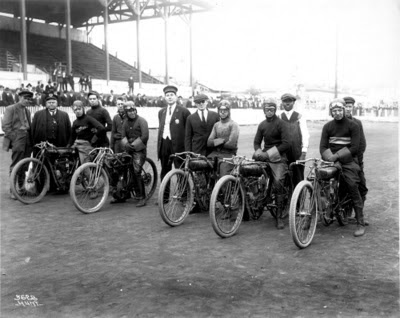
Race Competitors
O. V. Hunt 1914 - Birmingham, AL. Public Library Archives

Upon arrival in Birmingham, the Harley-Davidson Team claimed the Indian Team was followed "by an automobile, with spare parts, and skilled mechanics".  They also claimed one of the Indian riders received help from the mechanics following their team in violation of the event's rules. The Harley-Davidson Team filed a protest with the referee, but the referee ruled against them.

The decision was made that the Harley-Davidson team riders would not compete in Sunday's return to run to Atlanta. Harley-Davidson ran several ads in the Atlanta Constitution, which were picked up by newspapers around the country, to explain their position.


Atlanta Constitution - July 5, 1914
Atlanta Constitution - July 8, 1914
Chicago Daily Tribune - July 26, 1914

Wheels Through Time Museum Collection
Photo by Chris Price of Georgia Motorcycle History


With the withdrawal of the Harley-Davidson Team, the remaining two days of the race were dominated by the Indian riders.  At the end of the 860-mile run, the Birmingham Indian team had dominated the race.
Gail Joyce - Birmingham, AL. 1914 - Indian
O.V. Hunt Collection


Gail Joyce won the race, with his teammates Gene Walker in second, and Johnny McHale in third.  Bob Stubbs was among the six Indian riders that finished the race without mechanical problems.

Robert Stubbs - Gadsden, AL. ca 1914
Robert Scarboro Collection
Gadsden, Alabama Public Library Archives 

Johnny McHale - Birmingham 1914
O.V. Hunt - Birmingham, AL. Public Library Archive
Christine Turner Collection


In response to the ads run by Harley-Davidson in the Atlanta Constitution, the Indian Motocycle Company ran their own ad after the race was completed.


Atlanta Constitution - July 8, 1914


Motorcycle Illustrated - July 9, 1914

The controversy over the race results was settled by a telegram from Birmingham Ledger Editor B. H. Mooney that appeared in the Sports section of the July 8, 1914, Atlanta Constitution Newspaper confirming Indian riders had won the race. Gail Joyce was the winner, followed by Gene Walker in second, and John McHale in third.


Atlanta Constitution - July 9, 1914

1914 Birmingham Ledger Indian Team trophy
T. McClellan Collection

Atlanta Constitution July 12, 1914

1915 Birmingham Ledger Cup Race


Birmingham Ledger - April 3, 1915

Despite the controversy surrounding the results of the 1914 race, another race was scheduled for Easter Sunday, April 4, 1915. The 422 mile Birmingham Ledger Cup Race followed the same route between Birmingham and Atlanta as the 1914 race. Unlike, the 1914 race, that started at 3:00 am, the 1915 race started at the more civilized hour of 10:00 am.  Both Harley-Davidson, and Indian, entered two teams each in the race.

Birmingham Harley-Davidson Team #1:

William Specht, Willard E. DeGroat.

Atlanta Harley-Davidson Team #2:

Johnny Aiken, Wilmer "Tex" Richards, H.P. Buttrick, R. B. Parrish.

Birmingham Indian Team #1:

Bob Stubbs, Ollie Roberts, Robert Horton, John T. McHale.

Atlanta Indian Team #2:

Ed Wilcox, Harry Glenn, Berry Cohen.

On Easter Sunday morning, 24 riders lined up in front of the Birmingham Ledger Office and were again sent out at 2-minute intervals. Remarkably, at the end of the first days run from Birmingham to Atlanta, 22 of the riders arrived in Atlanta with a perfect score.

Atlanta Constitution - April 5, 1915

Atlanta Harley-Davidson rider, Johnny Aiken, was the first rider to arrive at the final check point. Aiken set a new record for the run between Birmingham and Atlanta in 5 hours and 30 minutes. This broke the previous record by half an hour. The only incident was a crash outside Rome, Georgia involving Birmingham Harley-Davidson rider W. E. DeGroat, who was an accomplished local racer, having won the professional sidecar race October held at the Alabama State Fairgrounds Raceway on October 7, 1914.

Willard E. "Big Daddy" DeGroat  of Birmingham, AL.
1915 Birmingham Ledger Race - Gadsden, AL. - 1915
Gadsden Alabama Public Library Archives - Robert Scarboro Collection

Birmingham Ledger - April 10, 1915

At the end second days run from Atlanta, back to Birmingham, W.E. DeGroat appeared to have shaken off his crash the day before. When the scores were tallied, DeGroat was tied with Indian rider D. H. Horton for first place. 

Birmingham ledger - April 7, 1915


The Team Prize was awarded Indian Team #1 consisting of Stubbs, Horton, and Roberts. It was decided the individual race winner was to be decided by the run back to Atlanta starting at 5:30 am. on Tuesday April 6th, but this was later changed to 5:30 am Friday April 9th.

Friday morning, DeGroat lined up at the starting line, but Horton failed to show for the return run. DeGroat filed a protest, asking to be awarded the win, due to a forfeit by Horton. After waiting a reasonable amount of time for Horton to arrive, the event referee declared DeGroat the winner.

Bob Stubbs filed a protest for Horton. Stubbs stated Horton had been instructed by the referee not to show up for the return run, due to DeGroat's protest. It was left to the State Referees, who reviewed both protests.


Birmingham Ledger - April 7, 1915

In a meeting at the Ledger Offices on the evening of April 9th, the judges awarded the individual prize, and the Birmingham Ledger Cup to DeGroat. Upon hearing of the judge's ruling, Horton sent a note to them withdrawing the protest filed on his behalf. He also asked that the individual prize be awarded to DeGroat.

Willard E. DeGroat - 1915
Specht's Harley-Davidson - Birmingham, AL.
Jessica DeGroat Hayes Collection

Birmingham Ledger - April 10, 1915


Atlanta Constitution - April 10, 1915


DeGroat's win  appeared in a Harley-Davidson ad in the Atlanta Constitution.

Atlanta Constitution - April 11, 1915

Stubb's Indian Ad
Birmingham Ledger - April 1915


Atlanta Constitution - April 25, 1915

With the results of the 1915 race decided, the score between Harley-Davidson, and Indian, stood at one individual win, and two team wins for Indian. Harley-Davidson claimed one individual win. The results of both the 1914, and 1915 races were a point of contention between Indian and Harley-Davidson riders, for years to come, as each claimed to have been cheated. As America's involvement in World War 1 approached, the 1915 race was the final running of the Birmingham Ledger Cup Race.

The 1914 and 1915 Birmingham Ledger Cup Races were just two small skirmishes in the ongoing competition between the Indian, and Harley-Davidson companies, for sales dominance in the American motorcycle market. This competition continued on roads, racetracks, and dealerships for years to come. It finally came to an end when Indian closed its doors in 1953.

Epilogue: 


Gray Sloop, was one of two riders, killed in separate accidents during the Savannah 300 Road Race on November 25, 1914.  

Bob Stubbs, closed his Birmingham Indian dealership in 1918, and taking a job in Montgomery, AL. He died of cancer in 1922.

William F. Specht Jr. closed his Birmingham Harley-Davidson dealership, and returned to Atlantic City, NJ. He became a successful hill climb competitor for Harley-Davidson. 

Gail Joyce, the 1914 race winner, continued his successful racing career.  Joyce opened the Joyce Motor Company in Birmingham in 1918. He owned the Birmingham Harley-Davidson dealer until his death in 1934.

Gene Walker , who finished 2nd in the 1914 race, was hired as an Indian factory rider in 1915. Walker became one of the top motorcycle racers in the country. He was killed in a racing accident in 1924.

Johnny Aiken, who competed in both the 1914 and 1915 races, continued to work in Atlanta Harley-Davidson dealer Gus Castle, until he enlisted in the Army at the start of World War 1. He served overseas as a 1st Lieutenant in a Motorcycle Dispatch Company and remained in the Army until 1920. Upon his return to Atlanta after the war, he made the switch to automobile racing, and became one of the top drivers at Atlanta's Lakewood Speedway.

Ed Wilcox, who competed in both the 1914 and 1915 races, was killed in a racing accident at Atlanta's Lakewood Speedway in 1917. He was attempting to take the lead from Gene Walker on the first lap of the race. He lost control and crashed into the fence on the outside of the track.

Willard E. "Big Daddy" DeGroat, winner of the 1915 race, later joined the Birmingham Police Department He attained the rank of Detective and served in the Homicide until he retired in 1945. He passed away in Birmingham in 1965 at age 75.

The Birmingham Ledger was purchased by their competitor The Birmingham News in 1920 and ceased publication later that year. The Birmingham News is Birmingham's newspaper.


Charlotte, NC. Observer - April 18, 1920

Sources:

Ancestry.com

Atlanta Constitution

Birmingham Public Library Archive - O. V. Hunt Collection

Birmingham News

Charlotte, NC. Observer

Chicago Daily Tribune

Chris Price

Gadsden Alabama Public Library Archive - Robert (Bobby) Scarboro Collection

Georgia Motorcycle History

Jessica DeGroat Hayes

Johnny Whitsett Collection

Indianapolis Star

Motorcycle Illustrated

Newspapers.com

Robert (Bobby) Scarboro Collection - Gadsden Public Library Archives

Scott Bashaw Collection

Wheels Through Time Museum Collection

Tuesday, April 02, 2013

Harley-Davidson Comes to Birmingham, AL. - Episode #10

April 2, 2013
Updated - March 2, 2022

By: David L. Morrill

@ Deadly Dave's Blog
Sylacauga, Alabama


Specht Harley-Davidson 1714 3rd Avenue North - Birmingham, AL.
L to R - J. Aiken, W. Specht Jr., Gray Sloop
O.V. Hunt 1914 - Johnny Whitsett Collection

In the early teens, motorcycles were a popular form of transportation in Birmingham. Many businesses in town used them for moving goods or providing services to the growing city. Motorcycles were also raced on the one-mile oval dirt track at the Alabama State Fairgrounds beginning in 1906.

In early 1914, Atlantic City Harley-Davidson dealer and racer William F. Specht Jr. moved to Birmingham and opened the first Harley-Davidson dealership in Cliff Howell's bicycle shop at 1714 3rd Avenue North. The opening of the dealership was explained in an article in the Atlanta Constitution newspaper.


Atlanta Constitution - March 29, 1914

The first wagon load of Harley-Davidsons that arrived in Birmingham was captured by photographer O. V. Hunt. Specht Harley-Davidson was located across the street from Bob Stubbs’ Indian dealership, and they would be rivals for the next few years.


1914 Harley-Davidsons arrive in Birmingham  
O.V. Hunt 1914 - Johnny Whitsett Collection


Interior of Specht Harley-Davidson - ca. 1914


During the 1914 Southern Series, Specht and his friend and fellow Harley-Davidson dealer/rider Sloop Gray of Mooresville, North Carolina won races at Meridian, MS., Anniston, AL. and Charleston, SC. They were featured Charleston, SC. They were featured in a Harley-Davidson factory ad in the September 22, 1914, issue of The Bicycling World and Motorcycle Review.


In October, Specht got a chance to challenge his rival Bob Stubbs at the Fairgrounds Raceway. Harley-Davidson factory rider Red Parkhurst beat several of Stubbs' young riders and won the F.A.M. One Hour Championship Race on the new 11-K racer.

Harley-Davidson 11K Racer (Left)
Stripped Stock Model (Right)

The Birmingham win went down as Harley-Davidson's first Championship race win and played a key part in their advertising for the 1915 model. 


1915 Harley-Davidson Ad

A letter from Specht praising the new Harley-Davidson model appeared in a full-page ad.


By October 1915, Specht Harley Davidson had moved to a new location at 310 North 17th Street.


Birmingham News - October 9, 1915
By January of 1917, the dealership had changed names to the Harley Davidson Sales Company of Birmingham, and again relocated to 1616 Third Avenue North. They were regularly advertising in publications like Popular Mechanics selling Harley-Davidson, Indian, Excelsior, Pope, Merkel, and Henderson Motorcycles.

In December 1917, an article, and photograph, appeared in Motorcycle and Bicycle Illustrated which announced the Birmingham dealership at 1616 Third Avenue North had been taken over by Charles A. Merkel of Rochester, NY.

Motorcycle and Bicycle Illustrated - December 20, 1917

Motorcycle and Bicycle Illustrated - December 27, 1917

Motorcycle dealerships throughout the country were hit hard by the shortages of new motorcycles and parts caused by America’s involvement in World War 1. Merkel's Harley-Davidson Sales Company survived the war, but he closed the dealership in 1919. 

William F. Specht Jr. returned to New Jersey and became a top contender in National Championship Hill Climb events throughout the Northeast. 


In early 1919, Gail Joyce opened the Gail Joyce Motor Company at 1709 3rd Avenue North in Birmingham. 

Gail Joyce Motor Company - Birmingham, AL. ca. 1931
Birmingham, Alabama Public Library Archives - O.V. Hunt Collection

Although the record is a little spotty, it appears he handled both Indian, and Harley-Davidson motorcycles until his death in 1934. 

Birmingham News - November 26, 1934

His family took over the business and were still the Birmingham Harley-Davidson dealer in the early 1950s.

Sources:

Atlanta Constitution

Bicycling World and Motorcycle Review

Birmingham Alabama Public Library Archives 

Birmingham News

Johnny Whitsett Collection

Motorcycle and Bicycle Illustrated

O. V. Hunt Collection


Friday, October 26, 2012

Controversial 1914 Birmingham, AL. F.A.M. Race - Episode #7

October 26, 2012
Updated - March 3, 2015

By: David L. Morrill

@ Deadly Dave's Blog
Sylacauga, Alabama


American Iron Magazine - 2013

A special thank you to Buzz Kanter, and the staff of American Iron Magazine, for including this article in their American Glory Special Edition celebrating Harley-Davidson's 110th anniversary.

This story started with a trip to my local Harley-Davidson dealer a few months back. Harley is now selling early racing photographs from their achieves, and the local dealer had several framed board track photos for sale. I picked up a photo of Otto Walker taken after his win at Venice, California in April 1915.

Harley-Davidson Motor Company Archive

The small plaque on the photo claimed this was Harley-Davidson's first Championship win. That was a little surprising, as I had heard of at least one earlier Championship Race win.  I figured it was time to share a small and almost forgotten piece of Harley-Davidson's history.


1914 Harley-Davidson 11-K Racer (left)
Stripped Stock Model (right)


1914 was a pivotal year for Harley-Davidson. Although long opposed to Championship racing, the factory changed course.  They hired engineer William "Bill" Ottaway to develop their production v twin engine for racing. The result was the Harley- Davidson 11-K racer.

Harley-Davidson 11-K Racer
Leslie "Red" Parkhurst was the first rider hired by the Harley Davidson factory in 1914 to ride the new racer. By July, the racer was ready for its first big test, the Dodge City 300-Mile Road Race in Dodge City, Kansas. Parkhurst was one of six team members sent by the factory to compete in the Dodge City 300 that year. The new racers were fast, but only two of six were running at the end of the race.

Leslie "Red " Parkhurst

Daniel Statnekov Collection
On October 5, 1914, Red Parkhurst lined up for the Federation of American Motorcyclists (FAM) One Hour Championship Race held at the Alabama State Fairgrounds Raceway in Birmingham, Alabama.  Parkhurst was riding one of Bill Ottaway's factory prepared 11-K racers. Parkhurst was assisted in his pit by the new Birmingham Harley-Davidson dealer William F. Specht Jr., along with Johnny Aiken.

1914 Harley- Davidsons - Specht's Harley- Davidson Birmingahm, AL.
O. V. Hunt Collection

Specht, who was also a racer, had relocated to Birmingham from Atlantic City, New Jersey. In early 1914, he opened a Harley-Davidson dealership in Cliff Howell's bicycle shop in downtown Birmingham. The arrival of the first wagon load of 1914 Harley-Davidsons in Birmingham was documented by local photographer and motorcycle enthusiast O.V. Hunt.


In the Birmingham race, Parkhurst's chief competition was Excelsior factory rider Joe Wolters. The Birmingham Indian dealer Bob Stubbs sponsored two local racers, Gail Joyce and Gene Walker. Joyce was the more experienced of the two, having won several Southern Series races outside Birmingham. Walker had made a name for himself in the amateur ranks at the Birmingham track, but this would be his first professional race.

Alabama State Fairgrounds Raceway
O.V. Hunt 1914 - Birmingham Public Library Archives

As the race started, Gene Walker jumped into the lead setting a new track record. Parkhurst was running second, followed by Wolters.  On the third lap, Parkhurst passed Walker for the lead. Walker was later passed by Wolters. Parkhurst built a considerable lead over Walker, Wolters, and Gail.  On lap 33, a fuel problem forced Parkhurst to into the pits.

Red Parkhurst
Daniel Statnekov Collection

In the Harley-Davidson pit, Specht and Aiken refueled Pankhurst's axillary fuel tank. Parkhurst attempted to clean his oil and dirt covered goggles with a handkerchief he kept tied to his handlebars. The handkerchief was also covered with oil and dirt, so Parkhurst asked a spectator for a clean handkerchief. The spectator enthusiastically provided a handkerchief, and assisted Parkhurst with cleaning his goggles. Parkhurst rejoined the race, and when the flag was thrown to end the race, he was leading Joe Wolters by half a lap. Indian rider Gene Walker took the lead at the beginning of the race, setting a new track record, and finished 3rd. Shortly after the race, Walker's Indian teammate, Gail Joyce, filled an official protest, claiming the spectator in the pits had improperly aided Parkhurst.

The results of the race were not settled until the following week at the Chicago Motorcycle Show. On Tuesday of the show, Joe Wolters approached FAM Chairman John L. Donovan claiming he was due another lap at Birmingham. He claimed he had finished a half a lap ahead of Parkhurst.

The October 27, 1914, issue of Bicycling World and Motorcycle Review quoted Chairman Donovan's finding on the two Birmingham race protests. In disallowing Joyce's protest, Chairman Donovan stated:

"Safety requires that competitors in races shall be permitted to see what they are doing. It certainly would be ridiculous to disqualify Parkhurst because he permitted someone to assist him in wiping the oil and dirt off his goggles. Parkhurst clearly is entitled to the victory."

Concerning Joe Wolters' late protest, Chairman Donovan stated:

"Of course, the rules require that protests shall be made within a half-hour after the close of the race. The rules would not permit official consideration of additional points not included in the original protest. But courtesy required that I should wire for information, and I did so. It is perfectly clear that Parkhurst won the F. A. M. hour championship fairly and squarely."

With the protests settled, Parkhurst was awarded the trophy and his winnings on the second day of the Chicago show.  Shortly after the decision was announced, a large sign proclaiming Parkhurst's victory on a "stripped stock Harley-Davidson against ported and eight valve machines," appeared behind the 11-K Harley-Davidson on display at the show. Parkhurst's win went on be the center piece of Harley-Davidson's advertising for the upcoming 1915 model.

Was the 1914 Birmingham Championship Race win the first for a Harley-Davidson factory rider on a factory prepared bike? I'll leave that one to the experts. The one/two finish of factory riders Otto Walker and Red Parkhurst in the 1915 Venice race was a more prestigious win against stiffer competition. But Parkhurst's Birmingham win may have paid a much more import role in Harley-Davidson history and opened the door for the Venice win months later.

Harley Davidson founders William Harley and William Davidson attended the July 1914 Dodge City 300 Road Race.  They made it clear in post-race comments; their intention was to provide factory prepared machines to select dealer supported riders. It appears; they had no intention of a full factory supported racing team. The publicity surrounding Parkhurst's Birmingham win may have changed their minds. In November 1914 they sent a factory supported race team to compete in the Savannah 300 Road Race in Savannah, Georgia.

This was the beginning of the famed Harley-Davidson Racing Team, which came to be known as "The Wrecking Crew." Parkhurst's 1914 Birmingham win may have opened the door for creation of a fully factory supported racing team. The Harley-Davidson Factory Racing Team continues to compete today and is one of the longest running and most successful racing teams in the country.


Leslie "Red" Parkhurst continued to ride for Harley-Davidson through 1921 His most prestigious win came at the 1919 Marion, Indiana 200-Mile Road Race. Parkhurst retried from professional racing in 1921 but continued to race occasional events through 1924.

Reading, PA. Times - November 6, 1919

There was another participant, who benefited greatly from his finish in the 1914 Birmingham race. Gene Walker, the young local rider who finished fifth that day, was hired by the Indian factory in Springfield, Massachusetts. Walker went on to become one of the greatest riders of his time. In 1920, Motorcycling and Bicycling Magazine proclaimed Gene Walker "Champion of Champions."


Don Emde Collection

Motorcycle racing historian and 1972 Daytona 200 winner Don Emde provided this Gene Walker race poster from his collection. For more information on Gene Walker's career, please check out my article:

Gene Walker, Birmingham's Lost Racing Champion: 

http://dlmracing.blogspot.com/2012/07/gene-walker-birminghams-lost-racing.html


Sources:

Birmingham, Alabama Public Library Archives

Chris Price@Georgia Motorcycle History

Don Emde Collection

Motorcycling and Bicycling

Daniel Statnekov Collection - Pioneers of American Motorcycle Racing: 
http://www.statnekov.com/motorcycles/index.html

Johnny Whitsett Collection

Reading, PA. Times

Parkhurst Family Webpage:

http://www.parkhurstfamily.org