Showing posts with label Arthur Chapple. Show all posts

Sunday, November 01, 2015

Twice Around the Clock at the Stadium Motordrome - Episode #37

November 1, 2015

By: David L. Morrill
@MototiqueRacing
Sylacauga, Alabama

Motorcycle Illustrated - October 3, 1912

By the fall of 1912, an exciting new sport was sweeping the country. Motordrome racing featured top motorcycle racers from around the country competing on steeply banked circular board tracks, called "Saucer" tracks for their round shape. Motordromes were built in major cities across the country and were typically 1/4 to 1/3 of a mile in length. They could seat crowds of up to ten thousand spectators in bleachers that surrounded the top of the tracks, and electric lighting allowed night racing.  The best motorcycle racers in the country were hired to race on them.

New York City boasted two of the new Motordromes just a short distance from the city. The Vailsburg Park Motordrome was in Newark, New Jersey, and the Stadium Motordrome was located in Brighton Beach, New York. These tracks were popular and drew large crowds to races held several days a week.

Motorcycle Illustrated - September 1912

That changed on September 8, 1921, when popular racers Eddie Hasha, and Johnny Albright, were killed, along with six spectators in a crash at the Vailsburg Park Motordrome in Newark.

New York Times - September 9, 1912

Newark City Father's quickly closed the track and banned motorcycle racing from the city. The Brighton Beach track stayed closed for a week in respect to the deaths of the spectators, and the two riders, who had also regularly competed at the Brighton Beach track.

Stadium Motordrome - Brighton Beach, New York
Library of Congress Collection

When the Stadium Motordrome reopened a week later, it was announced that a "Twice Around the Clock"  24 hour motorcycle race would be held at the track on September 20-21. The purse was a $5500, with the winning team of two riders receiving $2500 and a Gold Championship Cup. This was a princely sum, at a time when major races might pay $500 in gold for a win and was clearly an attempt to draw crowds back to the track, after the tragic crash at Newark.

Brooklyn Daily Eagle - September 1912

A total of five teams, with two riders sharing each, bike would compete in the race: 

Billy Shields & George Lochner - Indian

John Cox & James McNeil - J.A.P.

Arthur Chapple & George Spencer - Indian

  Billy Wray & William Vanderbury - Indian

 H. H. Thomas & Ray Veditz - Indian

 Earle Eckle & Herbert Ayrault were not initially entered in the event but would play a part in the later stages of the race. All the teams rode Indian Motocycles, except the team of John Cox & James McNeil who shared a J.A.P. powered racer.  

Many racers, and fans, thought this was a foolhardy endeavor, as Motordrome races typically lasted no more than an hour or two. These races rarely involved pits stops for refueling, repairs, or rider changes. Many thought the fast, but delicate racing bikes of the time, would only last a few hours. Just how long the racing tires of that day would last on the steep wooden banking was another unknown.

Stadium Motordrome 24 Hour Competitors
Motorcycle Illustrated - October 3, 1912

At 10:10 PM on September 20th, 1912, a starter's pistol was fired and a crowd of ten thousand spectators watched as the five teams of riders took to the track. The team of George Lochner & Billy Shields, riding an Indian, quickly jumped in the lead, with the other teams in hot pursuit. At the end of the first hour Lochner & Shields led, with Chapple & Spencer in second, and Cox & McNeil in third.

Brooklyn Daily Eagle - September 22, 1912

While many thought the machines were the weak link, it was some of the riders, who were not up to the task at hand. At the six-hour point, the team of Thomas & Veditz retired from the race. As the sun rose on the September 21st, many riders were complaining of leg cramps, and kidney pain. The track physician found that John Cox was having heart palpitations, and he was retired from the event.

This is the point where the race scoring started to get complicated. All the teams would spend the next 3 hours in the pits, to rest. During this break in racing, Eckle & Ayrault, were sent out on the track to keep the crowd occupied. At the end of the three-hour break, Eckle was allowed to team with McNeil on the J.A.P. This was the first of several shifts in the makeup riders of the teams.  At the tenth hour Vanderbury retired, so Wray teamed with Veditz.  At the twentieth hour, both Veditz and Spencer retired, leaving Wray to finish the race with Chapple.

When 10:10 PM on September 21st rolled around, Shields & Lochner on an Indian, having completed 21 hours of racing, won the race. They were followed by McNeil & Eckle in second on the J.A.P., with Chapple & Wray in third on an Indian.  Many spectators were not satisfied with the final results, and complained Eckle had been teamed with McNeil, and Eckle did not start the race. The racers were just too exhausted to make a serious issue of the final results. It was however clear to everyone, that the winning team of Shields & Lochner could have easily gone the full 24 hours.

Confusion also arouses over how many miles the top three teams had traveled during their 21 hours of racing. The winning team of Lochner & Shields were credited with having traveled 1374 miles plus two laps, some 4124 laps, around the 1/3-mile track.  It was learned track officials had estimated the number of laps each team would have traveled during the 3-hour safety break, and that number of laps was added to each team's total mileage. The Goodyear Tire Company used those mileage totals in their post-race advertising.

Goodyear Tire Ad
Motorcycle illustrated - October 3, 1912

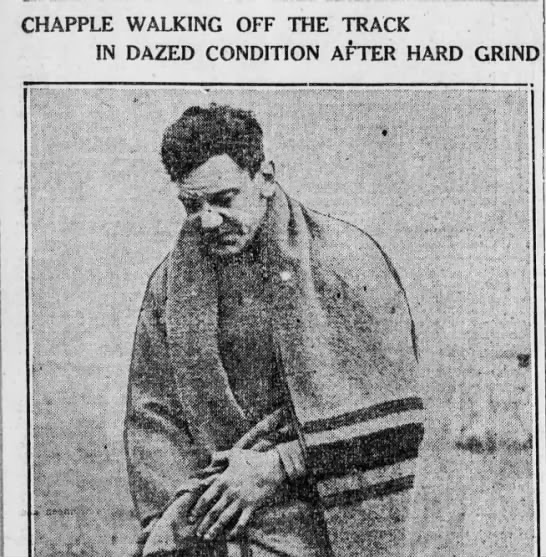
Despite the questions, race officials finalized the results, the prizes were distributed, and the first, and probably only 21 Hour Motordrome Race slipped into history. The toll this race took on all the riders, was captured in a local newspaper photograph of an exhausted Arthur Chapple taken after the race.

Brooklyn Daily Eagle - September 22, 1912
Sources:

Brooklyn Daily Eagle

Library of Congress Collection

Motorcycle Illustrated

New York Times

Friday, August 01, 2014

Indy's First Race - Episode #26


August 1, 2014
Updated - August 17, 2014

By: David L. Morrill
@MototiqueRacing
Sylacauga, Alabama


Indian Motorcycle Club France Collection

I've had a fascination with the Indianapolis Motor Speedway since my childhood. I remember taking a Sunday family ride in 1964 and listening to descriptions of the horrendous crash in the 500 Mile Race on our car radio. I have never made it to the Speedway in person, but rarely miss the 500 Mile Classic on television. Indy race fans know the Speedway opened in 1909, but few know the first event held there was a motorcycle race. Time to share this little-known piece of early motorcycling history.

In early 1909, construction began on a racetrack in Indianapolis, Indiana. The 2-mile oval track was surfaced with gravel and tar.

Chicago, IL. Tribune - January 24, 1909

By mid 1909, arrangements had been completed between the Federation of American Motorcyclists (F.A.M.), and the management of the newly completed Indianapolis Motor Speedway for a National Championship Motorcycle race to be held on August 13 & 14, 1909. Wire service articles about the planned races began to appear in newspapers across the country. The motorcycle races would be followed one week later by Championship Automobile Races at the Speedway. President William Howard Taft was scheduled to take part in the opening ceremonies for the Speedway's automobile races.

Bakersfield, CA. Californian - August 14, 1909
Harrisburg, PA. Courier - July 25, 1909

Indianapolis, IN. News - July 30, 1909

Indianapolis, IN. News _ August 9, 1909
The races would coincide with the F.A.M.'s annual convention, which was also to held in Indianapolis. An August 10th article in the Indianapolis News, announced that entries for the race were closed, and that "Leading Riders of the World Will Compete." The article also went on to state that "riders had tested the track" and that "records will be smashed."

Indianapolis News - August 10, 1909
On August 11th, an unflattering cartoon, which appeared to mock the races, appeared on the front page of the Indianapolis News.

Indianapolis News - August 11, 1909

That same day, a more positive wire service article about the races appeared in papers across the country. It gave details of the races being run during the two-day event, along with information on the convention, and details about the Speedway.

Warren, PA. Times Mirror - August 11, 1909

On the morning of the 13th, rain fell, and the races were postponed to the following day.

Indianapolis News - August 13, 1909
There were already concerns that the rush to complete the track's surface, prior to the scheduled races, had resulted in a racing surface that had not been properly laid. Many of the 32 race competitors entered began to complain the track surface had not been properly rolled for smoothness, was both rough and dangerous for the riders.

Indianapolis Motor Speedway - August 1909
Ramin Faz Collection
The events of the August 14 motorcycle races held at the Speedway are documented in a two-page article that appeared in the August 14, 1909, edition of Bicycling World and Motorcycle Review.

Bicycling World and Motorcycle Review - August 14, 1909
Controversy started after an amateur rider J. S. Tomey crashed, at the beginning of the 10 Mile Amateur National Championship race. Tomey was not seriously injured but was forced to drop out the race.

Things came to a head, when professional rider, Jake DeRosier, crashed heavily. DeRosier's crash, was said to have been caused when the rough track surface ripped his front tire off the rim. DeRosier was traveling at over a mile a minute, and his injuries were appeared very serious. Word spread through the competitors, that DeRosier's injuries might be fatal. This was the final blow, which forced the rider's into action.

Wichita, KS. Daily Eagle August 15, 1909
The riders gathered and began to talk of a strike, to shut down the races. All but two of the thirty riders in the event voted to strike. However, the strike failed to materialize. The F.A.M. Official in charge of the meet stated any rider, who did not compete would be suspended from competition for sixty days.

The threat of suspension, along with word from the Speedway Hospital, that DeRozier's injuries were not serious, put an end to the threatened strike. Many of the top riders entered in the day's races, did not appear to have their hearts in the competition. Spectators, and the press, thought they were just riding around at less than full speed.

The Ten Mile National Amateur Championship Race had been postponed after J.S. Tomey's crash. When the race resumed, without Tomey, Indianapolis rider Erwin Baker took an easy win on his Indian. Baker's win in the 10 Mile national Amateur Championship Race got nationwide coverage, eclipsing the winners of both the professional race, and the other amateur classes.

Indianapolis News - July 13, 1909
The race results went out in a wire service article to newspapers around the country. That night, F.A.M. Officials met, and cancelled the remaining races scheduled for August 15th.

Washington, DC. Post - August 15, 1909


Erwin Baker became a top competitor in professional motorcycle competitions across the country. In 1914, he set an endurance record crossing the country in eleven days on his Indian Motorcycle. That record earned him a new nickname, and he would be known "Cannonball" Baker for the remainder of his life.

Erwin George "Cannon Ball" Baker - Indianapolis, Indiana
Wikipedia.com
Jake DeRosier recovered from his injuries and went on to be hired as a factory rider for Indian Motorcycles. In 1911, he set a new World Speed Record at Brooklands in England. He died in 1913, as the result of racing injuries.

Jacob "Jake" DeRosier 1880-1913
Daniel Statnekov Collection

The following weekend, the Indianapolis Motor Speedway held it's first automobile races. The poor track surface is said to have contributed to two fatal crashes during that event.

In 1910, the track was repaved with bricks, giving it a length of 2.5 miles. The first Indianapolis 500 Mile race was held in May 1911. In 1922, one of the entrants in the 500-mile race was one "Cannon Ball" Baker, who finished 11th.

In September 2008, ninety-nine years after the 1909 F.A.M. Championship Races, top motorcycle riders from around the world once again gathered at the Indianapolis Motor Speedway to compete in the Moto GP World Championship Races.


Sources:

Bakersfield Californian - Bakersfield, CA.

Bicycling World and Motorcycle Review

Harrisburg Courier - Harrisburg, PA.

Indian Motocycle Club France Collection - Indian Motocycles Club of France on Facebook

Indianapolis News - Indianapolis, IN.

Mark Dill Collection - firstsuperspeedway.com

Newspapers.com

Smithsonian Library - Bicycling World and Motorcycle Review - August 14, 1909

Daniel Statnekov - Pioneers of American Motorcycle Racing

Warren Times Mirror - Warren, PA.

Washington Post - Washington, DC.

Wikipedia.com

Wichita Daily Eagle - Wichita, KS.


Tuesday, April 01, 2014

A Tale of Two McNeils - Episode #24

April 1, 2014
Updated - April 5, 2025
By: David L. Morrill
@MototiqueRacing
Ocala, Florida 

The way in which history is recorded, can sometimes be strange. Suppose that over a hundred years ago you had two early racers, with very similar names. They competed in the professional Motordrome races at about the same time. One would die early in a tragic accident. The other would have a long career becoming one of the top racing engineers in the country. And suppose over the past 100 years historians have mistakenly merged these two individuals into one person. One McNeil's story was lost in this accident of history. It's time to unravel this tale and set the record straight.

James "Jock" McNeil - "The Little Scot"

James "Jock" McNeil on his JAP Special "Auld Nic"- Old Devil
at the Atlanta Motordrome - 1913


In September 1912, a young motorcycle racer from Edinburgh, Scotland named James McNeil, arrived in New York to compete at the Stadium in Brighton Beach, New York and Valisburg Motordrome in Newark, New Jersey.  He quickly adopted the nickname "Jock" so he wouldn't be confused with another racer named Joseph Addison "J. A." McNeil from Canada. Jock's true first name is unclear but is probably James. Newspaper articles of the time initially list his first name as James, then John but that is his brother's name. He was said to be a Scottish or European Racing Champion, but there is no known history back up that claim. In just a few weeks, the Little Scot, on his JAP special racer nick named "Auld Nick" (Scottish slang for Old Devil), would become a crowd favorite, and a dominant force at the Stadium Motordrome.

At about the same time, a young Canadian motorcycle racer named Joseph Addison "J. A." McNeil was making a name for himself in Motordrome racing in both Canada, and the United States. More on him later. 

Stadium Motordrome Brighton Beach, New York
Library of Congress Collection
By mid 1912, New York City had two new Motordromes in close proximity to the City. They were the Stadium Motordrome in Brighton Beach, New York, and the Vailsburg Motordrome in Newark, New Jersey.  A group of contracted riders competed at both of the new Motordromes.

Tragedy struck on September 8, 1912, when riders Eddie Hasha, Johnny Albright, and four spectators were killed in a racing accident at the Vailsburg Motordrome. Both Hasha, and Albright had competed at the Brighton Beach track, and their loss affected both fans, and riders.  The city fathers in Newark, moved quickly to stop motorcycle racing at the Newark track. The Brighton Beach track elected to continue racing, despite the tragic events at Newark.

Stadium Motordrome Ad - New York Times 1912
The operators of the Stadium Motordrome in Brighton Beach were mindful that a similar accident at their track, could lead to a complete ban on Motordrome racing.  They had a race scheduled just two days after the Newark tragedy, and immediate steps were taken to make the track safer, and calm spectators fears. An article detailing the safety changes appeared in the New York Times a week later.

New York times - September 15, 1912
Racing resumed at Brighton Beach on September 10th. James McNeil was scheduled to compete in his first race at the Brighton Beach Motordrome that night. One can only wonder if the little Scot was re-evaluating his career choice after such a violent deadly accident just a few days before.

Scranton, PA. Truth - September 10, 1912

James McNeil rode his JAP Special, which featured a frame he built, along with an Indian racing fork, and an 4 valve English JAP racing engine. That night, McNeil was matched with Arthur Chapple, in a race. Chapple easily won the first heat and was on his way to an easy second heat win. Chapple had a tire failure, and McNeil took the win.

Motorcycle Illustrated - September 1912

Brooklyn Daily Eagle - September 11, 1912
Scranton, PA. Truth - September 11, 1912


On September 12, 1912, James McNeil won a race with Arthur Chapple. The following day he won a race with John Cox.


New York Times - September 14, 1912


That weekend, Chapple again faced off with McNeil, in match races. Chapple won both races, but he would not have such an easy time beating McNeil in the future.


Brooklyn Daily Eagle - September 15, 1912


The next event was a grueling 24-hour race, in which two-man teams would circle the track for a whole day. The rules allowed for engine changes, if necessary, and for rebuilding wrecked bikes.

Brooklyn Daily Eagle - September 22, 1912

Brooklyn Daily Eagle - September 22, 1912
At the end of the 24-hour grind, the team of William Shields, and George Lochner, covered 1374 miles for the win.  Jock McNeil, and Earl Eckel finished second, just three miles behind Shields and Lochnar. Chapple, and Wray, finished third some 9 miles behind the leaders. 


Brooklyn Daily Eagle - September 22, 1912


The final race of the season was to be a six-hour race on September 30, 1912. It's unclear if this race took place. Early winter weather hit the area, and the race results do not appear in either New York paper.

Atlanta Motordrome - 1913


For the 1913 racing season, James McNeil, and several other riders from the Brighton Beach Motordrome, took the long train ride from New York City, to Atlanta, Georgia. They came to compete at the newly opened Atlanta Motordrome. James McNeil adopted the nickname "Jock," a common slang term in Scotland, for the first names John, James, and Jack.

Infield Crowd at the Atlanta Motordrome - ca 1913.
Chris Price @ Archive Moto

McNeil would be competing against established Motordrome stars like "Millionaire" Morty Graves from Los Angeles, French Champion Georges Renal, Freddie Luther of Ft Worth, Wilmer "Tex" Richards from Waco, and Billy Shields, who he had raced against McNeil at Brighton Beach. Local rider, Harry Glenn was also an accomplished racer, with Motordrome experience, and quickly adapted to the new 1/4-mile circular Atlanta board track.

Atlanta Motordrome Ad - June 1913

On May 27, 1913, riders took to the new Atlanta Motordrome. McNeil and two other riders narrowly escaped serious injury in separate incidents. While traveling about 85 miles per hour on the steeply banked track, McNeil's front tire began to jump the rim. McNeil was able to slow his bike, and thereby escape a sure trip to the hospital.

Atlanta Constitution - May 28, 1913

This article identifies him as "Jack" McNeil, but this may be a misprint of his new nickname "Jock" He is first identified as "Jock McNeil" in an Atlanta Constitution article on June 1, 1913. 


Atlanta Constitution - June 1, 1912


On June 2, photos of McNeil along with riders Freddie Luther, and Billy Shields appeared on the Atlanta Constitution's Sports page.

Atlanta Constitution - June 2, 1912


In early June, Jock took an intrepid lady Reporter Mignon Hall of the Atlanta Georgian Newspaper on a spin the Atlanta Motordrome. She wrote glowingly about the experience comparing it to "flying."


Atlanta Georgian - June 8, 1913

Unpredictable weather meant that several racing programs were scheduled, only to be canceled due to wet track conditions. The first races took place on June 14, 1913.

Atlanta Constitution - June 14, 1913.
Despite the previous cancellations, seven thousand enthusiastic fans showed up for the Opening day's races.

Atlanta Constitution - June 15, 1913

Jock McNeil was pitted against the French Champion Georges Renel in the third heat. McNeil won both the heat race, and the six-mile final. Billy Shields finished second.

Tex Richards on his eight valve Indian dominated the second race meet held on June 17th.  McNeil won two heat races that day.

Atlanta Constitution - June 18, 1913


Over the next several weeks, a rivalry developed between Tex Richards on his Indian, and McNeil on his JAP Special. The local press fueled the rivalry, which went on to include Morty Graves in a three-way fight for dominance at the Motordrome.  They would swap wins in match races, much to the delight of the local race fans. Morty Graves, who was from a wealthy Chicago family, went so far as to order a new Excelsior racer to give him a competitive edge.

Swapping the track record became a regular competition between the three riders. On June 25th, Tex Richards broke the track record during a heat race. Jock McNeil won one final race, and was leading Richard in the Motordrome purse race, when his bike suddenly began to misfire. Richards took the lead, with Billy Shields in a close second. McNeil's bike came back to life, and he rode the wheels off it and was a close third at the end of the race.

Atlanta Constitution - June 27, 1913


Atlanta Constitution - June 28, 1913


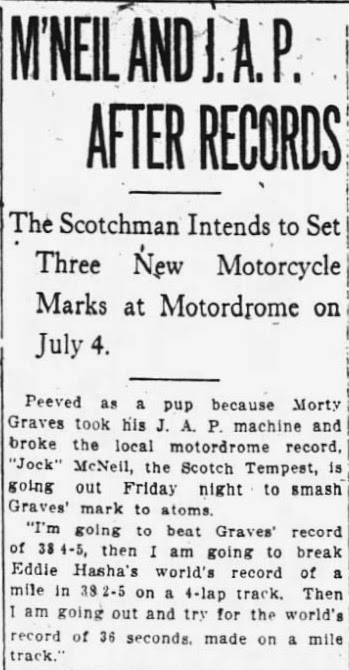
On June 28th, Morty Graves smashed the one-mile track record averaging 92 miles per hour on Jock McNeil's JAP Special. Graves new Excelsior had not yet arrived. McNeil rode the same bike to beat Tex Richards in the nights match race.  How Graves came to ride McNeil's JAP is not reported, but McNeil was none too happy about it.

McNeil, who secretly ordered two new JAP racing engines from London, stated he was going to break Graves record, and then go after Eddie Hasha's four lap, one mile, World's record at the July 4th race. One of the engines McNeil ordered was the newest long stroke motor, while the other an updated short stroke motor. Both motors were said to be faster than JAP engine McNeil was using at the time.

Atlanta Constitution - July 1, 1913

The July 4th races were rained out and took place July 8th. Despite all the hype about a record attempt by McNeil, Tex Wilmer won the money races after Jock's motorcycle developed engine trouble. Rain postponed the next several scheduled races. Racing finally resumed on July 16th. Once again Tex Richards dominated the races. Jock McNeil made an attempt to break the one-mile track record but fell short by just one an hour averaging 91 miles per hour for four laps.

On July 24th, Jock McNeil won the 105 lap "Marathon" race against nine other riders, picking up the $500 prize.

Atlanta Constitution - July 26, 1913

On August 12th, the rivalry with Morty Graves came to an end, when Graves was severely injured in a race. It was initially thought Graves would lose one of his eyes, but after he laid off the racing game for a while, he made a full recovery.

Atlanta Constitution - August 13, 1913

That same night, McNeil won a heat race, and finished second in two feature races. On August 15th, Atlanta's Harry Glenn narrowly escaped serious injury when he blew a rear tire during a sweepstakes race. The racing game in Atlanta, was getting dangerous. So far, no rider had been seriously injured, but it seemed to be just a matter of time till one was seriously injured or killed.

On August 17th, Jock McNeil decided to attempt a record run during a practice session for the day's races. McNeil felt he could gain a mile an hour, or two, by running the "white boards" at the top of the Motordrome's racing surface.


Atlanta Constitution - August 20, 1913
The press reports state McNeil had been dared by friends to run the white boards. These boards marked the top of the track, and they were not intended to be part of the racing surface. He was lapping at 90 miles per hour, when the white boards gave way. McNeil was thrown from his bike, and gravely injured.

Atlanta Constitution - August 19, 1913

James "Jock" McNeil died of his injuries on August 20, 1913. McNeil's brother John, who worked for the Hendee Manufacturing Company (Indian Motocycles) in Springfield, Massachusetts came to Atlanta at that time to surprise his brother, but instead had to take care of his brother's funeral arrangements.

 
Atlanta Constitution - August 21, 1913

James "Jock" McNeil was buried at West View Cemetery in Atlanta on August 21, 1913. He was 26 years old. He was apparently buried under the name Jock McNeil, as listed on the Fulton County Georgia death records, however the location of his grave in West View Cemetery is unmarked. 

Atlanta Constitution - August 22, 1913

 A Jock McNeil benefit race was scheduled but was delayed by weather until October 7, 1913. The benefit race was won by McNeil's Rival Tex Richards, and all the proceeds went to McNeil's mother in Scotland.

Atlanta Constitution - October 8, 1913

McNeil's' name was listed as " Jock McNeil on the Fulton County Georgia Death Documents.


The death of Jock McNeil was just one nail in the coffin of the Atlanta Motordrome. The constant race cancellations due to weather, and the death of the popular racer in full view of spectators caused the crowds dwindle. Poor management of the track also played a major role. The Atlanta Constitution, which had regularly reported on the races with favorable articles, became highly critical of the track management.

In October 1913, a race for black riders was held at the Motordrome. This was not a popular decision in Jim Crow Atlanta, and it was widely criticized by both local motorcycle dealers, and the National racing press. The track's sanction for National Championship races was withdrawn, and that forced the track into bankruptcy in late 1913. It briefly reopened under new management in 1914 but closed after only a few races. For more information on the story of the Atlanta Motordrome, click on the link below:


In a strange twist of fate, the Atlanta Constitution reported that Wilmer "Tex" Richards had been killed in a race in Houston, Texas in March 1914. The article stated Richards was riding the same JAP Special  Jock McNeil was riding the day he was killed.

Atlanta Constitution - March 26, 1914


The report of Richard's death proved to be premature. Despite being hurled some 275 feet outside the Houston track, Richards had miraculously escaped serious injury. He later returned to Atlanta, and continued as one of the top racers in the South for many years.


Joseph Addison "J.A." McNeil

Joseph Addison "J. A." McNeil
Daniel K. Statnekov Collection

Joseph Addison McNeil was born in 1882 of Scotch parents in Prince Edward Island, Canada. McNeil was an accomplished bicycle racer, and in 1900 his family moved to Boston, Massachusetts, and he began to compete in cycling races around the United States.

Joseph A. McNeil - ca.1900
Paul Eichelberger Collection

In a July 1908, McNeil appears as a bicycle competitor in the Motorcycle and Bicycle Races taking place at the newly opened Seal Gardens Saucer Track in Los Angeles.


Los Angeles, CA. Herald - July 11, 1908


The Seal Gardens track also featured some of the best motorcycle racers in the country. This was probably McNeil's introduction to the world of professional motorcycle racing. By 1910, McNeil made the switch from bicycle to motorcycle racing competing in professional races at the Los Angeles Coliseum on a Reading Standard motorcycle. In March 1910, J. A. McNeil finished third in the 12 Mile race for professional riders at the Coliseum.

Later that year, McNeil, and several other West Coast riders including Morty Graves spent three months racing at the Wandemere Motordrome in Salt Lake City Utah. Graves and McNeil returned to Los Angeles and continued to compete at the Coliseum.

In mid 1913, McNeil returned to Salt Lake City to compete. He appears in Tribune reports racing an Excelsior at the Wandemere.  An August 1913 Automobile Journal article reports that J. A. McNeil competed in four motorcycle Class A Match Races at the Wandemere Motordrome. McNeil, who was riding an Excelsior motorcycle, finished second in two races, and third in two other races.

Automobile Journal - August 1913

By 1914, J.A. McNeil had been hired as a test rider for the Cyclone racers of the Joerns Manufacturing Company in St. Paul, Minnesota. In October, McNeil set a new one-mile speed record of 101 miles per hour, at Omaha, Nebraska.

Cincinnati, OH Enquirer - October 5, 1914
The wire service article on McNeil's record identified him as John W. McNeil. He later raised his speed record to 111 miles per hour. After McNeil's records, articles sometimes erroneously referred to McNeil, as an American from Omaha, Nebraska.  McNeil confirmed in an article in the Winnipeg Tribune that he was in fact a Canadian, having been born in Prince Edward Island, of Scottish parents. 


Winnipeg, Canada Tribune - July 1, 1915 

In 1915, Joseph McNeil, who was a machinist by trade, left Cyclone and was hired by Ignaz Schwinn as a development rider/engineer for his Excelsior Motorcycle Company. McNeil played an important part in the development of Excelsior's engines, and for the next few years often raced the bikes he helped develop.

McNeil returned to Canada in early 1916 and enlisted in the army at the beginning of World War 1. He was seriously injured as a motorcycle dispatch rider in England, badly breaking one leg, when he struck a wagon. Press accounts erroneously reported one of his legs had been amputated, but this was not true. He did spend many months recovering in a hospital in England.

Ottawa Journal - April 5, 1919
After the war, McNeil returned to Excelsior, where he continued his development work, and also served as the Racing Team Manager.

1920 Excelsior Racing Team - Wells Bennett, Bob Perry, J.A. McNeil, Joe Wolters
http://www.excelsiorhenderson.com

McNeil played a significant role in developing Excelsior's new gear drive overhead valve racer (pictured above). Excelsior rider Bob Perry took the new racer out for a practice run at the Ascot Park Speedway in Los Angeles in January and was killed in a crash.

Indianapolis, IN. News - January 15, 1920
Perry was a favorite of Excelsior owner Ignaz Schwinn, and legend has it Schwinn went into the race shop, and personally smashed the racers with a hammer. That story may be more legend, than fact, but Excelsior did suspend their racing activities for part of 1920.

By September 1920, Excelsior had returned to the racing circuit, and McNeil entered the grueling 200 Mile Road Race at Marion, Indiana. McNeil led at the start of the race but crashed through a chain link fence putting him out of the race.  He was not seriously injured.

J. A. McNeil - Excelsior leads the start of the Marion, Indiana Road Race
Motorcycle and Bicycle Illustrated - September 16, 1920


Indianapolis, IN. News - September 7, 1920

1921, appears to have been McNeil's final year as an active rider.  The forty-one-year-old McNeil left racing to his younger team riders, but continued to play a significant part in the development of Excelsior's overhead cam racing engines, and served as the Racing Team Manager.

In 1937, McNeil developed a motorcycle featuring a six-cylinder automobile engine for a Bonneville salt Flats record speed record attempt.  Fred Luther attempted a motorcycle land speed record run-on the Salt Flats, but a high-speed engine failure ended the record attempt.  With his retirement from racing, James McNeil faded into history.

Over the next one hundred years, the stories of two McNeils were merged into a single person, one J.A. "Jock" McNeil. This is understandable, as the press accounts of both McNeils rarely mentioned first names. When they did, they were often wrong, i.e., John, James, Jimmy, or Jack, etc. I did not find any press accounts of the time that identified J. A. McNeil by the nickname "Jock" and found no evidence he rode a JAP powered bike during his career.

It is clear, that both John "Jock" McNeil of Edinburgh, Scotland, and Joseph Addison "J. A." McNeil of Prince Edward Island, Canada each played significant roles in early racing, and deserve their separate places in Motorcycle racing history.

Epilog: 

I have been searching for any relatives of Jock McNeil, in either Scotland. or the United States, to share this episode. If anyone has any contact information on a surviving family member, please feel free to contact me. The records indicate John was born in Scotland, possibly Edinburgh, in 1887.  His father was also named John McNeil, and that he and Jock's mother lived in Scotland. He also had a sister in Cleveland, Ohio, and a brother John, who was with him when he died and worked for Hendee MFG. (Indian Motocycles) in Springfield, Massachusetts. Any help will be appreciated!

Sources:

Ancestry.com

Atlanta Constitution

Atlanta Georgian

Automobile Journal - August 1913

Brooklyn, NY. Daily Eagle

Cincinnati Enquirer

Chris Price@Archive Moto

Daniel K. Statnekov Collection

ExcelsiorHenderson.com

Fulton County Georgia 1913 Death Records

Graham Chivrall

Hathi Trust Collection

Indianapolis, IN. News

Mark Stevens - Evanton, Scotland

Ottawa, Canada Journal

Paul Eichelberger Collection

RootsChat.com

Scranton, PA. Daily Truth

Stephen Wright 
American Racers 1900-1940

Toronto, Canada World

The Speed Kings by Don Emde

Newspapers.com New York Times

Winnipeg, Canada Tribune