Tuesday, April 14, 2015

A Short History of Harley-Davidson's Early OHV Racers - Episode #33

April 14, 2015
Updated - July 30, 2015

By: David L. Morrill

@MototiqueRacing
Sylacauga, Alabama

Early Harley-Davidson Blanked Off OHV Single Cylinder Racer - ca. 1916
Lonnie Isam Jr. Collection

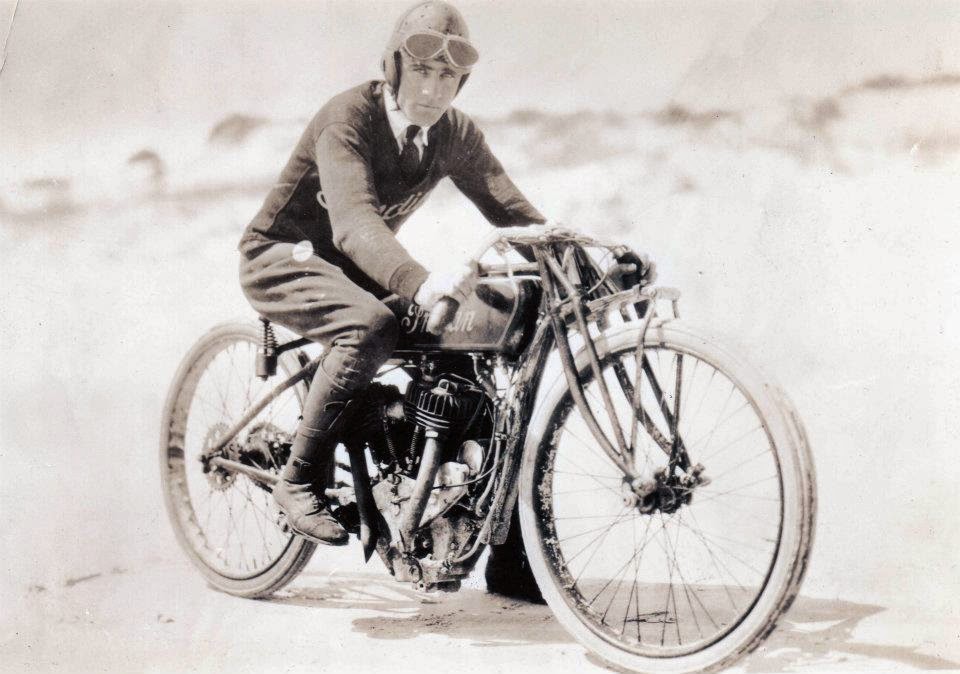
The idea behind this episode comes from a single photograph shared on Facebook by Lonnie Isam Jr. Lonnie's family has a long history of involvement in antique motorcycle restoration.  The photo shows a rider, whose name escapes me, seated an early Harley-Davidson single cylinder overhead valve (OHV) half mile dirt track racer.

The introduction of Harley-Davidson's all conquering eight valve racers of the teens and twenties, is a bit of a mystery. Little is known about the development of these engines, but I have been able to find a few period articles that may shed a little light on the story. In Episode #30, on the birth of Harley's 11-K racer, I detailed Harley-Davidson's late entry in the professional motorcycle racing game.  When they did, they started with a racing engine loosely based on their 1914 production pocket valve single cam V twin. While this engine was quickly competitive, Harley's chief competitors on the track had been racing exotic overhead valve racing engines for years. Harley's Race Engineer, Bill Ottaway, realized he would quickly reach the limit of the pocket valve racer's development, and so he began developing special four overhead valve cylinders. The exact history of when this development started has been lost to time, but it appears it began sometime in 1915.

1915 Harley Davidson Single Cylinder Pocket Valve Racer
R. I. Jones Collection

While Harley-Davidson had a 1915 single cylinder racer, for reasons unknown, Ottaway chose to use the V twin bottom end, as the test bed for his new engine. This was accomplished, by blanking off one cylinder. By removing one cylinder, piston, rod, and rebalancing the crankshaft he created a blanked of 30.5 ci. single. The 30.5 ci class had been created to slow down the 61ci V twins, which were previously used on the half mile dirt tracks popular in the period.

It is pure speculation, but Ottaway may have chosen to develop the new OHV cylinder, on a single cylinder engine, because the single has a straight intake from the carburetor to the cylinder. The V twin uses the same T shaped intake used on the production engines, with the carburetor sticking out to the right or left of the engine.  That style intake creates more turbulence of the incoming gas/air mixture.

Maldwyn Jones made his reputation on the racing circuit riding Flying Merkle racers but decided to switch to Harley-Davidson for the 1916 racing season.  Bill Ottaway installed one of the new Harley-Davidson blanked off 4 valve race engines into a special lowered Merkle racing frame and fork jones had developed.  Due to his short stature, Jones preferred the Merkle frame's lower seat height, and better fork. Jones would use this bike to win half mile races across the country. Jones also went on to race a Harley-Davidson 8 Valve engine in the same frame and fork combination.

Maldwyn Jones - Harley-Davidson 4 Valve Racer - 1916
R. I. Jones Collection

By April 1916, the OHV single was ready for its first race test. Several bikes were sent to the half mile races held at Roanoke, Virginia on April 30, 1916. The new single cylinder OHV racers were fast right from the start, with team rider Ray Weishaar wining several races.  He even lapped an "OHV ported" Indian in one of the races.

Motorcycle and Bicycle Illustrated - June 1916

Harley-Davidson wasted no time in advertising the new racer's win, with a two-page ad in Motorcycle and Bicycle Illustrated.

Harley-Davidson Ad - Motorcycle and Bicycle Illustrated
July 9, 1916

Now, there was certainly more to Ottaway's plan than just building a single cylinder half mile racer, and there was. He was also, at the same time, developing an eight-overhead valve V twin to challenge Indians eight valve racers.

8 Valve Harley Racer - ca. 1916
Lonnie Isam Jr. Collection

For this venture, he also used the 11-K V twin bottom end. New front and rear OHV cylinders were added, and testing began. By June 1916, the new V twin OHV racer was ready to race, and was shipped to held at Detroit, Michigan on June 11, 1916.

 Motorcycle and Bicycle Illustrated - June 1916

Bill Brier won a heat race on the new eight valve racer, but the new racers suffered teething problems in the longer races, and development continued.

On July 4, 1916, the new 8 valve racer proved its speed by winning the pole for the biggest race of the year, the Dodge City 300. Floyd Clymer, on his first time on board the new 8 valve racer, set the pole time. While Clymer led the race, he eventually slowed with engine problems, Irvin Janke went on to win the race for Harley-Davidson on one of 8 valve racers.
Motorcycle Illustrated - July 6, 1916 

Harley-Davidson Racing Team - 1916 Dodge City 300

The new 8 valve racers showed also their dominance in the 100 Mile Championship Race at Sheepshead Bay, New York. Harley-Davidson took five of the top six spots, proving the new 8 valve racer was more than a match for it's competition.
Harley-Davidson 8 Valve Racer Ad - July 6, 1916
Motorcycle and Bicycle Illustrated 

A new two cam bottom end was developed for both the V twin racer, and the blanked off single. In the hands of Harley's 'Wrecking Crew" Racing Team riders, both of these bikes went on to become a dominant force in racing for years to come.

1923 Harley-Davidson 2 Cam OHV Racing Engine Patent Drawing
WWAG.COM

1928 Harley-Davidson 2 Cam Racing Engine
R. I. Jones Collection

In 1921, Harley-Davidson ceased involvement in professional racing. They did however continue to provide select riders with race bikes thorough their dealer network.  One of the beneficiaries of this program was Gene Walker of Birmingham, Alabama. Walker, an Indian Factory team member, was one of the top riders in the country.

In mid 1921, Walker was suddenly fired by Indian for refusing to ride in the Dodge City 300. Left without a ride, Walker returned to Birmingham, and went to work for his former Birmingham Indian teammate, Gail Joyce, who was now the Birmingham Harley-Davidson dealer. Walker got his hands on a blanked off two cam Harley-Davidson and began racing it. How this came about, has been lost to history, but perhaps Harley-Davidson saw a way to poke their former racing rival Indian. Walker would become a dominant force on half mile dirt tracks around the country.

Gene Walker - Harley-Davidson 2 Cam Single - 1923
Don Emde Collection

After dominating the half mile races on the Harley two cam Harley single in 1923, Harley-Davidson issued an ad touting his dominance.

Harley-Davidson Ad - 1923

The Harley-Davidson ad may have been the final humiliation for Indian, as they quickly rehired Walker. Sadly, he died of injuries sustained in a practice crash on the half mile track at East Stroudsburg, Pennsylvania in June 1924.

After Walker's death, Indian threatened to pull out of racing if the displacement was not reduced to slow the bikes on the half mile dirt tracks. The displacement was reduced to 21ci. -350cc. In 1926, Harley introduced a new single cylinder OHV racer, which came to be known as the Peashooter, for the unique popping sound it made. Most of these bikes went to Europe, Australia, and New Zealand, but a few stayed here for use on half miles, and cinder tracks.

1927 Harley-Davidson Peashooter Racer
Harley-Davidson CAC Cinder Track Racer

When the Great Depression hit, American motorcycle companies were struggling to survive, and racing activities were curtailed. They would return in the 30s with Class C racing, which outlawed specialty racing machines not based on production models. This was not the end of the exotic OHV racers.  The technology was used to build alcohol powered hill climb racers.

1930 Harley-Davidson DAH Hill Climber
R. I. Jones Collection

As the years passed by, few examples of these early OHV racers have survived, and they are among the rarest of Harley-Davidson's early racers.


Sources:

Bicycling World and Motorcycle Review

Don Emde Collection

Lonnie Isam Jr. Collection

Motorcycle Illustrated.

R. I. Jones Collection


Friday, March 13, 2015

The Strange Case of Louis Delibero - Episode #32


March 13, 2015
Updated - November 23, 2017

By: David L. Morrill
@MototiqueRacing
Sylacauga, Alabama

Luigi "Louis" Delibero  
Delibero Family Collection

Family stories are an interesting thing. They come down to us from older relatives, and are sometimes dismissed by others, because they assume their recollections of events long passed are suspect. This story comes from a reader, who asked me to help find more information on the mysterious death of a family member in 1918. The family story she shared with me, was so intriguing, I thought it was worth of looking into.

Luigi Delibero aka Louis Lawrence Delibero was born in San Lorenzo, Italy on August 9,1892.  By the early teens, he was part of a wave of Italian immigration to the United States. Delibero, along with other family members settled in the seaport town of Bridgeport, Connecticut.  Delibero Americanized his first name to Louis, and eventually found work as a mechanic at the Automatic Machine Company. The Automatic Machine Company was part of Bridgeport's ship building industry. With World War 1 raging in Europe, and assumptions that America would eventually be drawn into the war, ship building was an important industry.

Bridgeport, CT.  Telegram - 1918
Louis Delibero - Automatic Machine Company ca. 1918
Delibero Family Collection

Motorcycling for both transportation, and recreation, was well established in the Bridgeport area. They had an active motorcycle club going back to the early teens. It was also the home of Stanley T. Kellogg, who was one of the most accomplished motorcycle racers of this period, and also the local agent for Excelsior motorcycles.


The Bridgeport Motorcycle Club, which boasted fifty members in 1911, began sponsoring motorcycle competitions at the Bridgeport Aerodrome, the Nutmeg Driving Park, and later at the Seaside Park Racetrack.

Bridgeport Motorcycle Club Race Ad
Motorcycle Illustrated - September 1911

Bicycling World and Motorcycle Review - 1911

Bridgeport was also close to two centers of early professional motorcycle racing.  They were the Vailsburg Park Motordrome in Newark, New Jersey, and the Stadium Motordrome in Brighton Beach, New York.  Top racers from around the world competed on these steeply banked circular board tracks, drawing large crowds of spectators. A tragic crash at the Newark track in September 1912, killed two well-known racers, along with several spectators, and led to the banning of motorcycle racing in Newark.

Atlanta Constitution - September 1912


After the Newark tragedy, and another tragic accident at the Lagoon Motordrome in Ludlow, Kentucky, which also killed several racers, and numerous spectators, motorcycle racing began to shift back to the dirt oval horse racing tracks common in the area.

Motorcycles provided cheap transportation in the days when automobiles were out of reach of all but the affluent. Like many young men of this age, Louis Delibero was also drawn to the freedom, and excitement, of motorcycles. He purchased an Indian Motorcycle, most likely from the Bridgeport Cycle Company, which was the local Indian dealer.

Bridgeport, CT. Telegram -1918
Louis Delibero with Family Members
Delibero Family Collection


Louis Delibero of Bridgeport, Connecticut was listed as motorcycle owner #743 on the State of Connecticut List of Registered Motor Vehicle dated August 15, 1914. A few months later, Delibero caught the attention of the State Police, for riding with his exhaust cutoff open. The loud pipe very nearly cost him his driver's license, but a local Officer interceded on his behalf.


Bridgeport, CT. Evening Farmer
September 10, 1914

As he became more involved in motorcycling, he joined the Bridgeport Motorcycle Club, and began to compete in their motorcycle events around Bridgeport.


Louis Delibero - 1918
Delibero Family Collection

Seaside Park Racetrack - Bridgeport, CT.
Bridgeport Baseball History - Mike Roer


On July 10, 1915, Louis Delibero set the 1 Mile Track Record at the Bridgeport Aerodrome, now known as the Bridgeport Motordrome Park, and was awarded a silver cup to commemorate his new track record.


In 
Fred A. Delibero Collection
In late December 1915, Louis Delibero, and his wife witnessed a fatal accident between and automobile and a trolley car. The details of the accident were reported in the Bridgeport Evening Farmer on December 31, 1915.


Bridgeport, CN. Evening Farmer
December 31, 1915


With the approach of America's involvement in World War 1, Louis Dlibero registered for the draft in Connecticut. Although he was a Naturalized American Citizen, he was not drafted, as he had a dependent wife, two children, and his employment at the Automatic Machine Company was considered an essential war industry.


In October 1918, Louis Delibero was killed when his motorcycle was struck by a truck. The collision with the automobile literally broke Delibero's Indian Motocycle in half.  There appears to be no mention of Delibero's fatal accident in the local paper, even though they regularly covered motorcycle and automobile accidents. State of Connecticut  Death Records indicate Louis Delibero died on October 1918 in Norwalk, Connecticut. 

Remnants of Delibero's Indian Motocycle -1915
Delibero Family Collection


After Delibero's death, it was rumored that his fatal accident was staged by local Black Hand Society members, because he refused to fix the outcome of upcoming motorcycle races.

Black Hand Society Symbol

The Black Hand Society which had origins in Sicily, was well established within Bridgeport's Italian American Community. Their principal crime was extortion from Italian owned businesses, and they were suspected in several local murders.

Bridgeport, CT. Telegram - 1918

Motorcycle racing was popular in Italy, and betting on the results of races, which was controlled by local crime figures, was common. It was also common practice at American racetracks of the time to gamble on the outcome of motorcycle races. A local Italian racer would have been a crowd favorite with Bridgeport's Italian race fans. If the story passed down through the Delibero family was true, the local Black Hand Society also wanted to fix the outcome of the races.


Luigi "Louis" Delibero was buried in the St. Michaels' Cemetery in nearby Stratford, Connecticut. He was twenty-six at the time of his death, and left behind his wife Rose Masisco Delibero, and young sons Louis, and Frederick Delibero. St. Michael's Cemetery Records indicate Luigi was born on August 1, 1892, and died on October 4, 1918. Luigi's date of on his World War One Draft Registration indicates he was born on August 9th. 

St. Michael's Cemetery Burial Records

Whether Delibero's death was just a tragic accident, or a ninety-seven-year-old unsolved murder mystery, will never be known. Crime within immigrant communities of the time, did not garner the attention of law enforcement, it would in other communities.

With the demonstrated violent nature of the local Black Hand Society, anyone with information, would have surely feared to came forward. The local press liked the sensational headlines generated by this type of crime, but they seldom followed up beyond the initial headlines. There is certainly enough circumstantial evidence to question if the death of Louis Delibero was in fact an unsolved murder.

Sources:

Ancestry.com

Atlanta Constitution

Bicycling World and Motorcycle Review - 1911

Bridgeport, CN. Evening Farmer

Bridgeport, CT. Telegram

Delibero Family Collection

Fred A. Delibero Collection

Motorcycle Illustrated - 1908, 1915, 1916

St. Michael's Cemetery Burial Records 

State of Connecticut Death & Burial Records

Wednesday, January 28, 2015

Herbert McBride, Birmingham's Amateur Champion - Episode #31

January 28, 2015
Updated - February 20, 2015

By: David L. Morrill

@MototiqueRacing
Ocala, Florida

Herbert McBride - Ormond Beach, FL. - April 1920
Bettman Image Collection

This early 1920s photo of a man at the beach on an Indian Motocycle keeps showing up on social media, but few people know the story behind it. It is the story of three men from Birmingham, Alabama, each of whom played a part in early motorcycle racing history. Time to tell their story.

Herbert Foster McBride Sr., also known as Percy, was born in Jefferson County, Alabama in 1901. Like many young men of this time, he was drawn to the freedom, and excitement of early motorcycles. How Herbert McBride was introduced to motorcycles has been lost to time, but eventually the sixteen-year-old McBride, landed a job working in the machine shop of William F. Specht Jr's Harley-Davidson Motorcycles machine shop in downtown Birmingham, Alabama.

Also working in the machine shop at the time, was an up-and-coming local racer named Gene Walker. With the help of the Birmingham Indian Motocycles dealer, Robert Stubbs, Walker built a winning reputation, in the races on the one-mile dirt oval at the Alabama State Fairgrounds in Birmingham. In 1915, Walker was hired as a member of the Indian Motocycles Factory Racing Team, and relocated to their headquarters in Springfield, Massachusetts.

Gene Walker - Birmingham, AL.
O. V. Hunt - 1914 (cropped)

With the approach of America's involvement in World War 1 in 1917, professional motorcycle racing shut down, and Walker returned to Birmingham. Both Walker, and McBride were exempt from the 1917 military draft. Walker was the sole support for his widowed mother, and McBride was too young.  Walker, and McBride, worked together at Specht's machine shop for the next year or so. With then end of the war in 1918, Walker returned to the professional racing, while McBride remained working as a machinist in Birmingham, but switched to working for Bob Stubbs at the Birmingham Indian dealership.

At the end of a successful 1919 racing season, the Indian Motocycles Factory Racing Team, decided they would go after the existing motorcycle speed records at Ormond Beach, Florida in April 1920. Beginning in 1909, racers used the sands of Ormond Beach, Florida for motorcycle speed records. The course was laid out along the beach, at low tide. Gene Walker's former boss at the Birmingham Indian dealer, Robert Stubbs, was a member of the Indian Motocycles Factory Racing Team in the 1909 Ormond Beach event.

Robert Stubbs - Ormond Beach, FL. - March 1909
Chris Price @ Georgia Motorcycle History

Stubbs still had considerable influence with the Indian factory, and Gene Walker was chosen to go after the existing professional class speed records in 1920.

Gene Walker
Ormond Beach, FL. - April 1920

Don Emde Collection

For this attempt, Indian built racing bikes with four different engines. They were the eight valve V twin, the Power Plus side valve racing V twin racing, a stock 61ci Production side valve V twin, and a four-valve racing single. A decision was made to go after both the National records measured in miles, and the international records measured in kilometers in both the amateur, and professional classes.

1920 Indian Eight Valve Racer
R. I. Jones Collection
The decision to also go after the amateur records, opened a slot on the team for another team rider, who was not a professional racer. Gene Walker recommended his friend from Birmingham, Herbert McBride, to be his amateur teammate. This was a great opportunity for McBride, who would ride some of the best racing bikes in the country, under the supervision of one of the countries' most successful professional racers. It did not take long for McBride to accept Walker's invitation.

Between April 12, and April 15, Walker, and McBride set twenty-four new National, and International motorcycle speed records. Walker was credited with the first official F. I.  M. World Motorcycle Speed Record of 104.12 mph. on a stock 61ci side valve Indian Scout.  Walker also set a new National Motorcycle Speed Record of 115.79 mph. on an eight-valve racer.  Walker's faith in his amateur teammate was well placed, as McBride's new amateur record speeds were higher than the previous professional class records. The new records received coverage in newspapers across the country.

Oregon Daily Journal - May 9, 1920

Motorcycle and Bicycle Illustrated - April 1920


The Washington Times (Washington, DC.) - May 8, 1920

The new records were touted in Indian Motorcycles advertising and were covered in the May 1920 edition of Indian's newsletter, known as Wigwam News. As a result of the new records set by Walker, and McBride, the Indian Power Plus production bikes, would come to be known as "Daytona Racers".

Indian Motorcycle Ad - May 1920

Wigwam News - May 1920
Furman Family Collection

May 1920 Wigwam News
Carol Watson Collection

With the records set, and the hoopla over, Hebert McBride returned to his job a a machinist at the Indian dealership. In October of 1921, "Percy" McBride was mentioned as an entry for a contestant in a 500-mile motorcycle endurance race through Georgia, and Alabama.


Atlanta Constitution - October 16, 1921.


In November 1921, Herbert McBride married Amy Bell George, and retired from motorcycle competitions. McBride took a job as a Plymouth/DeSoto automobile salesman for Street Motors in Birmingham. They had a son, Herbert Foster McBride Jr.

With his retirement from motorcycling, McBride could look back with pride to those four days in April 1920, when he set twelve new speed records, and was the Fastest Amateur Motorcyclist in the World. Not a small achievement for a young man from Birmingham.

Epilogue:

Three years after the Ormond Beach Record runs, Gene Walker died of injuries from a practice crash in East Stroudsburg, Pennsylvania. He was returned to Birmingham and buried at historic Elmwood Cemetery.

Birmingham News - June 24, 1924

For more information on Gene Walker's career, please check out Episode #2 - Gene Walker Birmingham's Lost Racing Champion at:


Robert Stubbs died of cancer in 1922, and was buried at Eastlake Cemetery in Birmingham.

For more information on Robert Stubbs' career, please check out Episode # 6 Bob Stubbs Birmingham's First racing Champion at:


Herbert Foster McBride Sr. died in Birmingham, Alabama in 1946.  He was buried at Elmwood Cemetery, not far from his friend, and racing mentor Gene Walker.

Elmwood Cemetery Section #23
Birmingham, Alabama


Sources:

Ancestry.com

Atlanta Constitution

Bettman Image Collection

Birmingham News

Birmingham, Alabama Public Library Archives

Carol Watson Collection

Chris Price @ Georgia Motorcycle History

Don Emde Collection

Motorcycle and Bicycle Illustrated

Newspapers.com

R. I. Jones Collection

The Washington Times

Wigwam News