Wednesday, August 15, 2012

Orlando's, Dexter Campbell - Episode #4


September 12, 2012
Updated - August 7, 2026

By: David L. Morrill
@ Deadly Dave's Blog
Sylacauga, Alabama


Dexter Campbell & Joe Luke - Dade City, FL. 1964
Denny Haven Collection

The seed for this story came from my friend Bob Castlen. Bob and I served together on the Orlando Police Department and have kept in touch since we both retired. Recently, he sent me an e mail, asking me to find out about a motorcycle racer from Orlando, FL. named Dexter Campbell. Bob's sister had briefly dated Dexter and he used to pick her up on his orange Harley-Davidson Sportster.

Now, I don't usually write stories about racers of the modern age, unless I had a direct involvement with the person in the story. I leave that to the folks who actually were involved. I do however like to find racing stories that have not been told and bring them to light. I lived in Orlando, raced motorcycles for many years, and never heard a word about Dexter Campbell. Once I found out more about him, I figured it was a story that needs to be told.

Dexter Lee Campbell was born in Florida just before World War II and grew up in Orlando. He was only about 5' 8 ", and slight in build, which was the perfect size for racing the small displacement motorcycles of the mid 50s and early 60s. Campbell's talent was recognized, and he began riding for Puckett Harley-Davidson on South Orange Blossom Trail in Orlando. Puckett was a hotbed of racing, competing in dirt track, scrambles, road racing, and drag racing at both the amateur and professional levels. Dick O'Brien and Joe Luke were building racing engines at Puckett's.


Puckett Harley-Davidson - Orlando, FL. ca. 1955
Charlie & Aladra Adams Collection

Puckett had developed a strong reputation for modifying the Harley-Davidson 165cc engines for racing. Dick O'Brien's younger brother Jesse and Dexter Campbell both rode for Puckett. They competed around the state of Florida on Puckett prepared Harley 165s in scrambles, short track, and road racing. This continued until the end of 1957, when Dick O'Brien left Puckett to take a job as Director of Racing for the Harley-Davidson factory, and his brother Jesse retired from racing.

In February 1956, sixteen-year-old Dexter Campbell was riding his motorcycle in Orlando and observed a hit and run accident. Young Dexter gave chase to the fleeing vehicle, and eventually persuaded the hit and run driver to pull over. Two young girls were fatally injured in the accident, and run driver was jailed for manslaughter. The story of Campbell's pursuit of the hit and run driver, made newspapers throughout the country.

Corsicana, TX. Daily Sun
February 23, 1956

In June 1956, Campbell traveled the Port St Lucie airport to compete in the American Motorcyclist Association's Sportsman's Road Races. Campbell finished 4th in the Bantam Weight class.

St. Pierce News Tribune
June 25, 1956


In 1958, Campbell won light weight class scrambles races across Florida with multiple wins at Orlando, as well as a win at St. Petersburg. He clinched his first Florida State Scrambles Championship in the Bantam Weight class.

1959 was a breakout year for Campbell.  At Daytona, he won the Heavy Weight Sportsman Class drag race, and finished 2nd in the Lightweight Road Race on old beach circuit. He also finished 2nd in the 55ci class of the Measured Mile Speed Run with a top speed of 123.28 mph. held on the beach course ocean side straight.

Dexter Campbell 165cc Harley-Davidson
Robbie Knight Collection

Campbell dominated the lightweight scrambles class throughout Florida in 1959, on his Puckett's modified Harley 165. He won races at Gainesville, Orlando, Sarasota, and clinched his second Florida State Bantam Weight Scrambles Championship. He closed out the 1959 season with a second-place finish in the open class road race at the Punta Gorda, FL.

#20 - Francis Chromczak of New Brunswick, NJ. and #104 Dexter Campbell run
neck-in neck for the win in the Open Class at the Punta Gorda, FL. Road Races.
Chromczak won the race, with Campbell finishing second.
Robbie Knight Collection
In 1960, he again won the Florida State Bantam Weight Scrambles championship, including scrambles wins at Daytona, Orlando, Winter Haven, a 165cc short track race win at Lakeland, a 250cc TT Race win at Ojus, and a 250cc class road race win at Ft. Myers.

In 1961, the Daytona Beach motorcycle races were moved to from the old beach course to the Daytona International Speedway. Road races were run on the high banked speedway and infield road course, The drag races were held on the speedway backstretch. Campbell finished second in the Daytona Open Gas Drag Racing Class. He began to gain national recognition that year, with his win of the Florida State Scrambles Championship in Miami. This is the only time motorcycle races were held inside the Miami Stadium, with a course that ran around the outside of the baseball diamond. It was covered with a two-page article in American Motorcycling, which centered on Campbell's dominant performance in two classes. Riding his Puckett's Harley-Davidson 165 in the Bantam Weight Class, he easily won his 4th Florida State Scrambles Bantam Weight Championship.

Miami Stadium Race - 1961
Robbie Knight Collection

Later that afternoon, he won the Open Class Sweepstakes race with a 100-yard lead over the second-place rider. His victory was even more amazing, as he was riding the same bike, he rode to a win in the Bantam Weight class. His bike had the smallest displacement (165cc), in a class open to bikes with a 1000cc displacement. Sheriff Thomas Kelly presented Dexter with the four-foot-tall trophy. The trophy was nearly as tall as Dexter.

Miami 1961
Robbie Knight Collection

Harley-Davidson had purchased Italian manufacturer Aremacchi, and was importing their 250 and 350cc street bikes and racers. Dexter used his 250 Aremacchi Harley-Davidson racer, tuned by Puckett's Racing Manager Joe Luke, to win the 250 class at a Dade City, FL. Road Race.

Over the next few years, Dexter sharpened his road racing skills. He won the 900cc and 175cc class road races at Savannah, GA in April 1963, and the 900cc class in the June Savannah race. In 1964, Dexter again won the 175 and 900cc classes at Savannah, along with two heat races, and two finals at Punta Gorda, FL. He also finished 6th in the 50-mile Novice 250cc race at Nelson Ledges, OH.

For the 1965 season, Campbell qualified 4th at Daytona Speed Week 100 Mile Amateur Race with a trap speed 125.209 mph. He dropped out of the race on lap 10. Campbell entered the 100-mile Expert race finishing 18th.

Dexter Campbell - Nelson Ledges, OH. 1964
Denny Haven Collection

Dexter also continued drag racing on both his trademark orange Sportster, and on a specially built Panhead twin carburetor Harley racer known as Big Bertha. To read more about Big Bertha:

http://108.163.194.210/~dbbpcom/dbbp/coolest/bigbertha.html

 Campbell won his most famous race during this time. In a match race held at the Kissimmee, FL. Airport, he rode Puckett's Big Bertha Harley-Davidson against Ocala, FL. drag racing legend "Big Daddy" Don Garlits in his Swamp Rat dragster. This was one of several match races held during this period between Garlits and Puckett rider's Charlie Winslow and Dexter Campbell. The Puckett riders won all of these match races.

Dexter Campbell (center) - Georgia State Drag Race
John Lapanne Collection

Puckett's also built Dexter a jet powered drag bike, using an aircraft rocket assist motor for a power plant. Dexter and his friend Denny Haven were chosen to test the jet dragster on the roads of an empty subdivision outside Orlando. The bike was never raced. They discovered there was no way to shut down the engine until it ran out of fuel. This made running it on the 1/4 mile drag strips too dangerous.
Dexter's story fades from the national press after Daytona 1965. There is no mention of him competing in any other national race in 1965. He's not listed among the participants at the 1966 Daytona races, or any other national race, until May 1966. 

Atlanta's Lakewood Speedway
"Indy of the South"

In May 1966, Campbell entered the AMA professional dirt track race on the 1-mile oval of Lakewood Speedway in Atlanta, GA. On May 15, while leading his heat race, Dexter lost control of his bike. He was thrown into a guardrail, and then struck by other riders. He died of his injuries at the age of 27.

Professional Dirt Track Memorial Page

Dexter Lee Campbell was buried at Highland Memory Gardens in Seminole County, Florida.


He was survived by his wife, Lucille Campbell Gatewood, and his daughter Dana Campbell Haley, born shortly after her father's death. Dexter has three grandsons, Sean Patrick Haley, Tyler James Haley, and Spencer Thomas Haley.

Dexter Campbell was among a breed of motorcycle racers from the 50 and 60s, who competed regularly on both dirt and pavement. Shortly after his death, Lucille donated over 500 of Dexter's racing trophies to the area Boy's Club. We can only wonder, what Dexter would have accomplished had he survived.


Sources:

Campbell Family Collection

Charlie & Aladra Adams Collection

Corsicana, TX. Daily Sun

Denny Haven Collection

Eddie Boomhower Collection

Eric Smith Collection

Lt. Robert "Bob" Hutter - Orlando Police Department - Retired

Motorcycling and Bicycling Magazine

Professional Dirt Track Memorial Page

Robbie Knight Collection

St. Pierce News Tribune

Wikipedia.org


Author’s note:

A special thanks to Dexter Campbell's family for sharing their memories, and to, Denny Haven, Robbie Knight, and Eric Smith for providing photographs and articles from their collections. Without their assistance this article would not have been possible.

Denny Haven, National # 80, of Newberry, FL. was a friend and fellow competitor of Dexter’s. He also provided his memories of Dexter.  Denny passed away at his home in Newberry, Florida on June 17, 2013. Rest in peace my friend. Thank you for sharing your memories of your teammates Tommy Seagrave, and Dexter Campbell.


National # 80 Dennis "Denny" Haven 1939 - 2013
Racer's Reunion Collection


Friday, July 27, 2012

Birmingham's Alabama State Fairgrounds Raceway - Episode #3

July 7, 2012
Updated - December 29, 2015

By: David L. Morrill
@ Deadly Dave's Blog
Sylacauga, Alabama


Alabama State Fairgrounds Raceway - 1914
Birmingham, AL. Public Library Archives
O. V. Hunt Collection

The other day I was reading the Birmingham News and came across an article about a political battle brewing around the use of the old Alabama State Fairgrounds property. Seems they want to build another big box store on the site. Few folks in Birmingham know it, but the raceway which was located on this site for over one hundred years played a very important role in early history of motorcycle racing. It's time to tell the story, so it's not lost!

If you ride down Bessemer Road in the Five Points West neighborhood of Birmingham, AL., you come across a several acre bare plot of land, that was formally the site of the Alabama State Fairgrounds.  This is also the site of the old Fairgrounds Raceway. The original one-mile dirt oval was used as a horse racing track until 1907.

Alabama State Fairgrounds
Site Map
Motorcycle racing in Birmingham began with a single race held at the Fairgrounds track on April 2, 1906. Eight riders competed in the race, which was won by a Birmingham rider named Jenkins.

Bicycling World and Motorcycle Review
April 7, 1906
On July 4, 1907, the track held their first motorcycle race sponsored by the newly formed Birmingham Motorcycle Club. Club president Robert Stubbs riding an Indian won all five races.

Bicycling World an Motorcycle Review - July 13, 1907

Robert Stubbs became the driving force for early motorcycling in Birmingham. He went on to set a world motorcycle speed record at Ormond Beach, Florida as a member of the Indian Factory Racing Team in 1909 and was the Birmingham Indian Motocycle dealer for many years.

Robert Stubbs - Ormond Beach, Florida 1909
Chris Price@Archive Moto

 Motorcycle races were held there until shortly after World War 1. In the teens, motorcycle racing on the board and dirt tracks throughout the country, was one of the most popular spectator sports. Despite the danger to both racers and spectators, the motorcycle races became very popular in Birmingham drawing large crowds of spectators.

Alabama State Fairgrounds Raceway - July 4, 1911
Chris Price@Archive Moto - Motorcycle Illustrated July 13, 1914

Amateur Race Start
Alabama State Fairgrounds Raceway
Birmingham, AL Public Library Archives

They came to see the countries' leading professional racers compete on the one-mile dirt oval. The track featured a modern covered grandstand down the front stretch. Birmingham became a popular spot with professional motorcycle racers from across the country. They would spend their winters in Birmingham sharpening their racing skills.

In 1912, Birmingham native Gene Walker entered his first motorcycle race at the Fairgrounds. At the time, Walker delivered mail on his motorcycle for the Birmingham Post Office. He raced at the Fairgrounds Raceway, as an amateur for the next two years.

Gene Walker - 1914

Walker gained a reputation as the man to beat at the Birmingham track. He honed his racing skills against the professionals' racers, who relocated to Birmingham for winters. His talent was recognized by the local Indian Motorcycle Company dealer Bob Stubbs, who put him on a new 8 valve Indian racer.
In October 1914, Walker entered his first professional race at the Fairgrounds Raceway. He was able to run with the lead pack, led briefly, and set a new track record. The race was won by Harley-Davidson's new factory rider Red Parkhurst, but the results were protested. Parkhurst's win was later upheld, giving Harley-Davidson their first ever win in a National Championship Race. This win was used in their advertising for the 1915 models.

Harley-Davidson Ad - December 1914

Walker would go on to be an Indian Factory rider, set the first official motorcycle land speed records, and become one of the top motorcycle racers in the country. He was tragically killed in a racing accident in 1924.

Motorcycle racing continued at the Fairgrounds until just after World War 1, when the focus shifted to automobile racing.  The dirt track was shortened in the 1930s. In 1961 it was paved over and renamed Birmingham International Raceway. A total of eight NASCAR races, many dominated by the Allison brothers Alabama Gang, were held at the Raceway from 1958 until 1968. The Raceway continued to operate, but gradually fell in disrepair. Birmingham Mayor Larry Langford proposed relocating the Raceway in 2008 and it was demolished in 2009. It had been in continuous use at that site for over eighty years.

One icon of the early Fairgrounds Raceway survives today. In 1904, Italian sculptor Giuseppe Moretti cast an iron statute of Vulcan, the Roman God of Fire, in Birmingham for exhibition at the upcoming World's Fair in St Louis. After the Fair ended, the statute was returned to Birmingham and reassembled at the Alabama State Fairgrounds. The statute remained at the Fairgrounds Raceway until the 1930s, when it was moved to its current location a top Red Mountain. This iconic symbol of Birmingham's industrial past overlooks the city today. It is the largest cast iron statute in the world.

Vulcan Statute at Alabama state Fairgrounds - Birmingham, AL.
Birmingham Public Library Archives - O.V. Hunt Collection

That raceway is gone now. It has been stripped away, leaving only an empty dirt lot. Soon it will be paved over in favor of progress, and all that happened there will be lost to time. I walked the site a few months ago. Little was left, just a few bits of broken concrete. I couldn't help but think of those early days. What was it like to sit in those grandstands a century ago? The deafening roar of the bikes drowning out a crowd of thousands cheering for their favorite rider, as they tore around the track at breakneck speed, seemingly oblivious to the life and death struggle they were in.

Alabama State Fairgrounds
Raceway Site - 2012

Sources:

Bicycling World and Motorcycle Review

Birmingham, Alabama Public Library Archives - O.V. Hunt Collection

Chris Price@Archive Moto

Maps.Google.com

Motorcycle Illustrated

Johnny Whitsett Collection


Monday, July 09, 2012

Gene Walker, Birmingham's Lost Racing Champion - Episode #2

July 9, 2012
Updated - January 11, 2021

By: David L. Morrill
@ Deadly Dave's Blog
Sylacauga, Alabama


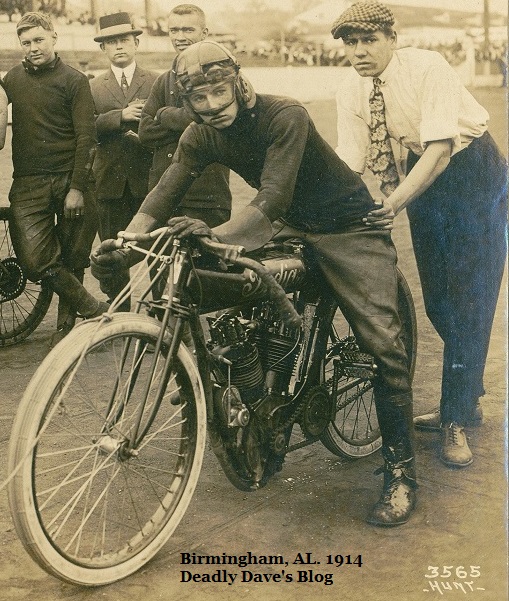
Gene Walker (right)
Birmingham, AL. 1914
This is an article I wrote for the Birmingham History Center 1731 Blog earlier this year.

http://birminghamhistorycenter.wordpress.com/ 

The path that led me to it actually started several years before. I've long had a passion for early American racing motorcycles. These early racers evolved from bicycles and racing them was a deadly serious business. A few years back I purchased and early Harley-Davidson that had been converted for racing. A short time later, my friend Johnny Whitsett sent me some pictures of early Birmingham motorcyclists. Among them was a photo of a motorcycle race at the Alabama State Fairgrounds.

I was surprised to find out that Birmingham, AL.  had held championship motorcycle races at the Fairgrounds beginning in 1906. As I started to try and identify the racers in the photograph, I ran across Daniel Statnekov's article Pioneers of American Motorcycle Racing. Daniel's work details many of the early racers and is a must read for board track racing fans:


In reading Daniel's article, I discovered the story of Birmingham native Gene Walker. During his 10year racing career, he became one of the top motorcycle racers in the country. In trying to learn more about Gene, I discovered he was all but unknown in modern Birmingham. I decided to try to find out more about him and share his story. The following article is the result of that research.

Gene Walker
Birmingham’s Lost Racing Champion


Birmingham’s historic Elmwood Cemetery is the final resting place of several Alabama sports legends, from Paul “Bear” Bryant to Dixie Walker. There is another legend buried there, who is all but unknown in his home town. During his career, his exploits made the sports pages of the major newspapers across the country, and his untimely death was mourned by fans nationwide. In the northeast corner of the cemetery is a simple marble headstone that reads:  Gene Walker 1893-1924.  
          
John Eugene "Gene" Walker
John Eugene “Gene” Walker was born in Plevna, Alabama in November 1893. On June 10, 1893, a few months before Gene was born, his father John Wood Walker Jr. was murdered by William Campbell in Madison County, Alabama. Campbell was later found guilty of voluntary manslaughter in the murder of Gene's father. Gene's mother later relocated her family to Birmingham, Alabama. 

Birmingham News - July 20, 1893 

1910-1913


Gene Walker got his first motorcycle in 1910 and rode it to deliver mail for the local Post Office. He was run over by a car while delivering mail in January 1912.
  
Birmingham News - January 8, 1912

Birmingham had a history of motorcycle racing at the one-mile dirt oval located at the Alabama State Fairgrounds. In October 1912, Walker entered the amateur class of a motorcycle race at the Birmingham Fairgrounds Raceway.  

Birmingham News - October 4, 1912

Gene finished second in the five-mile race that day, but he would go on to win countless races in his twelve-year racing career. 

Photo Courtesy of the National Motorcycle Museum
1912 Birmingham Race Trophy
National Motorcycle Museum Collection


Gene Walker (right) Stubbs Indian Birmingham, AL.
Furman Family Collection
Bob Stubbs, the local Indian Motorcycles dealer, took note of Walker's talents.  He put Walker on a new Indian eight valve racer and allowed Walker to race out of his Indian dealership in downtown Birmingham dealership. 


Gene Walker's 1920 Eight Valve Indian Racer
R. L. Jones Collection

Early racing motorcycles were little more than large bicycles, with large powerful engines, and no brakes. They could reach speeds of 90 mph on the racetracks of the day and racing them was a deadly serious business. The races at the Birmingham Fairgrounds drew large crowds, who came to see the top amateur and professional riders lap the dirt track at a blistering pace. 

By the fall race of 1913, Gene had established a reputation as the man to beat. His competition was established professional racers. Walker's sponsor, Bob Stubbs also rode for Indian. Joe Wolters and Charlie Balke represented Excelsior, with Arthur Mitchell ridding a Flying Merkel. 


Arthur Mitchell - Flying Merkel Racer - O.V. Hunt ca. 1913
Georgia Motorcycle History Collection

Walker won every race he entered during the weeklong fall program, beating all the established professional riders, and set a new lap record for the track. In doing so he earned the respect of some of the top riders in the country.


1914-1915


The following October, Walker entered his first professional race, the F.A.M. (Federation of American Motorcyclists) one hour race, at Birmingham. While he didn’t win, he was able to set a new lap record, and ran with the lead pack throughout the race. Besides his racing, Walker also worked as a Motorcycle Officer for the Birmingham Police Department. He gained quite a reputation chasing speeders on the streets of Birmingham and the story of his police career was featured in a October 1, 1919, New York City Evening World Newspaper article.

The Evening World (New York City)
October 1, 1919


In 1915, Walker was hired as a factory rider for the Indian Motorcycle Company, and moved to the company's headquarters in Springfield, Mass. 


Paul Braun Collection
Walker’s first National win came in 1915 at the F.A.M. National race in Saratoga, N. Y. He would go on to win several professional races, and set several track records each year for the following two years. 


Pittsburg, PA. Daily Post - July 11, 1915


Motorcycle Illustrated - July 15, 1915


In August 1915, Gene Walker was among the eight Indian factory riders sent to the Chicago, IL. Championship race.


Chicago Daily Tribune
August 25, 1915


1916

On July 4, 1916, Walker competed in the biggest race of the year, the 300 Mile Coyote Classic in Dodge City, Kansas.  Walker's fifth place finish in the race was mentioned in this Harley-Davidson factory ad.

July 1920 Harley-Davidson Ad

1917-1918

The next few years were quiet ones for Walker, as professional racing was curtailed for the duration of World War 1. As his mother’s sole support, Walker was not subject to the draft. He returned to Birmingham in 1917, working as a motorcycle machinist for William F. Specht Jr. at the Harley Davidson dealership on 3rd Avenue North. 


World War 1 Draft Registration
Ancestry.com
Walker continued to compete in the races run during this period on a Harley-Davidson. On July 4, 1917, Walker traveled to Atlanta for the opening races at the new Lakewood Speedway.


Atlanta Constitution - July 4, 1917

Walker won two July 4th races at the one-mile dirt oval south of Atlanta. He returned to Lakewood for the Labor Day races, and claimed his first Southern Dirt Track Championship, and finished second in two other races. The day's first race was marred by the death of Atlanta Indian rider Ed Wilcox, who crashed into the fence on the outside of the first turn, while jockeying for position on the first lap. 

At the end of 1917, Walker returned to work at the Indian factory in Springfield, MA. Walker remained there through 1918, working in the testing room. During the next year, Walker would help develop, and test, Indian's newest racers


1919

With the end of World War 1, professional racing resumed in the United States. Walker returned to racing for the Indian factory in 1919 in grand style, winning six National Races. 


Atlanta Constitution May 31, 1919


In June 1919, Walker traveled to Atlanta to compete in the Championship Races at Lakewood Speedway. In the pre-race Atlanta Constitution publicity, Walker appeared with Atlanta Indian Dealer/Racer Harry Glenn Sr., Glenn's five-year-old son Harry Glenn Jr, Atlanta racer Nemo Lancaster, and black racer, Bones the Outlaw. Bones worked for Harry Glenn SR as a mechanic. He was one of Atlanta's famous Black streak Racers.  


Walker dominated the Atlanta Races. He won the one mile, Five mile, and Twenty Mile National Championships races at Atlanta's Lakewood Speedway.


Walker also reclaimed the Southern Dirt Track Championship from Atlanta's Nemo Lancaster, and set a new Lakewood track record. 


Atlanta Constitution - June 4, 1919


The write up on the Southern Championship Race also mentions Walker's job as a Birmingham Motorcycle Police Officer.

Gene Walker leads Shrimp Burns - Atlanta 1919
Furman Family Collection
Later that year, Walker dominated the races at Port Royal, Pennsylvania, and Greeley, Colorado.


In September, Walker returned to Atlanta's Lakewood Speedway for the Labor Day races.


Walker won four races, and set a new track record.

Atlanta Constitution - September 14, 1919


 -
1920

In April 1920, Gene Walker, and amateur rider Herbert McBride traveled to Ormond Beach, Florida for a speed record run. McBride was also from Birmingham, AL., and was picked by Walker to be his amateur teammate.  Between April 12, and April 15, Walker, and McBride set twenty-four new National, and International motorcycle speed records. Walker was credited with the first official 
F. I. M. World Motorcycle Speed Record of 104.12 mph. on a "stock" 61ci. side valve Indian Scout racer.

Gene Walker on Indian Scout Racer - Ormond Beach, FL. in April 1920
Don Emde Collection 
Walker also set a new National Motorcycle Speed Record of 115.79 mph. on a 61ci. eight valve racer.
All of McBride's amateur class records, where faster than the previous professional class records over those distances.

Motorcycle and Bicycle Illustrated - May 1920


Oregon Daily Journal - May 9. 1920

May 1920 Wigwam News
Furman Family Collection

The speed records set by Walker, and McBride became the center piece of Indian Motorcycle Company’s advertising that year. After the record runs, the Indian Power Plus side valve racers referred to as Daytona Indians."


April 1920 Indian Motorcycle Company Ad

Motorcycle Illustrated - February 17, 1921

The record runs were filmed and presented at theaters across the country. No surviving copy of the film is known to exist.

Santa Ana, CA. Register - May 26, 1920

In June 1920, Walker won the half mile Championship race at Greeley, Colorado. 


Greeley Daily Tribune - June 1920

On July 3, Walker set a new track record at the year's biggest race, the Coyote Classic at Dodge City, Kansas. In the race, Walker finished second, behind his former Indian teammate Jim Davis, who was now riding for Harley-Davidson.

Gene Walker Dodge City Kansas - July 1920

The Hutchinson News - July 3 & 6, 1920

On September 12th, Gene Walker won every professional race at the newly opened Logansport, Indiana half mile dirt oval.

Logansport Pharos Tribune
September 13, 1920

At the close of the 1920 season, Motorcycle and Bicycle Illustrated magazine declared Walker a “Champion of Champions”. 


1921

The 1921 season started well for Gene Walker, who won all the races at Greeley, Colorado on May 3, 1921.

El Paso Herald - May 31, 1921


Controversy soon followed Walker's wins at Greeley.  Indian insisted that Walker again compete in the Dodge City race in July. Despite his success at Dodge City the year before, Walker did not like the dusty conditions of the Dodge City track, feeling it was unsafe. Indian thought Walker had committed to Dodge City, but he notified them at the last minute he would not race at Dodge City.

Instead, Walker entered a race in South Bend, Indiana two weeks later. Walker was involved in an accident in the race, after another ride fell in front of him. This was his first accident in several years, but he was not seriously injured. Rumors began to appear in the press that Walker had been released by Indian for refusing to compete at Dodge City. Indian accused Walker going "Pot Hunting". They felt Walker sought an easy payday, against lesser competition.

In the June 13, 1921, issue of Motorcycling and Bicycling, an article on Gene's firing appeared under the Headline:

 "Gene Fired From Indian Wigwam". 

The article contained a telegram from the Hendee Manufacturing Company (Indian Motorcycles) to Gene Walker with the following text:

"Your refusal at the last moment to ride Dodge City after agreeing through Butler to do so has seriously embarrassed this company, consequently you deserve no consideration at our hands. Under circumstances, will require your services are no longer and thank you to turn machines over to Indian dealer, Mr. Schaub, to whom we are wiring today."


(Signed) HENDEE MFG. CO.

The article went on to state: 

"Mr Franklin, and in fact the entire Indian organization, dislike very much to lose Gene Walker.  They realize that he is beyond a doubt one of the finest dirt-track riders in the world, but this action , coming on top of two very similar cases a year ago, forced drastic action.

Gene Walker was an employee of the Hendee Company and as such was was subject to their orders. Therefore, to maintain discipline, the Hendee Company have been forced to sacrifice the services of a very valuable man in their racing Organization."

The article does not mention details of the previous incidents.  Regardless of the bad feelings on both sides, Walker continued to ride Indians through the end of the 1922 season.

Fort Wayne Journal-Gazette - December 11, 1921


1922


July 1922

In July, 1922 Gene Walker broke Maldwyn Jone's World's Record for half mile tracks at Signac, New Jersey.

Fort Wayne Journal-Gazette July 21, 1922

Jones reclaimed the half mile record later that year, but that did not deter Walker.  He finished out the 1922 season by reclaiming the half mile World record for Indian at their home track in Springfield, Massachusetts. 

El Paso Herald - November 4, 1922


1923

Despite that success, Indian released Walker from their team for the 1923 season. The reason given to the press was Walker's refusal ride in the 1921 in Dodge City race.  Walker returned to Birmingham. He continued to race and win races around the country on his privately entered 4 valve Harley-Davidsons.

Gene Walker - 1923 Harley-Davidson 4 valve Racer
Don Emde Collection
1923 Harley-Davidson Ad

Gene Walker continued to dominate the races he competed in during the 1923 season, and his name on a race flyer still drew big crowds of spectators.


The Indian Factory reconsidered their decision to fire Gene Walker, and he rejoined Indian at the end of the 1923 season.  When the racing season ended, Walker returned to his job as a Motorcycle Police Officer in Birmingham.


Santa Cruz News - December 6, 1923

1924


Gene Walker started the 1924 season with a win for Indian at Championship race on the Beverly Hills Speedway oval board track at Los Angeles, California. Then, on April 13th Walker won two races at Ascot Speedway dirt oval in Los Angeles. 

 During the five-lap race Walker, and Harley-Davidson rider Ray Weishaar, were battling for the lead. Walker's Indian teammate, Johnny Seymour drafted past them. This caused Weishaar's bike to go into a wobble, and then skid into the fence on the outside of the track. Weishaar was conscious after the accident, and did not appear seriously injured, but died a couple hours later at the hospital.


San Bernardino County Sun - April 14, 1924

On June 7, 1924, Gene was practicing for a race on the half mile dirt track at East Stroudsburg, Pennsylvania. 


Fairgrounds Racetrack - East Stroudsburg, Pennsylvania
Stroud Township Bicentennial Collection

While taking practice laps, he struck the rear wheel of a tractor that had pulled onto the course, and then collided with a tree stump on the track's infield.


The severely injured Walker was transported to Rosenkrans Hospital. His wife Eunice, who was pregnant with their third child, traveled by train from Birmingham to Pennsylvania, and stayed by his bedside until his condition seemed to improve.  Assured by Gene's doctors, that he would recover, she returned to Birmingham. When she got off the train in Birmingham, she was met by an Indian Motorcycle Company representative, who told her Gene had died of his injuries on June 21, 1924.

Scranton Republican - June 24, 1924

Birmingham News - June 24, 1924
Motorcycling and Bicycling - June 25, 1924

On June 24, 1924, Gene Walker's family, and friends gathered at Elmwood Cemetery to say farewell to one of Birmingham's most famous sons. Birmingham Police Motorcycle Officers and the Birmingham Motorcycling Community escorted Gene's body to Elmwood. Walkers' friends, and fellow racers served pall bearers.

Gene Walker was 31 years old at the time of his death and was survived by his wife Eunice Harwood Walker and daughters, Ruth Jane, Eunice, and Elizabeth Gene Walker. His youngest daughter Elizabeth Gene was born seven months after her father’s death. 

The newspaper in East Stroudsburg, PA. started a benevolent fund for Gene's family.


A few days after Gene’s death, Birmingham News Sportswriter Zipp Newman, eulogized the hometown motorcycle celebrity under the headline: 


MOTORCYCLE RIDING HAS LOST ITS GREATEST STAR IN THE DEATH OF WALKER”

"Throughout his career, Walker always claimed Birmingham as his home and continued to send a portion of his earnings to his mother in Birmingham. He made the name Birmingham a household word. He saved his money and looked after his family." 
    
 In the June 25, 1924, edition of Bicycling World and Motorcycle Review a tribute to Walker. The author is identified only as Eee Bee.


After Gene's death, the Indian Motorcycle Company released a memorial ad dedicated to their lost racing team member.


Indian Motorcycle Company
Memorial Ad - June 1924

During his 10-year professional career, Walker won 19 championship and numerous non-championship races on both board and dirt tracks. He set track records on many of the tracks as well as several motorcycle land speed records. His lap record at the Birmingham Fairgrounds Raceway was not broken when the track stopped racing for World War 1.


In 1998, Gene Walker was inducted into the American Motorcyclist Associations Hall of Fame.

Gene Walker's Headstone 
Elmwood Cemetery Birmingham, AL.
YouTube video containing the only known footage of Gene Walker racing:

http://www.youtube.com/watch?v=QPZY-MUx8qk


Sources:

Ancestry.com

Atlanta, GA. Constitution

Birmingham, Alabama Public Library Archives

Birmingham History Center

Birmingham Ledger

Birmingham News

Chicago, IL. Tribune

Dave Dobner

Don Emde Collection

Elmwood Cemetery - Birmingham, AL.

El Paso, TX. Herald

Ft. Wayne, IN. Journal-Gazette

Furman Family Collection

Greeley, CO. Daily Tribune

Hutchinson, KA. News

Johnny Whitsett Collection

Logansport Pharos Tribune

Motorcycle Illustrated

Motorcycling and Bicycling

National Motorcycle Museum Collection - Animosa, Iowa.

New York, NY. Evening World

Paul Braun Collection

R.L. Jones Collection

San Bernardino, CA. County Sun

Santa Cruz, CA. News

Sara Thiem Collection

Scranton, PA. Republican

Stroud Township Bicentennial Collection 

The Bicycling World and Motorcycle Review

Youtube.com

Wigwam News


Epilogue:

In the month's following the posting of this article on the Birmingham History Center Blog, I made contact with three of Gene's Walker's Granddaughters, and one great granddaughter. While they had some information on Gene's racing career, much had been lost after the death of Gene's wife Eunice Harwood Walker. I was able to share articles and photographs with them. I had the honor of meeting Gene's granddaughter Sara Thiem, and her husband Warren as they passed through Birmingham on their way home to Bozeman, MT. Sara had been searching for her grandfather's grave for many years, and had all but given up on finding it. I was able to take her to her grandfather's grave in Elmwood Cemetery. During that visit, she discovered the graves of several other family members. It was a very touching experience to help her reconnect with her long lost grandfather.

Granddaughter Sara Thiem and Author 
visiting Gene Walker's Grave

While researching this article, my wife Kim and I, spent several hours in the Birmingham Public Library searching their microfilm archive of the Birmingham News. We were able to locate the June 1924 article by Zipp Newman announcing Gene Walker's death. This article allowed me to locate Gene Walker's grave at Elmwood Cemetery and to share it's location with Gene's family. Thank you to the staff at the Birmingham Public Library Archive and the folks at Elmwood Cemetery for their assistance.

Birmingham New June 24, 1924

Motorcycle Racing Historian Don Emde, shared this June 26, 1924 Motorcycle and Bicycling Magazine article on Gene Walker's death from his collection. Thank you Don. Without your assistance, this article would not have been possible.

Bicycling and Motorcycling - June 25, 1924

Gene Walker is primarily associated with the Indian Motorcycle Company, having worked for both the local dealer and the factory racing team in Springfield, MA. However, when I located a copy of his World War 1 Draft Registration, Walker stated on it he worked as a machinist for the Harley-Davidson Dealer William F. Specht, Jr. at 1714 Third Avenue in Birmingham, AL. It also shows he was the sole support for his widowed mother, Martha J. Walker. He was exempted from military service, and continued to send a portion of his winnings to her in Birmingham throughout his racing career.

Gene Walker's World War 1 Draft Registration - Ancestry.com