Thursday, February 02, 2017

Montgomery, Alabama's Van Diver Park Race Track - Episode #40

By: David L. Morrill
@ Mototique

Updated - February 17, 2017

This episode is a continuation of my search for early Alabama motorcycle racing history.

In the early 1900s, motorcycle racing was sweeping the country drawing large crowds of spectators to local horse tracks, and the new wooden  motordromes. By 1909, Birmingham, Alabama was the established motorcycle racing capital of Alabama. The Alabama State Fairgrounds Raceway began holding motorcycle races in July 1907. Birmingham Indian Motocycle dealer, Robert Stubbs, was recognized as the Southern Champion. Stubbs was a member of the Indian Factory Racing Team, that set several speed records at Ormond Beach, Florida in March of 1909.

Robert Stubbs - Ormond Beach, Florida - March 1909
Chris Price @ Archive Moto


Montgomery, Alabama's Capital City, would soon follow Birmingham in embracing the motorcycle racing craze. In 1907, the legislature of the State of Alabama passed a bill funding upgrades to fairgrounds around the State of Alabama. The Montgomery County Fairgrounds was the recipient of $8,500. to up grade their facilities. Among the improvements added in the next year, was a large horse track. The exact length, and dimensions, of the Montgomery County Fairgrounds track at Vandiver Park are lost to time, but from the few surviving photos, it appears to be a 1 mile oval dirt track. Horse racing was a popular fair exhibition, and with the increasing popularity of automobile racing, the Vandiver Park track also began hosting automobile meets. Motorcycle racing was soon to follow.

In May of 1909, a motorcycle race was included at the Fairgrounds race track Automobile Meet. Bob Stubbs traveled to Montgomery, and "easily won the 5 mile handicap." Stubbs also rode a 5 Mile Exhibition for the crowd that day.


Bicycling World and Motorcycle Review - May 5, 1909

When the professional motorcycle races held in conjunction with the 1910 Montgomery County Fair during October rolled around, Bob Stubbs again dominated, and his win received coverage in the national racing press.

Motorcycle Illustrated - November 1, 1910

Bicycling World and Motorcycle Review - October 29, 1910
With the formation of the Montgomery Motorcycle Club in mid 1911, amateur racers were ready to tackle the big  dirt oval. The club held a members only session at Vandiver Park in late August 1910, and planned a regular race in September. These events were mentioned in the September 7, 1911 edition of Motorcycle Illustrated magazine.

Motorcycle Illustrated - September 7, 1911
On September 26, 1911, the club hosted it's first amateur race. The proceeds from the race went in support of the Anti-Tuberculosis League of Montgomery.

Bicycling World and Motorcycle Review - September 9, 1911
In October, 1911, the Montgomery County Fair returned to the Capital City, hosting both amateur, and professional motorcycle races. Just a week before the fair, Bob Stubbs, received a serious eye injury during a race at Birmingham. While Stubbs was on his way to a full recovery, his wife convinced him to retire from track racing. This opened the door for one of Stubbs' sponsored riders, Gail Joyce to replace Stubbs.

Bob Stubbs Indian Riders -Birmingham, AL. ca. 1913
Richard Gayle, Gail Joyce, Gene Walker
Furman Family Collection
This would not be a cake walk for Gail Joyce. He would face serious competition at the Montgomery race from Texas rider Eddie " The Texas Cyclone".  Hasha, who was quickly proving he was one of the best riders in the south. In September of 1910, Hasha had defeated Bob Stubbs at Waco, Texas riding an early Harley-Davidson racer loaned to him, by Harley-Davidson co founder Arthur Davidson.

Motorcycle Illustrated - September 15, 1910
This was a rare move for Harley-Davidson, who had up to that point had avoided the deadly business of track racing. For the Montgomery race, Hasha, like Gail Joyce, would be back on his Indian twin cylinder racer.

Bicycling World and Motorcycle Review - October 28, 1911
When Hasha, and Joyce squared off on the track, later that week, Hasha won three races, with Joyce claiming two races. Period press accounts sometimes confuse Gail Joyce's first name, with his Stubbs Indian teammate Richard Gayle's last name.

Eddie " The Texas Cyclone" Hasha - 1912
The next race event held was held in conjunction with an aviation, and automobile exhibition at the Spring Celebration on March 4, 1912.
Motorcycle Illustrated - March 7, 1912
That event was followed up on March 10, 1912, holding the races that had been rained out the previous weekend.

Bicycling World and Motorcycle Review - March 16, 1912
Sadly, on September 9, 1912, Eddie "The Texas Cyclone" Hasha, along with fellow rider Johnnie Albright, and 5 spectators were killed in a horrendous crash at the Vailsburg Park Motordrome board track in Newark, New Jersey.

Asbury Park, New Jersey Press - September 9, 1912
I have been unable to find any further mention of motorcycle races at the Vandiver Park track in the period motorcycle press. There is however one item I found, which may explain why the track did not hold more races. During the 1912 Montgomery County Fair, Aviator Louis Mitchell was killed in a crash barnstorming over the Fairgrounds track. This followed a similar fatality during the fair in Birmingham a week earlier. Some ten thousand spectators observed the Vandiver Park crash, and City father's may have re-evaluated such dangerous exhibitions, and races.

Greenville, Alabama Advocate - October 30, 1912
The racetrack at Vandiver Park had been used as a training site for Alabama National Guard units beginning in the early teens. With America's build up to entering World War 1, the Vandiver Park racetrack/Montgomery County Fairgrounds site was condemned. It was taken over by the United States Army, as a training site in 1916, and renamed Camp Sheridan. It was just 50 years from the end of the Civil War, and having a U. S. Army camp named after a prominent Yankee general just a few miles from the original Capital of the Confederacy, was probably not very popular with some Montgomery residents.

 While I was unable to locate any period racing photos of the track, a portion of one of the dirt track's turns and straight away can clearly be seen between the building in this photo of Camp Sheridan.

Camp Sheridan @ the old Vandiver Park Race Track - ca. 1917
State of Alabama Archives
Camp Sheridan was mentioned one final time in the February 7, 1918 edition of Motorcycle Illustrated magazine. The article was about a visit by the Goodyear Friars of the Goodyear Tire & Rubber Company in Akron, Ohio. The Friars were entertaining former Goodyear employees, who were receiving Army training at both Camp Sherman in Ohio, and Camp Sheridan in Alabama.

Motorcycle Illustrated - February 7, 1918
The site of the old Montgomery County Fairgrounds and race track is marked by a State of Alabama Historic Marker, recognizing it as the scene of Camp Sheridan during World War 1.


Sources:

Asbury Park, New Jersey Press

Bicycling World and Motorcycle Review - Smithsonian Collection

Chris Price @ Archive Moto

Furman Family Collection

Google

Greenville, Alabama Advocate

Motorcycle Illustrated - Hathi Trust Collection

Newspaper.com

State of Alabama Archives

State of Alabama Historic Markers


Friday, December 30, 2016

Rat Racer Returns - Episode #39

December 31, 2016

By: David L. Morrill

@MototiqueRacing
Ocala, Florida


Rat Racer at the Rat's Hole Bike Show at Ocala, FL. Bike Fest
Photo by Julius Williams

Well, it's been about a year since I have given an update on my 1921 Harley-Davidson replica racer, which I call "Rat Racer." It's always a continuing work in progress, with several changes since I last wrote about it in Episode 29. To start with, it made an appearance in the Rat's Hole Bike Show at Ocala Bike Fest this past July. Teddy Smith, and his staff at the Rat's Hole do a first class job and were great folks to work with.

The day of the show, a photo of me sitting on Rat Racer appeared in the Ocala Star Banner article on Bike Fest. Pretty cool!


We were lucky enough to walk away with a win in the Pre 1935 Antique Bike Class and received a great plaque designed by Teddy Smith.

Rats Hole Bike Show Plaque
By Teddy Smith


With the bike show commitment completed, I could concentrate on converting Rat Racer to ride on the street. There were several problems to solve, including working brakes/clutch, and a better carburetor. I tackled the carburetion problem first. Over the past few years, I have tried both period Schebler & Linkert carburetors. The problem was neither could be leaned out enough to use on a single cylinder bike. I finally decided to go with a 1970s era 34mm Mikuni VM carburetor. Yeah, I know it's blasphemy to use a modern Japanese carburetor on a 95-year-old Harley-Davidson. Funny thing is, before switching over to fuel injection, all the modern carbureted Harleys used Japanese carburetors.


The Mikuni, being a much more modern carburetor, has several advantages. First, they are relatively cheap, especially compared to period alternatives. Second tuning parts are readily available and reasonably priced. Finally, I am very familiar with tuning these Mikuni carburetors from my AMA road racing days. With a little tuning, the engine ran strong throughout the rev range with the Mikuni.

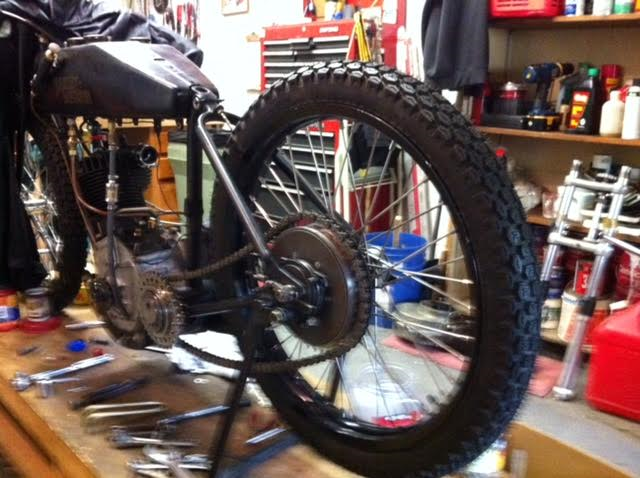
The next problem was a working brake. The rear wheel assembly with the Free Wheel Clutch assembly I am using, also comes with a period style drum brake on the right side of the hub. The trouble is the hub assembly with the clutch and brake, would no fit my racing frame. I opted to use the hub with the clutch assembly and find an alternative brake for the front end. This required a pretty significant offset in the lacing of the rear wheel to get the tire aligned with the centerline of the frame, but after a few hours of painstaking adjustment, everything lined up.

Free Wheel Clutch Rear Wheel After Alignment

After some time searching Bay, I located an early 80s Kawasaki dirt bike front wheel with a small drum brake. 

Front Wheel Assembly with Drum Brake

With all the major problems solved, it was time for a road test.

Rat Racer Road Test - November 6, 2016
Lee Merkel Field - Sylacauga, Alabama

The bike ran very well, reaching about 55pmh, tracking straight, the plug reading was good, and the front brake worked superbly. Mission accomplished!

Rat Racer - Road Ready

Sources:

Deadly Dave's Collection

Ocala Star Banner

Julius Williams

Saturday, December 26, 2015

Lena Cohen Rose - Early Motorcycle Thrill Show Rider - Episode #38

December 26, 2015
March 31, 2022 Update

By: David L. Morrill

@ MototiqueRacing
Sylacauga, Alabama


Birmingham, AL. News - October 13, 1913

Over a year ago, I was doing research at the Birmingham Public Library Archive. As I scrolled through the microfilm of the October 1913 editions of the Birmingham News, I suddenly came across a grainy newspaper photograph of a women wearing an early leather motorcycle helmet. Because I was pressed for time, I printed out the article, without reading it.  Sadly, that article sat in a stack of some 20 pages printed out that day for over a year.

One day, I shuffled through that stack looking for another article. When I came across her photo, I finally took time to read the article. It was then that I realized it documented one of the earliest known women to perform in a motorcycle thrill show.

In 1911, the first Motordrome Thrill Show was built in Luna Park on Coney Island New York. These early Motordrome shows where the precursor of the motorcycle Wall of Death Shows that still travel the country today.


New York Times - July 3, 1911


This steeply banked circular wooden track was sunk into a hole in the ground. Descriptions in the press vary slightly, listing the track's diameter at either 65, or 80 feet. The wooden planks making up the track were laid vertically at either a 65, or 72 degree angle. This formed a track that looked like a large saucer, hence the name "Saucer Tracks.". The riding surface of the track was only two feet wide, but the small racing cars, which first used the track could hit 50 miles an hour, ripping round the tiny Motordrome.

New York Times - April 30, 1911
The New York Daily World - August 10, 1912


Motorcycle Illustrated - August 22, 1912
Motorcycles soon took to the track as well, and large crowds of enthusiastic spectators watched the riders zip around at breakneck speed, standing on a wooden platform around the top of the Motordrome. On May 18, 1912, the danger of the thrill show, struck home. Rider "Daredevil Dick" was lapping the track on his motorcycle up close to the top of the wall. Suddenly he got too high on the wall, and he and his motorcycle were propelled out of the attraction. His motorcycle struck several spectators on the way out injuring them, and "Daredevil Dick", whose real name was William Mullen, was killed.

Washington Post - May 19, 1912

About this same time, Lena Cohen, of Savannah, Georgia, was working as a stenographer and bookkeeper for a Wall Street Firm was drawn into this dangerous profession. After meeting her future husband, "Wild Billy" Rose, one of the motor dome thrill show riders in 1912, the adventuresome girl convinced Rose to teach her to ride the Motordrome.  Lena was an accomplished bicycle rider and took to the risky sport quite easily.  Soon she quit her Wall Street job to ride in the Motordrome show. She is said to have performed at the Coney Island attraction during the summers of 1912, and 1913.

By 1913, Lena had married Billy Rose, and they were traveling with a new "portable" circular wooden motordrome that appeared in Fairground Midways across the South.

Motorcycle Illustrated - May 15 1913
The new portable motordrome is described in a September 13, 1913 Nashville Tennessean article:

Nashville, TN. Tennessean - September 13, 1913
It was similar in design to today's Wall of Death Shows, except the track was only 60 feet across, and was banked an angle of about 65 degrees. These early traveling Motordromes came to be known ad Whirl of Death attractions.

In May 1913, the American Motordrome Company's portable Whirl of Death Motordrome attraction made its first visit to Durham North Carolina for a Carnival Fund Raiser. Durham motorcycle dealer S. E. Rochelle (far left) was photographed, along with the attraction performers, if front of the attraction.  This is one of the few known photographs of an early traveling Motordrome attraction.

American Motordrome Company Portable Whirl of Death Motordrome
Durham, NC. May 1913
S. E. Rochelle Collection - Durham County Library
Durham, NC. Daily Herald Ad - May 4, 1913
In October 1913, Lena Rose, and her husband, brought their Motordrome Thrill Show to the Midway at the Alabama State Fairgrounds in Birmingham, Alabama. 

Alabama State Fairgrounds Midway
O.V. Hunt Collection ca. 1914

A lengthy article detailing Mrs. Rose's career appeared in the Birmingham News on October 3, 1913. 

Birmingham, AL. News - October 13, 1913

The Birmingham article mentions that Lena Rose tried to get the Fair Management to let do some laps on her motorcycle around the Fairgrounds Raceway's 1 mile dirt oval. The Fairgrounds Raceway was hosting National Championship motorcycle races, with some top professionals in the country, competing during the fair. Fair Management, and Race Officials, would not allow her on the track, which really disappointed Lena, as she had ridden on several dirt track, along with the Vanderbilt Cup Auto Racecourse in her hometown of Savannah.

After Birmingham, there is no further mention of Lena as "Mrs. Billy Rose."  Perhaps her husband finally convinced her to give up the dangerous pursuit. Interestingly, a female Motordrome rider named Rose Moore and billed as the "Champion Motorcycle Rider of America", begins appearing with the Allman Brothers Big Shows Motordrome in 1914. 

Lead, SD. Daily Call - June 26, 1914


It's possible, Lena and Billy split up. She may have gone on the road with another show, along with a new stage name, or it may be a totally different performer.  It is interesting there are no ads for Rose Moore before 1914. After the 1914 season there are a couple mentions in Fair-Carnival ads for "Motordrome - Dare Devil Rose" in 1917.

What happened to spunky lady rider from Savannah, Georgia has been lost to time.  Billy Rose continued to travel with his "Wild Billy's Motordrome, for years to come. Two 1920 ads indicate that Wild Billy Rose was still using female motordrome riders, so it's possible Lena was still performing in Billy's Show.

Billboard Magazine - January 31, 1920
Logan-Pharos, IA. - May 24, 1920

A July 22, 1939 Billboard article on the New York World's Fair indicated that Billy Rose had been engaged to bring his Motordrome "Wall of Death" attraction to the Fair. There was no mention of Lena in the article. It did also state that Rose operated a Motordrome attraction at Coney Island from 1909-1910. and that Rose "is said to be the originator of the portable Motordrome."  There is a single photograph of the Rose's Motordrome from the 1938 World's Fair, but it is under copyright. 

Regardless of what happened to Lena Rose, she was a veteran performer of the earliest Motordrome Thrill Shows in the country and helped start the tradition of women Wall of Death performers that continues to this day.


Sources:

Billboard Magazine

Birmingham Public Library Archives

Birmingham News

Lead, SD. Daily Call


Motorcycle Illustrated

Nashville Tennessean

New York Times

O. V. Hunt Collection


Washington Post

Sunday, November 01, 2015

Twice Around the Clock at the Stadium Motordrome - Episode #37

November 1, 2015

By: David L. Morrill
@MototiqueRacing
Sylacauga, Alabama

Motorcycle Illustrated - October 3, 1912

By the fall of 1912, an exciting new sport was sweeping the country. Motordrome racing featured top motorcycle racers from around the country competing on steeply banked circular board tracks, called "Saucer" tracks for their round shape. Motordromes were built in major cities across the country and were typically 1/4 to 1/3 of a mile in length. They could seat crowds of up to ten thousand spectators in bleachers that surrounded the top of the tracks, and electric lighting allowed night racing.  The best motorcycle racers in the country were hired to race on them.

New York City boasted two of the new Motordromes just a short distance from the city. The Vailsburg Park Motordrome was in Newark, New Jersey, and the Stadium Motordrome was located in Brighton Beach, New York. These tracks were popular and drew large crowds to races held several days a week.

Motorcycle Illustrated - September 1912

That changed on September 8, 1921, when popular racers Eddie Hasha, and Johnny Albright, were killed, along with six spectators in a crash at the Vailsburg Park Motordrome in Newark.

New York Times - September 9, 1912

Newark City Father's quickly closed the track and banned motorcycle racing from the city. The Brighton Beach track stayed closed for a week in respect to the deaths of the spectators, and the two riders, who had also regularly competed at the Brighton Beach track.

Stadium Motordrome - Brighton Beach, New York
Library of Congress Collection

When the Stadium Motordrome reopened a week later, it was announced that a "Twice Around the Clock"  24 hour motorcycle race would be held at the track on September 20-21. The purse was a $5500, with the winning team of two riders receiving $2500 and a Gold Championship Cup. This was a princely sum, at a time when major races might pay $500 in gold for a win and was clearly an attempt to draw crowds back to the track, after the tragic crash at Newark.

Brooklyn Daily Eagle - September 1912

A total of five teams, with two riders sharing each, bike would compete in the race: 

Billy Shields & George Lochner - Indian

John Cox & James McNeil - J.A.P.

Arthur Chapple & George Spencer - Indian

  Billy Wray & William Vanderbury - Indian

 H. H. Thomas & Ray Veditz - Indian

 Earle Eckle & Herbert Ayrault were not initially entered in the event but would play a part in the later stages of the race. All the teams rode Indian Motocycles, except the team of John Cox & James McNeil who shared a J.A.P. powered racer.  

Many racers, and fans, thought this was a foolhardy endeavor, as Motordrome races typically lasted no more than an hour or two. These races rarely involved pits stops for refueling, repairs, or rider changes. Many thought the fast, but delicate racing bikes of the time, would only last a few hours. Just how long the racing tires of that day would last on the steep wooden banking was another unknown.

Stadium Motordrome 24 Hour Competitors
Motorcycle Illustrated - October 3, 1912

At 10:10 PM on September 20th, 1912, a starter's pistol was fired and a crowd of ten thousand spectators watched as the five teams of riders took to the track. The team of George Lochner & Billy Shields, riding an Indian, quickly jumped in the lead, with the other teams in hot pursuit. At the end of the first hour Lochner & Shields led, with Chapple & Spencer in second, and Cox & McNeil in third.

Brooklyn Daily Eagle - September 22, 1912

While many thought the machines were the weak link, it was some of the riders, who were not up to the task at hand. At the six-hour point, the team of Thomas & Veditz retired from the race. As the sun rose on the September 21st, many riders were complaining of leg cramps, and kidney pain. The track physician found that John Cox was having heart palpitations, and he was retired from the event.

This is the point where the race scoring started to get complicated. All the teams would spend the next 3 hours in the pits, to rest. During this break in racing, Eckle & Ayrault, were sent out on the track to keep the crowd occupied. At the end of the three-hour break, Eckle was allowed to team with McNeil on the J.A.P. This was the first of several shifts in the makeup riders of the teams.  At the tenth hour Vanderbury retired, so Wray teamed with Veditz.  At the twentieth hour, both Veditz and Spencer retired, leaving Wray to finish the race with Chapple.

When 10:10 PM on September 21st rolled around, Shields & Lochner on an Indian, having completed 21 hours of racing, won the race. They were followed by McNeil & Eckle in second on the J.A.P., with Chapple & Wray in third on an Indian.  Many spectators were not satisfied with the final results, and complained Eckle had been teamed with McNeil, and Eckle did not start the race. The racers were just too exhausted to make a serious issue of the final results. It was however clear to everyone, that the winning team of Shields & Lochner could have easily gone the full 24 hours.

Confusion also arouses over how many miles the top three teams had traveled during their 21 hours of racing. The winning team of Lochner & Shields were credited with having traveled 1374 miles plus two laps, some 4124 laps, around the 1/3-mile track.  It was learned track officials had estimated the number of laps each team would have traveled during the 3-hour safety break, and that number of laps was added to each team's total mileage. The Goodyear Tire Company used those mileage totals in their post-race advertising.

Goodyear Tire Ad
Motorcycle illustrated - October 3, 1912

Despite the questions, race officials finalized the results, the prizes were distributed, and the first, and probably only 21 Hour Motordrome Race slipped into history. The toll this race took on all the riders, was captured in a local newspaper photograph of an exhausted Arthur Chapple taken after the race.

Brooklyn Daily Eagle - September 22, 1912
Sources:

Brooklyn Daily Eagle

Library of Congress Collection

Motorcycle Illustrated

New York Times

Thursday, October 22, 2015

How Racing Teams Worked 100 Years Ago - Episode #36

October 22, 2015
Updated - December 31, 2015

By: David L. Morrill

@MototiqueRacing
Sylacauga, Alabama

Indian Racing Team Fort Erie, Ontario - July 1911
Chris Price @ Archive Moto

This photo was originally shared by Chris Price of Archive Moto. According to Chris, it shows the Indian Racing Team Camp, known as the Wigwam, at the FAM Championship Race held at Fort Erie, Ontario in July 1911.

This enhanced section of the above photo was shared by Marcello Villada. It gives us a rare glimpse into the logistics of professional motorcycle racing in the early teens. It shows Indian Racing Team members, along with the shipping crates for their race bikes.  So how did this work?

Marcello Villada Collection

The various motorcycle companies involved in racing, would prepare their bikes at their race shops. Once the bikes were prepared, they would be loaded into the crates shown in the photo, for shipping.

Maldwyn Jones and his Flying Merkel Racer
 with his shipping crate - 1914
Ralph Goins Collection

The bikes were then shipped by rail, accompanied by mechanics, to the races which were held across the country.


Indian 8 Valve Racer
Barber Vintage Motorsport Museum Collection

In the meantime, the racing team members would receive telegrams instructing them to travel to the races, by rail, and arrive on a specific date. When the bikes arrived at the rail depot of the towns, where the races were held, the were transported to the track by either truck, of by horse drawn livery wagons.

Harley Racers headed to the Dodge City Races
R. I. Jones Collection

When the races were over, the bike were then returned to the factories, and the riders returned to their home cities.

This is a rare glimpse behind the scenes of professional motorcycle racing over 100 years ago!

Sources:

Barber Vintage Motorsports Museum Collection

Classic American Iron

Chris Price @ Archive Moto

Marcello Villada Collection

Ralph Goins Collection

Wednesday, September 16, 2015

Press Release #7

By: David L. Morrill
@ Mototique


A big thank you to the folks at MetroJacksonville.com (Jacksonville Beach, Florida) for including a photo, and a link to Deadly Dave's Blog in their recent story 8 Facts You Didn't Know About Our Beaches.


To read the story on Jacksonville, FL. early motorcycle racers Jonathan Yerkes and Bert Camplejohn click on the link below:

Jonathan Yerkes & Bert Camplejohn - Jacksonville's Early Racing Champions - Episode #14

Sources:

Bicycling World & Motorcycle review

MetroJacksonville.com

Friday, July 10, 2015

100 Years Ago Today - Episode # 35

July 7, 2015
Updated - August 6, 2015

By: David L. Morrill

@MototiqueRacing
Sylacauga, Alabama


Gene Walker at Bob Stubbs Indian Dealership in Birmingham, AL. ca. 1913
Furman Family Collection


100 Years ago today, a young Birmingham, Alabama motorcycle mail clerk, took his first step towards becoming one of the most accomplished professional motorcycle racers of his time.

On July 10, 1915, Gene Walker won the Five Mile National Championship Race at Saratoga, New York. This was Walker's first season as a member of the Indian Motocycle's Factory Racing Team.


Motorcycle Illustrated - July 15, 1915

Pittsburgh, PA. Daily Post - July 11, 1915

During his ten-year racing career, Walker won 19 National Championships, numerous non championship races, and set track records at racetracks across the country.

Atlanta Constitution - September 1919

In April 1920, he set the first officially recognized motorcycle land speed record for Indian at Ormond Beach, Florida.

Indian Motocycles Wigwam News - May 1920

Indian Motocycle Ad - 1920
Walker died of injuries sustained in a practice crash in June 1924 at the age of thirty.

Birmingham, AL. News - June 1924
Indian Motocycle Memorial Ad - June 1924

Gene Walker was inducted into the American Motorcyclist Association's Hall of fame in 1998.


To read more about Gene Walker's career please check out Gene Walker, Birmingham's Lost racing Champion - Episode #2 @


Sources:

Atlanta, GA. Constitution

Birmingham, AL. News

Furman Family Collection

Gene Walker, Birmingham's Lost Racing Champion - Episode 2

Hendee Manufacturing Company - Indian Motocycles

Indian Motocycle Wigwam News

Motorcycle illustrated

Pittsburgh, PA. Daily Post