Sunday, November 03, 2013

Motordrome Racing's Darkest Days, Newark, NJ. & Ludlow, KY. - Episode #19

November 3, 2013
Updated - July 30, 2015

By: David L. Morrill
@MototiqueRacing
Ocala, Florida

Much has been written about the events that took place at the Vailsburg Motordrome board track in Newark, New Jersey on September 8, 1912, and later at the Lagoon Motordrome in Ludlow, Kentucky on July 30, 1913. As racers prepared for these two events, no one could expect the tragedies about to unfold. The two tragic events, lead to the eventual end of Motordrome racing. My intention in telling this story, is not a rehash of the events of those days, but show how the press covered the events, and how that coverage changed early racing.

Vailsburg Motordrome - Newark, New Jersey

In July 1912, famed board track builder Jack Prince completed his latest venue, the Vailsburg Motordrome, outside Newark, New Jersey. This track was located only about 20 miles from the recently opened Brighton Beach Motordrome. Prince had some of his best riders in country under contract racing at Brighton Beach. They would now have a second track to race on, which was also in the New York City market.

Brighton Beach Motordrome - August 1912
Fort Wayne Daily News

Vailsburg was the latest of the circular board tracks, often referred to as "Saucer Tracks". This was due to the fact their steeply banked circular design looked like a large saucer. These tracks allowed the racing motorcycles of the day to reach speed of close to 90 miles per hour. They also allowed the spectators, who were seated in grandstands above the top of the racing surface, to get a close up look at the action. Fans often stood along the railings to watch the riders, who flew past at breakneck speed just a few feet from the crowds of spectators.


Eddie "The Texas Cyclone" Hasha - Newark 1912
Pioneers of American Motorcycle Racing
Daniel K, Statnekov

The Vailsburg Motordrome opened with a full program of motorcycle racing on July 4, 1912. The event drew a crowd of 8000 spectators.  Newark Mayor Jacob Haussling fired a starters pistol to start the first race. Freddie West of San Francisco won the first professional race held at Vailsburg.

New York Times - July 5, 1912

The July 5th New York Times Sports Page also reported the crash of Brooklyn Rider Freddie Mercer, in the final race of the day at the nearby Brighton Beach Motordrome on July 4th. This was the first serious crash at the newly opened track. Mercer broke several bones but had no life-threatening injuries.

New York Times - July 5, 1912

On July 14th, the sports page of the New York Times featured an article on a race at Vailsburg under the headline " CONSTANT BREAKS RECORD". The article detailed the days races and the new track record set by J.U. Constant in the one-mile exhibition.  The article refers to the Vailsburg track as a "four lap" track", meaning the track was 1/4 of a mile in length, and required four laps to complete a one-mile run. Constants completed the mile run in just 46 seconds, giving him an overall speed of 78.26 miles per hour.

New York Times - July 14, 1912

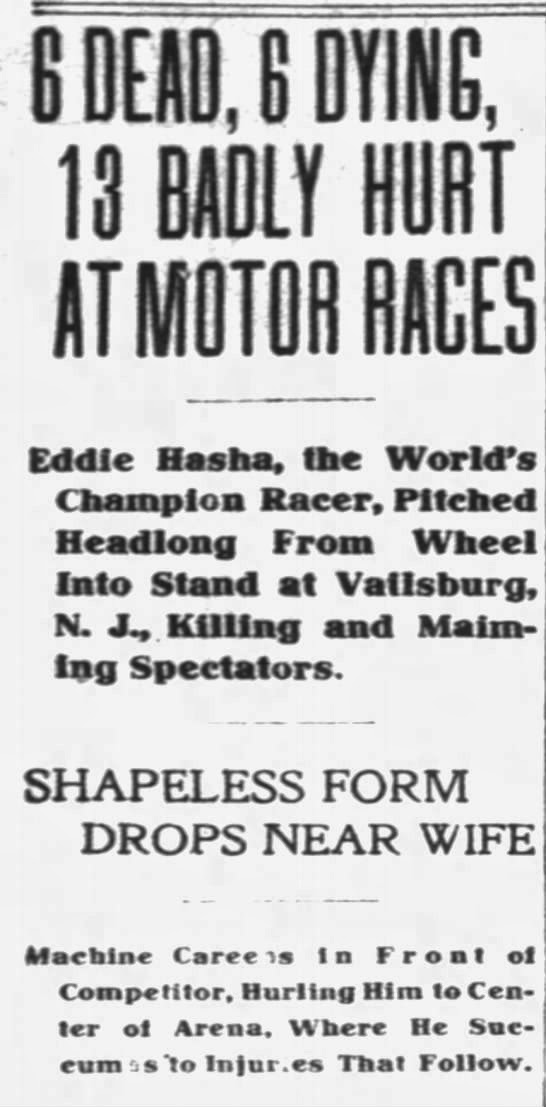
The races returned to Vailsburg, on Sunday September 8th. At about 5 PM, the riders took to the track for the five-mile race. As the race began, Eddie "The Texas Cyclone" Hasha on an Indian, was leading fellow Indian rider Ray Seymore. Hasha's bike developed a miss fire, and Seymore took the lead. Hasha made an adjustment to his carburetor, and he re-entered the race at the top of the racetrack. Hasha's bike suddenly took a sharp turn crossing the black warning line at the top of the racing surface. Hasha traveled about a hundred feet along the three-foot spectator railing at the top of the track, striking the heads of numerous spectators. He then struck a large roof post and was hurled into the spectator seating area. Hasha's bike slid down the banking into the path of fellow rider John Albright, who was thrown from his bike.

Fort Wayne Daily News - September 11, 1912

When the dust cleared, Hasha was dead of a broken neck, Albright was seriously injured, and five spectators were either dead or dying. The crash, and resulting carnage, caused a spectator stampede out of the grandstands, injuring numerous spectators. Albright died of his injuries later that day. The final death toll from the horrific crash was eight, which included Hasha, and Albright, along with six spectators. Three of the dead, were young boys twelve to fourteen years old.

There is a phrase in modern television journalism, "if it bleeds, it leads," meaning viewers are drawn to human tragedy. This is not a new phenomenon, as the newspapers of the early nineteen hundred often used sensational headlines to attract readers to their newspapers. By the time of the Newark accident, there had been several deaths of both riders, and spectators, at motordromes around the country. The Newark accident was tailor made for this type of story. No less than the New York Times had an article on the crash on their front page.

New York Times - September 9, 1912
In the next few days, and weeks, headlines, articles, and diagrams detailing the crash appeared in newspapers across the country.

Newspaper Headlines September 9, 1912

Sandusky Register

Atlanta Constitution


 Inter Ocean


Decatur Daily Review  


Fort Wayne Daily News

Washington Post

McKinney Courier-Gazette 


On September 10th, articles began to appear in newspapers across the country identifying the victims of the Vailsburg accident.

Washington Post

This September 10th article in the Washington Post also mentions the death of rider Curtis Edwards at the Riverview Motordrome in Chicago and September 9th. The wives of Eddie Hasha, and Johnny Albright, had both witnessed their husband's fatal accidents. They now claimed their husband's bodies and returned with them to their home states for burial. The article also makes mention that a previously scheduled race at Vailsburg the following Sunday "will be prohibited." 

Scranton, PA. Truth

On September 14th, the Newark's Mayor Haussling banned further motorcycle races from taking place at Vailsburg. This was a mere two months since he fired the starter piton for the first race held at the motordrome.

New York Times - September 15, 1912

On September 17th, articles appeared in newspapers around the country detailing safety changes being made Motordromes. This appears to have been an attempt Motordrome operators to head off a similar racing bans in other cities. The articles stated the safety changes were being made to all current motordromes throughout the country. It also stated any new motordromes built, would include the listed safety changes. While several other cities banned motorcycle racing at their motordromes, it appears the changes avoided a feared national motordrome racing ban.

Fort Wayne Daily News - September 17, 1912

The owners of the Vailsburg Motordrome, attempted to skirt the motorcycle racing ban, by scheduling a "Motorcycle Exhibition" featuring single riders lapping the tack alone. The event was to take place as part of an event featuring foot races. They made it clear there would be no racing, but the Newark Chief of Police Corbitt threatened to arrest the owners, and the exhibition was cancelled.

New York Times September 30, 1912

In addition to the closing of the Vailsburg Motordrome, the owners also faced criminal charges. On October 26, 1912, a grand jury cleared the motordrome owners of criminal negligence in the Vailsburg accident. The owners still faced several civil suits stemming from the accident.

The Motordrome was used for other events, including a marathon foot race featuring Finnish Olympic running star W. L. Kolhemainen, who set a new World Marathon Record during the event.

Chicago, IL. Inter Ocean September 21, 1912

While well attended, these events did not produce the revenue necessary to keep the tack operating, and it was closed. The Valisburg Motordrome was sold at a Sheriffs Sale for $9,500. in November 1912, to satisfy an outstanding judgment held by the carpentry firm, which built the facility.

New York Times - November 19, 1912

With the closing of the Vailsburg Motordrome, the controversy surrounding Motordrome racing did not end. In December 1912, an article titled "PUBLIC LIKES TO SEE RIDERS KILLED" appeared in several newspapers.

Fort Wayne Daily News December 12, 1912

In January 1914, the civil claims for four spectators injured in the Vailsburg accident were settled for just $328. The Motordrome was heavily damaged by fire in January 1915. It was later torn down to build Vailsburg Park.

Lagoon Motordrome - Ludlow, Kentucky

Northern Kentucky Views - www.nkyviews.com

The Lagoon Motordrome was built just across the river from Cincinnati, Ohio, in Ludlow, Kentucky. The one quarter mile circular board track was similar in design to the Vailsburg track and was opened in June of 1913.

Lagoon Motordrome Motorcycle Race- 1913
Northern Kentucky Views

Cincinnati Enquirer June 29-1913

Less than a year after the Vailsburg accident, tragedy struck again at the Lagoon Motordrome. On July 30, 1913, rider Oden Johnson of Salt Lake City, was running high up on the track, when he hit a light pole. The crash snapped off the pole, and the loose wires ignited Johnson's fuel tank. Johnson's lifeless body landed in the spectator seating area, along with what was left of his motorcycle, killing a spectator. Burning gasoline sprayed over a large crowd, which again set off a stampede of spectators trying to escape the burning fuel.

Odin Johnson - Salt Lake Tribune - July 31, 1913

Harrisburg Telegraph - July 31, 1913

In the ensuing chaos, it took police almost an hour to get control of the scene, and for rescue workers to reach all the victims. A total of eight people died in the next few days, from injuries and burns incurred the accident. Once again, newspaper headlines reported the injuries and deaths in great detail.

Anaconda Standard - August 1, 1913

Newspapers also began to again print lists of all the recent Motordrome fatalities across the country.

The Lima News - July 31, 1913

And like in the Vailsburg accident, the Lagoon Motordrome management faced criminal charges, and civil lawsuits.

Indianapolis News July 31, 1913

Indianapolis Star August 7, 1913

Cincinnati Enquirer - September 18, 1913

A jury cleared the Motordrome manager of wrongdoing in the Lagoon accident in December 1913. The jury found Oden Johnson, caused the accident, by riding high up on the track, and striking a light pole.

Cincinnati Enquirer - December 16, 1913

Remarkably, despite the serious injuries, and deaths, those who pushed to close the Lagoon Motordrome were unsuccessful. 


Cincinnati Enquirer - September 15, 1913


The track reopened and continued to hold races for through July 1915.

Cincinnati Enquirer - May 25, 1915

The Lagoon Motordrome was heavily damaged by a tornado that struck Ludlow, Kentucky on July 7, 1915. It was rebuilt in just 30 days, and racing was resumed.

1915 Tornado Damage - Lagoon Motordrome
Northern Kentucky Views - www.nkyviews.com


The Motordrome was rebuilt in just 30 days, and racing was resumed. 


Cincinnati Enquirer - August 1, 1915

At the end of the 1915 racing season, the Lagoon Motordrome was converted to a Baseball Park. The Park remained open for several more years but was closed with America's entry into World War 1.

I find it interesting, that these two tragic accidents, ended differently. Both events had similar numbers of fatalities and were covered by newspapers around the country with sensational headlines. As a result of the bad publicity, the managers of both facilities were criminally charged, only to be cleared by juries later.

The local authorities in Newark closed the Vailsburg Motordrome almost immediately, and it never reopened for racing. One would think that the second such large loss of life in a year would have certainly doomed the Lagoon Motordrome to the same fate. Not only did Lagoon survive the tragic events of July 30th, it continued to hold successful Motordrome racing for five more years.

Motordrome racing met a slow death after the Vailsburg, and Ludlow tragedies. Beginning in the later teens, longer oval board tracks, with banked corners, and flatter straightaways, were built. These oval tracks moved the spectator seating along the flatter straightaways. This change dramatically reduced spectator injuries, and deaths, as it tended to prevent motorcycles from flying into the spectator seating areas.

It was not until July of 1919, that the Motorcycle and Allied trades Association (M.A.T. A.) refused to sanction professional races on the circular board tracks under one mile.

Motorcycling and Bicycling - July 23, 1919.

In the end, these larger oval board tracks were eventually abandoned in favor of dirt oval tracks.  The cost of building, and maintaining board tracks, along with the threat of fire, and lack in insurance just made them just too financially risky.

There is still a chance to experience some of the thrills of early Saucer Track motorcycle racing today, in the form of the Wall of Death Motorcycle Thrill Shows.


American Motor Drome Company Wall of Death Thrill Show


Sources:

American Racer, 1900-1940
Stephen Wright

Anaconda Standard
Anaconda, MT.

Atlanta Constitution
Atlanta, GA.

Cincinnati Enquirer
Cincinnati, OH.

Decatur Daily Review
Decatur, IL.

Fatal Newark Motordrome Crash: 100 Years Later
http://localtalknews.com

Fort Wayne Daily News
Fort Wayne, IN.

Hamilton Journal News
Hamilton, OH.

Harrisburg Telegraph
Harrisburg, PA.

Indianapolis News
Indianapolis, IN.

Indianapolis Star
Indianapolis, IN.

Inter Ocean
Chicago, IL.

The Lima News
Lima, OH.

McKinney Courier-Gazette
McKinney, TX.

Newspapers.com

New York Times
NYC, NY.

Northern Kentucky Views
www.nkyviews.com

Pioneers of American Motorcycle Racing
Daniel K. Statnekov

Sandusky Register
Sandusky, OH.

Stanton Truth
Stanton, OH.

Washington Post
Washington, DC.

Monday, October 14, 2013

Lakewood Speedway, Atlanta's Early Racetracks - Episode #18

October 14, 2013
Updated - March 12, 2014

By: David L. Morrill
@Deadly Dave's Blog
Sylacauga, Alabama

Lakewood Speedway
Atlanta, GA.

 With the opening of the Lakewood Speedway in 1917, professional motorcycle racing returned to the Atlanta. The one-mile dirt oval was built the fairgrounds in Lakewood, GA. south of downtown Atlanta, and featured a large lake in the center of the track. 

The first motorcycle races were held at Lakewood Speedway on July 4, 1917. A four-race program, including five-, ten-, and fifteen-mile professional races, and a five-mile amateur dash. 


Atlanta Constitution July 4, 1917

Professional motorcycle racing had been curtailed during World War 1 and both Indian and Harley-Davidson had released their factory riders.  The Atlanta race still drew top professional riders from around the South. Gene Walker, and Tex Richards on Harley-Davidsons, would face a strong group of riders including Harry Glen, Ed Wilcox, and Nemo Lancaster. They were all riding Indians for the Atlanta dealer. Walker, a former Indian factory rider, was racing a privately entered Harley-Davidson due to the suspension of the factory racing program by Indian. 

After a long hot day of horse races, the motorcycles took to the track for their races. This brought the crowd to their feet, as the riders ran neck and neck at breakneck speed on the dusty one-mile dirt track. Gene Walker won the five- and ten-mile races, with Nemo Lancaster finishing second and Ed Wilcox finishing third in both races. No results were listed for the fifteen-mile race, which may have been cut from the program due to delays in the earlier horse racing program. The amateur race was won by Atlanta's J. Parmalee. 

The second motorcycle race held at Lakewood Speedway in September 1917 was marred by the death of one of the riders. On the first lap of the race, Atlanta's Ed Wilcox, who was jockeying for position, lost control of his Indian motorcycle, and crashed into the turn one fence. He died of his injuries. The crash was witnessed by his wife, who was a spectator.


Atlanta Constitution
September 4, 1917


Shortly after Lakewood Speedway opened, they revived the annual race for black riders, first held at the Atlanta Motordrome in 1913. A new group of riders, now known as "Atlanta's Black Streaks, competed in annual races until 1924. This was highly unusual in the Jim Crow south, and the coverage of the race in the motorcycling press often reflected the racist attitudes of the time.


Atlanta Black Streak Racers - 1919
By 1919, Atlanta had become the center of Championship Motorcycle Racing in the south, and the Lakewood Speedway races drew some of the fastest riders in the country. In September, top riders from around the country came to Atlanta to compete in the F.A.M. Championship races at Lakewood Speedway.

Atlanta Constitution
May 5, 1919

The entrants included Harley-Davidson riders Albert "Shrimp" Burns, and Ralph Hepburn. Atlanta's Nemo Lancaster, The Southern Champion, and Birmingham, AL.'s Gene Walker were on Indians. Walker was the previous Southern Champion.  Gene Walker and Nemo Lancaster would also compete against each other in a five-mile match race to determine the Southern Racing Champion.

Gene Walker leads Shrimp Burns
Lakewood Speedway - 1919
Furman Family Collection

When the dust settled on the day's races, Walker had broken the track record, and won the one-, five-, and twenty-mile races, along with the five-mile Southern Championship race.


Gene Walker went on to become one of the top racers in the country, winning 19 Championship races, and setting numerous track records, before he was killed in a racing accident in 1924.


Atlanta Constitution - July 2, 1921
In the early 20s, the popularity of motorcycle racing began to drop off in Atlanta. This may have been due to the fact that more folks were now using automobiles, rather than motorcycles, for transportation. Lakewood Speedway shifted the focus of it's racing program, to automobiles. Several of Atlanta's motorcycle racing stars, like Harry Glenn, and Tex Richards, began to compete in the auto races at Lakewood.  This was the end of the first great period of motorcycle racing in Atlanta. The track continued to hold occasional championship motorcycle races, but there is little documentation available on this period of Atlanta motorcycle racing history.

On September 2, 1929, Olin "Easy" Pickens was killed on the first lap of a motorcycle race at Lakewood. Witnesses stated he was thrown from his bike, after he blew his rear tire, and struck the outside fence. The turn one section of the Lakewood Speedway was very tricky, and the dust kicked up limiting riders' vision was always a problem. This is the same spot where Ed Wilcox was killed in the 1917 race.

Olin Edgar "Easy" Pickens (on bike)
Daryl Pickens Collection

Waco, TX. News-Tribune - September 3, 1929
After World War II, Lakewood Speedway began to hold NASCAR stock car races. This continued until 1960, when the Atlanta Motor Speedway opened 20 miles south of Atlanta in 1960. 

On August 8, 1948, Lakewood was the scene of one of the American Motorcyclist Associations most memorable events. Riders Billy Huber and Bobby Hill finished the 10 Mile National Race in a dead heat. This is the only time in AMA history of a dead heat finish in a National Race.

#71 Bobby Hill - Indian,  #7 Billy Huber- H-D   Lakewood Speedway - August 8, 1948
Chris Price @ Archive Moto

# 7 Billy Huber H-D, #13 Ted Edwards H-D, #71 Bobby Hill - Indian
American Motorcyclist Association Hall of Fame

American Motorcyclist Association's Hall of Fame - Billy Huber

The event is described in the AMA's Hall of Fame page for Billy Huber:

"One of Huber's most notable races occurred on Aug. 8, 1948, at the 10-Mile National at the Lakewood Park mile in Atlanta. Coming into the final lap of the race, Indian's Bobby Hill held a 30-yard lead over second-place Huber. Huber cut the lead in half during the first turn, holding his position on the back straight. Hitting the final turn wide open, Huber drove out of the corner on the inside and pulled up behind Hill. Capitalizing on the draft, Huber swung out with the finish line only 150 yards away and pulled neck mad neck with Hill. Both riders crossed the finish line simultaneously in a photo finish, setting a Lakewood Park record of 7:46.47. President Benton of the Lakewood Park Speedway declared both riders winners, and both received first-prize money."


Pottstown, PA. Mercury - August 9, 1948


Lakewood Speedway - 1948
Chris Price @ Archive Moto


In 1966, the Lakewood Speedway claimed another rider. On May 15, 1966, Orlando, FL. flat track racer Dexter Campbell was competing in the AMA Dirt track Championship Race at Lakewood. Campbell led the pack into the first turn on his KR-750 Harley-Davidson, but lost control of his bike, and was thrown into a guardrail on the outside of the track.  He bounced back onto the track and was struck by other riders. Campbell died of his injuries.


Dexter Campbell
Robbie Knight Collection
Campbell's death was eerily similar to the death Ed Wilcox, the Atlanta rider killed in the same spot of the first lap of the Championship race 48 years earlier. 

Lakewood continued to host A.M.A. National dirt track races through the early 70s. Three-time A.M.A. Grand National Champion Bart Markel made his final appearance in Grand National competition at the 1972 Atlanta National, finishing 12th.


Bart Markel
Imc. Narod. Ru Collection

On March 16, 1973, motorcycle stuntman Evel Knievel came to the Lakewood Exhibit Hall for three motorcycle jumps. Knievel made three successful jumps on his Harley-Davidson XR-750. The jumps took place on Friday, March 16 thru Sunday March18, 1973. 


Evel Knievel - Harley- Davidson XR-750
The Daily Grid - blog. calendars.com
Lakewood Speedway continued to host In September 1973, Lakewood Speedway hosted the American Motorcyclist Association's Atlanta Mile National Gold Cup Races. Top riders from around the country competed in this two-day event.


DadsVintageAds.com

As the focus of racing in Atlanta, shifted to the Atlanta Motor Speedway, the crowds at Lakewood races dwindled, and the track was closed in 1979.  Professional motorcycle racing would not return to the Atlanta area, until Road Atlanta opened in Braselton, GA. in the early 1970s.

With the passage of time, Atlanta’s role in early American motorcycle racing history has faded from memory, but during the teens and early twenties, the city played an important role in early racing history.

Sources:

American Motorcyclist Association's Hall of Fame

Atlanta Constitution

DadsVintageAds.com

Dana Haley

Daryl Perkins Collection

Deny Haven

Furman Family Collection

Imc. Narod. Ru Collection

Jesse O'Brien

Lucille Campbell Gatewood

Mike Bell

Motorcycling and Bicycling

Newspapers.com

Professional Flat Track Memorial

Robbie Knight Collection

Terry Griffith

The Daily Grid - blogcalenders.com

Friday, September 13, 2013

Atlanta's Early Racetracks - Full Throttle Article - Press Release # 2

September 13, 2013

By: David L. Morrill
@Deadly Dave's Blog
Sylacauga, Alabama


A shortened article on early Atlanta, Georgia racing history, that was in the September 1913 edition of Southland's Full Throttle Magazine Alabama Edition.


Click on the article to read it.


Wednesday, August 21, 2013

Atlanta Motordrome, Atlanta's Early Racetracks - Episode #17

August 21, 2013 
Updated - December 26, 2015
                                                                  
By: David L. Morrill
@ Deadly Dave's Blog
Sylacauga, Alabama


Atlanta Motordrome Program - 1913

This is the second story in a three-part series on Atlanta, Georgia's early racetracks. It has long been known that Atlanta had an early motorcycle board track, but much of the story of this track had been lost to time. I have, along with Georgia racing historian Mike Bell, been chasing this story for a while now. We were able to find much of the information, articles, photos, etc. in the Atlanta Constitution newspaper. Mike recently shared his research with me, so I could complete this story.

The Atlanta Motordrome

In 1913, famed board track builder Jack Prince, announced he was building a ¼ mile circular wooden track strictly for motorcycle racing at the old Jackson Street Fairgrounds north of downtown Atlanta. 


Jack Prince
Atlanta Constitution April 14, 1913
In April 1913, a permit was pulled for construction of the Motordrome, at an estimated cost of $5000.

Atlanta Constitution - April 20, 1913