Sunday, April 07, 2013

Atlanta's, Ed Wilcox - Episode #11

April 7, 2013
Updated - APRIL 16, 2015

By: David L. Morrill
@MototiqueRacing
Sylacauga, Alabama


Atlanta's Ed Wilcox
1915

The idea for this story, like many, came to me while researching another story. I was scanning through a online copy of a 1917 issue of Motorcycle and Bicycle Illustrated, I ran across a report of the death of racer Ed Wilcox at the Lakewood Speedway in Atlanta. I had not heard of Ed Wilcox and decided to see what I could find.

Edward Lewis Wilcox was born in Springfield, Illinois in 1879, and grew up in Brooks, Iowa. In 1903, he married Emma Lawrence, and in 1908 they moved to Loveland, Colorado. Wilcox went to work for the Indian Motorcycle Company.

 In 1912, they moved to Atlanta, Georgia, where he became the manager of Harry Glenn's Indian Motorcycle dealership. Glenn was an accomplished professional motorcycle racer, who regularly raced at the Atlanta Motordrome board track. Glenn also sponsored talented local riders, who raced Indian motorcycles.

Indian Motorcycles
Atlanta, GA.

Wilcox was becoming an accomplished amateur motorcycle racer on his Indian motorcycle.  Harry Glenn mentored his employee Wilcox, in the racing game.  As an amateur racer, Wilcox did not compete in the races at the Atlanta Motordrome. Board track racing was a dangerous affair, and was left to contracted professional racers, like Glenn.

In May 1913, Wilcox entered the professional motorcycle class at the annual Hill Climb race held on Stewart Avenue outside Atlanta. The race featured regular production motorcycles and was not open to special racing models.  Prior to the race, Harry Glenn made an exhibition run up the hill climb course in 48 seconds on the special Indian board track racer he used at the Motordrome.

Atlanta Constitution - August 25, 1913
Terry Griffith Collection

G. L. Singleton won the amateur event, and Ed Wilcox won the professional class, with a run of 57.4 seconds. Harry Glenn finished second to Wilcox.


Atlanta Constitution May - 1913

Later that year, Wilcox competed with some of the best riders in the country in the 1913 Savannah 300 American Classic Road Races. These grueling 5-hour races consisted of 27 laps of an 11.25-mile course made up of public roadways in Savannah, Georgia. The races attracted top factory riders representing most of the major motorcycle companies. Wilcox was not among the top finishers in the 1913 race, but apparently attracted attention with his ride.

In July 1914, Wilcox was a member of the Indian Factory Team that competed in the Southern Championship Endurance Race run between Birmingham, Alabama and Atlanta, Georgia. At the end of the three-day 860-mile event, Wilcox was one of six Indian riders that completed the race with a perfect score.


The pre-race report for the November 1914 Savannah 300 Road Race in Bicycling World and Motorcycle Review mentioned Wilcox among the returning crack competitors:


The Savannah Motorcycle Club determined the 32 entrants for the 1914 Thanksgiving Day race would be started in groups of five, with their overall starting position determined by drawing lots. Wilcox drew the number two starting position and started in the first group of five riders. At the end of the first lap, Wilcox on an Indian was second behind Savannah Harley-Davidson rider Zeddie Kelly. They were closely followed by Excelsior factory rider Joe Wolters.

1914 Savannah 300 American Classic

On the third lap Indian rider Gray Sloop left the course in a high-speed turn, struck a tree, and was killed instantly. The accident took place in full view of a large crowd of spectators. An ambulance pulled onto the track slowing the riders and jumbling the lead positions. When the track was clear, Wilcox's Indian was unable to match the speed of the factory prepared racers, and he had faded from the lead pack. On the 19th lap, Savannah rider Zeddie Kelly, who was in second at the time, crashed heavily, and was transported to the local hospital. 

 Indian 8 Valve Racer
Barber Museum Collection

Mechanical problems forced Wilcox to retire from the race on lap 24. Indian rider Lee Taylor won the race, after leader Joe Wolters slowed with a flat tire, and finished second. Wilcox was scored in 17th place. The following day Zeddie Kelly, died of his injuries. Despite the fact the 1914 race drew the largest crowd ever for an American motorcycle race, the fatalities proved too much for the City Fathers, and this was the final American Classic motorcycle race.

Wilcox started off the 1915 season in February, with a demonstration run on a sidecar equipped 1914 Indian up Georgia's Stone Mountain with Atlanta racer Harry Glenn.

Atlanta Constitution - February 28, 1915

On February 23,1915, The Atlanta Constitution reported the Wilcox won for races at the Augusta, Georgia Fairgrounds.


Atlanta Constitution - February 22, 1915


In April, 1915, Wilcox again competed in the Atlanta/Birmingham Endurance Run. He was among 22 riders, who finished the first day's run, with a perfect score. The overall race was won by W.E. DeGroat of Birmingham, Al. on a Harley-Davidson. No other results of that event are available.

Atlanta Constitution - April 5, 1915

On May 27, 1915, Wilcox set a new one-mile track record, and won the 25 Mile Race held at the track in Fitzgerald, GA.

Atlanta Constitution - May 28, 1915

On February 22, 1916, Harry Glenn, and Ed Wilcox traveled to Augusta, GA. Glenn won the 3-, 5-, and 15-mile races, and Wilcox finished second in each of the three races. Wilcox did beat Glenn in the Australian Pursuit Race.

Atlanta Constitution - February 23, 1916

In November 1916, Ed Wilcox dominated the races held during the Mecklenburg, North Carolina Fair.


Motorcycle Illustrated - November 16, 1916


On July 4th, 1917, the new Lakewood Speedway opened south of Atlanta. The 1-mile dirt oval known as the Indy of the South, hosted motorcycle races as part of their opening events.

Lakewood Speedway

A pre-race article in the Atlanta Constitution, mentioned that Ed Wilcox and M. Wise were being assisted by Harry Glenn


Gene Walker of Birmingham won both the 5-, and 10-Mile races on a Harley-Davidson. Wilcox's Indian teammate Nemo Lancaster finished second, and Wilcox third in both races.

Ed Wilcox returned to Lakewood Speedway on September 3, 1917, for the Labor Day races. Once again, he would compete with some of the best riders in the South, Including Gene Walker, and Tex Richards.

Atlanta Constitution - August 26, 1917

Wilcox lined up, with six other riders, for the start of the five-mile motorcycle race. As the race started, Wilcox was on the outside of the pack going into the first turn. Wilcox's Indian struck the wooden fence on the outside of the turn, and he sustained fatal injuries. This was the Speedway's first fatality. Wilcox's wife and young daughter were among the large crowd watching the race.


Atlanta Constitution - September 4, 1917

Adams County Free Press - September 5, 1917

It was originally thought Wilcox blew a tire, causing the accident. A later investigation revealed that both tires on Wilcox's Indian had air in them after the accident.

Atlanta Constitution - September 9, 1917

Wilcox's wife Emma, and her two children, accompanied Wilcox's body back to Iowa. 

Atlanta Constitution - September 6, 1917

Wilcox, who was 38 at the time of his death, was buried in the Walnut Grove Cemetery in Corning, Iowa.

Edward L. Wilcox's Obituary
Adams County Free Press - September 8, 1917


Edward & Emma Wilcox Headstone
Walnut Grove Cemetery
Cindy Baldogo Collection


Author's Note:

In 1979 and 1981, Dale Singleton won the Daytona 200 motorcycle race for Yamaha. He was the grandson of G. L. Singleton, who won the 1913 Stewart Avenue Hill Climb in Atlanta for Pope. Dale was tragically killed in a private plane crash in 1985, while traveling to a NASCAR event. For more information on Dale's career, clink on AMA Hall of Fame link below:


Dale Singleton - American Motorcyclist Association Hall of Fame

Dale Singleton - AMA Hall of Fame


 Sources:

Adams County Free Press

American Motorcyclist Association Hall of Fame

Atlanta Constitution

Barber Vintage Motorsports Museum Collection

Bicycling World and Motorcycle Review

Cindy Baldogo Collection

Motorcycle Illustrated

Terry Griffith Collection

Wikipedia.org

Tuesday, April 02, 2013

Harley-Davidson Comes to Birmingham, AL. - Episode #10

April 2, 2013
Updated - March 2, 2022

By: David L. Morrill

@ Deadly Dave's Blog
Sylacauga, Alabama


Specht Harley-Davidson 1714 3rd Avenue North - Birmingham, AL.
L to R - J. Aiken, W. Specht Jr., Gray Sloop
O.V. Hunt 1914 - Johnny Whitsett Collection

In the early teens, motorcycles were a popular form of transportation in Birmingham. Many businesses in town used them for moving goods or providing services to the growing city. Motorcycles were also raced on the one-mile oval dirt track at the Alabama State Fairgrounds beginning in 1906.

In early 1914, Atlantic City Harley-Davidson dealer and racer William F. Specht Jr. moved to Birmingham and opened the first Harley-Davidson dealership in Cliff Howell's bicycle shop at 1714 3rd Avenue North. The opening of the dealership was explained in an article in the Atlanta Constitution newspaper.


Atlanta Constitution - March 29, 1914

The first wagon load of Harley-Davidsons that arrived in Birmingham was captured by photographer O. V. Hunt. Specht Harley-Davidson was located across the street from Bob Stubbs’ Indian dealership, and they would be rivals for the next few years.


1914 Harley-Davidsons arrive in Birmingham  
O.V. Hunt 1914 - Johnny Whitsett Collection


Interior of Specht Harley-Davidson - ca. 1914


During the 1914 Southern Series, Specht and his friend and fellow Harley-Davidson dealer/rider Sloop Gray of Mooresville, North Carolina won races at Meridian, MS., Anniston, AL. and Charleston, SC. They were featured Charleston, SC. They were featured in a Harley-Davidson factory ad in the September 22, 1914, issue of The Bicycling World and Motorcycle Review.


In October, Specht got a chance to challenge his rival Bob Stubbs at the Fairgrounds Raceway. Harley-Davidson factory rider Red Parkhurst beat several of Stubbs' young riders and won the F.A.M. One Hour Championship Race on the new 11-K racer.

Harley-Davidson 11K Racer (Left)
Stripped Stock Model (Right)

The Birmingham win went down as Harley-Davidson's first Championship race win and played a key part in their advertising for the 1915 model. 


1915 Harley-Davidson Ad

A letter from Specht praising the new Harley-Davidson model appeared in a full-page ad.


By October 1915, Specht Harley Davidson had moved to a new location at 310 North 17th Street.


Birmingham News - October 9, 1915
By January of 1917, the dealership had changed names to the Harley Davidson Sales Company of Birmingham, and again relocated to 1616 Third Avenue North. They were regularly advertising in publications like Popular Mechanics selling Harley-Davidson, Indian, Excelsior, Pope, Merkel, and Henderson Motorcycles.

In December 1917, an article, and photograph, appeared in Motorcycle and Bicycle Illustrated which announced the Birmingham dealership at 1616 Third Avenue North had been taken over by Charles A. Merkel of Rochester, NY.

Motorcycle and Bicycle Illustrated - December 20, 1917

Motorcycle and Bicycle Illustrated - December 27, 1917

Motorcycle dealerships throughout the country were hit hard by the shortages of new motorcycles and parts caused by America’s involvement in World War 1. Merkel's Harley-Davidson Sales Company survived the war, but he closed the dealership in 1919. 

William F. Specht Jr. returned to New Jersey and became a top contender in National Championship Hill Climb events throughout the Northeast. 


In early 1919, Gail Joyce opened the Gail Joyce Motor Company at 1709 3rd Avenue North in Birmingham. 

Gail Joyce Motor Company - Birmingham, AL. ca. 1931
Birmingham, Alabama Public Library Archives - O.V. Hunt Collection

Although the record is a little spotty, it appears he handled both Indian, and Harley-Davidson motorcycles until his death in 1934. 

Birmingham News - November 26, 1934

His family took over the business and were still the Birmingham Harley-Davidson dealer in the early 1950s.

Sources:

Atlanta Constitution

Bicycling World and Motorcycle Review

Birmingham Alabama Public Library Archives 

Birmingham News

Johnny Whitsett Collection

Motorcycle and Bicycle Illustrated

O. V. Hunt Collection


Thursday, March 21, 2013

Barber Museum - Vintage Insider News - Press Release #1

March 21, 2013

By: David L. Morrill
@ Deadly Dave's Blog
Sylacauga, Alabama


A special thanks to the folks at the Barber Vintage Motorsports Museum in Leeds, Alabama for including the first installment of my story about The Controversial October 1914 Birmingham, AL. Race in their Winter 2013 Vintage Insider News.


Part 2

Part 2 of the story on the 1914 Birmingham FAM Race in the Summer edition of the Barber Vintage Motorsports Museum's Vintage Insider News.


To read the original story:

http://dlmracing.blogspot.com/2012/10/the-controversial-october-1914.html\

Sunday, February 03, 2013

Orlando's Tommy Seagraves - Episode #9

February 3, 2013
Updated - December 26, 2016

By: David L. Morrill
@ Deadly Dave's Blog
Sylacauga, Alabama

#95 Tommy Seagraves
Eddie Boomhower Collection

This story came by way of an earlier story I wrote on Tommy’s teammate Dexter Campbell. Dexter’s wife, Lucille Campbell Gatewood, mentioned that one of Dexter's Puckett Harley-Davidson teammates, Tommy Seagraves, had been killed in a racing accident at Watkins Glen, New York in the early sixties. I had not heard of Tommy during my thirty years in Orlando, so I contacted Denny Haven. It turns out Tommy rode with Denny to races and was at the 1960 Watkins Glen Road Race. He shared his memories for this story.
In the late 50s, Dick O’Brien was the Racing Manger for Puckett’s Harley-Davidson in Orlando, Florida. Puckett’s had developed a reputation for tuning and racing the Harley 165. As Dick looked around for riders, he chose his younger brother Jesse O’Brien, Dexter Campbell, and Tommy Seagraves. All three riders were from the Orlando area, and they began to dominate scrambles racing throughout Florida.
In 1957, Dick O'Brien left Pucketts to work for Harley-Davidson Factory Racing Team Manager Hank Syvertsen.  When Syvertsen retired later that year, O'Brien took his place as the factory Racing Team Manager. Tommy Seagraves had moved from scrambles into flat track and road racing. He was traveling to races with BSA rider Denny Haven. O'Brien arranged for Seagraves to race factory prepared Harley-Davidsons.

In 1960, Tommy Seagraves was one of the top amateur racers in the country. In March, he rewarded Dick’s confidence in him, by winning the 100 Mile Amateur Road Race at Daytona Beach, Florida.
American Motorcycling - April 1960


Riding a Harley-Davidson KRTT, Tommy set a new record speed on the course which used both the beach and a stretch of Highway A1A.  Later that year, Tommy won the dirt track National Race on the half mile Lilliana Motor Speedway in Schererville, Indiana.

American Motorcycling - August 1960


In August of 1960, Denny Haven and Tommy Seagraves headed to Watkins Glen, New York for the National Road Race. On August 14, 1960, Tommy was killed in a practice accident at the Watkins Glen Road Course. 


Syracuse, NY. Post Standard - August 14, 1960

The event is described Deny Haven:
We raced our way up and down the east coast. Months later we were on our way to The Harley-Davidson shop in Hartford Conn, to pick up Tommy`s Factory Harley. That road racer turned out to be the bike that Brad Andres won Marlboro on, and it still had Brad's # 4 on the plates. We had to find a sign shop and get the white plates painted yellow and add Tommy`s number 95.

Harley-Davidson KRTT
Wheels Through Time Collection

Wheels Through Time Museum Home Page

We made it to the Watkins Glenn National Road Race, me on my BSA road racer, and Tommy on his Harley Road racer.
In practice going into the S turn down the hill section, Bud Kohler on a Triumph and Tommy were side by side.  The Harley-Davidson, on the left, was leading.  I was on my BSA about 2 bike lengths behind them. Tommy was leaning way over and lost both ends of his Harley at around a hundred miles per hour. He went headfirst into a big mound of dirt piled up along the outside of the racetrack.

I went to our pits and Roger Reiman ran over to me and stopped me from going to the crash. He told me Tommy was killed instantly. I was in shock.

Tommy Seagraves was 20 years old at the time of his death. He was buried in Orlando, Florida. In remembering his friend, Denny Haven further stated:

Tommy died doing what he liked best.  We that knew Tommy Seagraves, miss him, and know he would have been a great racer, had he lived.
Thomas Allen Seagraves was buried in the Drawdy Rouse Cemetery in Orange County, Florida. He headstone features an engraving of a photo of his win in the 100 Mile Daytona Beach Amateur Race.


Howard Curran Collection


Sources:

American Motorcycling
Eddie Boomhower Collection

Howard Curran Collection

Syracuse, NY. Post Standard
Wheels Through Time Museum

Thursday, December 06, 2012

Building a 1921 Harley-Davidson Race Engine - Episode #8


December 6, 2012
Updated - February 13, 2014

By: David L. Morrill
@ Deadly Dave's Blog
Sylacauga, Alabama

This project started in 2010, when I visited the Wheels Through Time Museum in Maggie Valley, NC. The Motorcycle Cannonball Run cross country race, for pre-1916 bikes, stopped there. The visit allowed me to check out both the W.T.T. collection and the Cannonball entrants. The collection at Wheels Through Time is one of the finest collections of early motorcycles and memorabilia in the country.  It's a must visit for any motorcycle enthusiast:


While examining their collection, I came across a very rare early racer. The bike in question is a 1921 Harley Davidson SCA (Single Cylinder Alcohol) serial #1 racer. Looking at this old racer, in as raced condition, most would ignore it in favor of the bright and shiny restored bikes. These rusty relics are often worth way more than the bright and shiny restored bikes. As they say, it's only original once!

1921 Harley Davidson SCA Factory Racer #1
Wheels Through Time Collection

In the early 1920's, the engine displacement for short tracks was reduced from 61ci (1000cc) to 30.5ci (500cc), in the interest of safety. As a result of the displacement change, the folks at the Harley-Davidson factory race shop looked around for a way to build a competitive 30.5ci single cylinder race motor. They realized they could remove one cylinder, piston, and rod from their existing 61ci V twin pocket valve race motor and get the 30.5 ci. single cylinder engine they needed.

1922 Harley-Davidson SCA Racer
Glenn Bator Collection

The pocket valve engines are also referred to as I.O.E. (intake over exhaust) engines having an overhead intake valve and a flat head style exhaust valve below it. This design allowed the intake valve to be quickly changed if a problem arose, which often happened with a one-piece cast-iron cylinder and head.

1921 SCA #1 Blanked Off Twin Racing Engine
Wheels Through Time Collection

As I examined the motor on the SCA racer, I realized it was not all that dissimilar to the 1921 Harley-Davidson Model J engine that was on my workbench at home. I decided it would be cool to try and build a replica racer that folks could see, hear, and touch. Building an exact copy was not in the cards. Harley-Davidson factory racing engines in this period used special early narrow engine cases bearing racing serial numbers. If you could find a set of cases, or any of the ultra-rare internal bits that made them so fast, the cost would be too high for my budget. Fortunately, the basic engine layout is very similar to the Model J production motor.

My 1921 Harley Model J V Twin Engine
Before Conversion to a Banked Off Single

When you do a project like this, there is a steep learning curve. First off, the oldest Harley motor I had worked on previously was from the mid 1950s. The engines from the early 1920s, are a very different animal. When I got back to my shop, I tore into my 1921 V twin motor and found the internals were in pretty good shape, considering its 90 years old. The one thing that was missing, were the piston rings. This engine was on display in a museum for many years, and the rings were probably removed to keep the cast iron cylinder and piston from rusting together. These early cast iron rings are rare and hard to find. I managed to pick up a junk 1918 Model J motor that just happened to have a good usable piston and rings that would work in my cylinder. Problem solved, or so I thought.

Turned out the piston used a later larger diameter wrist pin, which would require a shift to a later model drilled rod. These rods are slightly longer than the early rods, but that didn't present a problem. It does raise the compression slightly, by pushing the piston father up the bore, but the engine stroke remains the same. I had a set of these rods stashed away. The crankshaft would have to be disassembled, rebuilt for a single, and then rebalanced.

Crankshaft Modified for a Single

I contacted my friend Jim Haubert, who worked for the Harley-Davidson factory, and asked him to modify my crankshaft. We decided to use the rear forked connecting rod, and the race from the front rod, to contain the center roller bearings in the big end. When Jim got the replacement rod, he realized the pressed in big end bearing races needed to be replaced. He didn't have a fixture to safely replace the bearing races.


Front Cylinder Mockup
The rod was shipped to Steve McPhillips at Moroney's Harley-Davidson in New York. Steve builds XR-750 race engines for many of the top dirt track racers, so it took a while for him to get to my rod. While the crankshaft parts were touring the country, I started mocking up the empty engine cases in my frame. These blanked off motors were built using either a front or rear cylinder, depending on the rider's preference. I mocked it up both ways, but since the rear cylinder had a nice wrist pin gouge in the bore, I settled on the front cylinder set up.
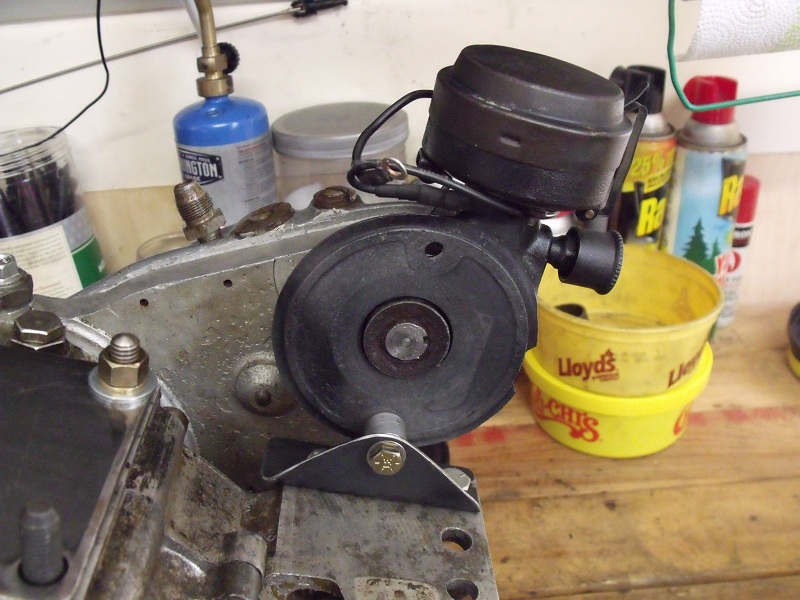
When the crankshaft returned from Jim's shop, final assembly was pretty easy. I modified a set of rockers to just work on the front cylinder cam lobes and made a plate to cover the missing cylinder. George Hood sent me a prototype rocker tower, with a longer rocker. This setup lets the engine breathe a little better. The generator was modified, eliminating the armature. The timer points cam was modified to fire only on the front cylinder. The ignition is now powered by small 12-volt battery firing through a modern coil.
Modified Generator/Timer Case

Within a few weeks, I the engine installed in a street frame, and fired it up for the first time:

YouTube video of the initial start up:


The next problem was the carburetor. I originally used a modified V twin intake, which had the carburetor come out on the right side of the engine. The original Model J twin cylinder engine used a one-inch bore Schebler carburetor. After the initial runs, I realized it needed to be changed to a smaller 3/4" bore Schebler. I found a guy, who had one, and we worked a trade.


Modified Intake & Ignition

The motor ran better with the smaller carburetor, but still had some problems running properly at full throttle. It was then I realized I had an intake air leak, where the carburetor intake attaches to the cylinder head. This is a common problem, and it took a little effort to fix. I turned a straight aluminum intake, and rubber mounted it to the cylinder. This is not period correct, but it allowed the motor to run better at all throttle setting.

I recently switched to a Linkert M741-1 carburetor from and Indian Jr. Scout. The Linkert features separate high and low speed adjustable needles, where the Schebler had only a single needle to adjust the fuel mixture at all throttle settings. This was a great improvement, that allows the engine to run well at both high, and low speed throttle setting.

Linkert 741-1 Carburetor with modified Rubber Mounted Intake

Stay tuned for Part 2
Assembling a Keystone Racing Chassis

Friday, October 26, 2012

Controversial 1914 Birmingham, AL. F.A.M. Race - Episode #7

October 26, 2012
Updated - March 3, 2015

By: David L. Morrill

@ Deadly Dave's Blog
Sylacauga, Alabama


American Iron Magazine - 2013

A special thank you to Buzz Kanter, and the staff of American Iron Magazine, for including this article in their American Glory Special Edition celebrating Harley-Davidson's 110th anniversary.

This story started with a trip to my local Harley-Davidson dealer a few months back. Harley is now selling early racing photographs from their achieves, and the local dealer had several framed board track photos for sale. I picked up a photo of Otto Walker taken after his win at Venice, California in April 1915.

Harley-Davidson Motor Company Archive

The small plaque on the photo claimed this was Harley-Davidson's first Championship win. That was a little surprising, as I had heard of at least one earlier Championship Race win.  I figured it was time to share a small and almost forgotten piece of Harley-Davidson's history.


1914 Harley-Davidson 11-K Racer (left)
Stripped Stock Model (right)


1914 was a pivotal year for Harley-Davidson. Although long opposed to Championship racing, the factory changed course.  They hired engineer William "Bill" Ottaway to develop their production v twin engine for racing. The result was the Harley- Davidson 11-K racer.

Harley-Davidson 11-K Racer
Leslie "Red" Parkhurst was the first rider hired by the Harley Davidson factory in 1914 to ride the new racer. By July, the racer was ready for its first big test, the Dodge City 300-Mile Road Race in Dodge City, Kansas. Parkhurst was one of six team members sent by the factory to compete in the Dodge City 300 that year. The new racers were fast, but only two of six were running at the end of the race.

Leslie "Red " Parkhurst

Daniel Statnekov Collection
On October 5, 1914, Red Parkhurst lined up for the Federation of American Motorcyclists (FAM) One Hour Championship Race held at the Alabama State Fairgrounds Raceway in Birmingham, Alabama.  Parkhurst was riding one of Bill Ottaway's factory prepared 11-K racers. Parkhurst was assisted in his pit by the new Birmingham Harley-Davidson dealer William F. Specht Jr., along with Johnny Aiken.

1914 Harley- Davidsons - Specht's Harley- Davidson Birmingahm, AL.
O. V. Hunt Collection

Specht, who was also a racer, had relocated to Birmingham from Atlantic City, New Jersey. In early 1914, he opened a Harley-Davidson dealership in Cliff Howell's bicycle shop in downtown Birmingham. The arrival of the first wagon load of 1914 Harley-Davidsons in Birmingham was documented by local photographer and motorcycle enthusiast O.V. Hunt.


In the Birmingham race, Parkhurst's chief competition was Excelsior factory rider Joe Wolters. The Birmingham Indian dealer Bob Stubbs sponsored two local racers, Gail Joyce and Gene Walker. Joyce was the more experienced of the two, having won several Southern Series races outside Birmingham. Walker had made a name for himself in the amateur ranks at the Birmingham track, but this would be his first professional race.

Alabama State Fairgrounds Raceway
O.V. Hunt 1914 - Birmingham Public Library Archives

As the race started, Gene Walker jumped into the lead setting a new track record. Parkhurst was running second, followed by Wolters.  On the third lap, Parkhurst passed Walker for the lead. Walker was later passed by Wolters. Parkhurst built a considerable lead over Walker, Wolters, and Gail.  On lap 33, a fuel problem forced Parkhurst to into the pits.

Red Parkhurst
Daniel Statnekov Collection

In the Harley-Davidson pit, Specht and Aiken refueled Pankhurst's axillary fuel tank. Parkhurst attempted to clean his oil and dirt covered goggles with a handkerchief he kept tied to his handlebars. The handkerchief was also covered with oil and dirt, so Parkhurst asked a spectator for a clean handkerchief. The spectator enthusiastically provided a handkerchief, and assisted Parkhurst with cleaning his goggles. Parkhurst rejoined the race, and when the flag was thrown to end the race, he was leading Joe Wolters by half a lap. Indian rider Gene Walker took the lead at the beginning of the race, setting a new track record, and finished 3rd. Shortly after the race, Walker's Indian teammate, Gail Joyce, filled an official protest, claiming the spectator in the pits had improperly aided Parkhurst.

The results of the race were not settled until the following week at the Chicago Motorcycle Show. On Tuesday of the show, Joe Wolters approached FAM Chairman John L. Donovan claiming he was due another lap at Birmingham. He claimed he had finished a half a lap ahead of Parkhurst.

The October 27, 1914, issue of Bicycling World and Motorcycle Review quoted Chairman Donovan's finding on the two Birmingham race protests. In disallowing Joyce's protest, Chairman Donovan stated:

"Safety requires that competitors in races shall be permitted to see what they are doing. It certainly would be ridiculous to disqualify Parkhurst because he permitted someone to assist him in wiping the oil and dirt off his goggles. Parkhurst clearly is entitled to the victory."

Concerning Joe Wolters' late protest, Chairman Donovan stated:

"Of course, the rules require that protests shall be made within a half-hour after the close of the race. The rules would not permit official consideration of additional points not included in the original protest. But courtesy required that I should wire for information, and I did so. It is perfectly clear that Parkhurst won the F. A. M. hour championship fairly and squarely."

With the protests settled, Parkhurst was awarded the trophy and his winnings on the second day of the Chicago show.  Shortly after the decision was announced, a large sign proclaiming Parkhurst's victory on a "stripped stock Harley-Davidson against ported and eight valve machines," appeared behind the 11-K Harley-Davidson on display at the show. Parkhurst's win went on be the center piece of Harley-Davidson's advertising for the upcoming 1915 model.

Was the 1914 Birmingham Championship Race win the first for a Harley-Davidson factory rider on a factory prepared bike? I'll leave that one to the experts. The one/two finish of factory riders Otto Walker and Red Parkhurst in the 1915 Venice race was a more prestigious win against stiffer competition. But Parkhurst's Birmingham win may have paid a much more import role in Harley-Davidson history and opened the door for the Venice win months later.

Harley Davidson founders William Harley and William Davidson attended the July 1914 Dodge City 300 Road Race.  They made it clear in post-race comments; their intention was to provide factory prepared machines to select dealer supported riders. It appears; they had no intention of a full factory supported racing team. The publicity surrounding Parkhurst's Birmingham win may have changed their minds. In November 1914 they sent a factory supported race team to compete in the Savannah 300 Road Race in Savannah, Georgia.

This was the beginning of the famed Harley-Davidson Racing Team, which came to be known as "The Wrecking Crew." Parkhurst's 1914 Birmingham win may have opened the door for creation of a fully factory supported racing team. The Harley-Davidson Factory Racing Team continues to compete today and is one of the longest running and most successful racing teams in the country.


Leslie "Red" Parkhurst continued to ride for Harley-Davidson through 1921 His most prestigious win came at the 1919 Marion, Indiana 200-Mile Road Race. Parkhurst retried from professional racing in 1921 but continued to race occasional events through 1924.

Reading, PA. Times - November 6, 1919

There was another participant, who benefited greatly from his finish in the 1914 Birmingham race. Gene Walker, the young local rider who finished fifth that day, was hired by the Indian factory in Springfield, Massachusetts. Walker went on to become one of the greatest riders of his time. In 1920, Motorcycling and Bicycling Magazine proclaimed Gene Walker "Champion of Champions."


Don Emde Collection

Motorcycle racing historian and 1972 Daytona 200 winner Don Emde provided this Gene Walker race poster from his collection. For more information on Gene Walker's career, please check out my article:

Gene Walker, Birmingham's Lost Racing Champion: 

http://dlmracing.blogspot.com/2012/07/gene-walker-birminghams-lost-racing.html


Sources:

Birmingham, Alabama Public Library Archives

Chris Price@Georgia Motorcycle History

Don Emde Collection

Motorcycling and Bicycling

Daniel Statnekov Collection - Pioneers of American Motorcycle Racing: 
http://www.statnekov.com/motorcycles/index.html

Johnny Whitsett Collection

Reading, PA. Times

Parkhurst Family Webpage:

http://www.parkhurstfamily.org